
Revision summary
India’s growth mix is still services-heavy; a larger manufacturing share is needed for jobs and tradable output. MSMEs are the bulk of industrial units and a large part of manufacturing and exports. PLI rewards scale in notified sectors; Udyam, CGTMSE and PMEGP formalise and finance the small unit. TReDS, Samadhaan and ZED support payments and quality around that core. The gap is still logistics, delayed payments, and a manufacturing share of GVA near one-sixth.
Model answer
Copper italics in this answer — like this — are the key facts. Each one is unpacked in the Facts & figures rail.
Introduction
India’s growth after 1991 was led more by services than by factories. A larger manufacturing share would absorb surplus farm labour, cut the import bill, and spread jobs beyond a few cities. Micro, Small and Medium Enterprises are the thick layer of that factory story. Present policy tries to raise both scale at the top and formal credit at the bottom.
Body
Why manufacturing and MSMEs
- Services cannot absorb the whole workforce that still sits in low-productivity agriculture.
- Manufacturing creates tradable goods, supplier chains, and shop-floor jobs that a call centre does not.
- MSMEs are the bulk of industrial units and a large share of manufacturing output and merchandise exports.
- Faster growth that skips this layer stays job-thin.
Present Government policies
- Production Linked Incentive (PLI) pays a time-bound incentive on incremental sales in notified sectors so firms scale electronics, pharma, autos, textiles, solar, and other lines in India rather than only assemble.
- Udyam is the online MSME registration that replaced older paper and Udyog Aadhaar routes; it uses Permanent Account Number and Goods and Services Tax data so a unit can prove size and claim schemes.
- Credit Guarantee Fund Trust for Micro and Small Enterprises (CGTMSE) gives a guarantee cover so banks lend without asking for heavy collateral from micro and small units.
- Prime Minister's Employment Generation Programme (PMEGP), run with the Khadi and Village Industries Commission, subsidises new micro enterprises in rural and urban areas.
- Related tools include Make in India, Trade Receivables Discounting System (TReDS) for unpaid bills, Samadhaan for delayed payments, cluster and Zero Defect Zero Effect (ZED) quality support, and emergency credit during the pandemic.
Comment
- PLI is aimed at large, exportable scale. It helps a few champion sectors; it does not by itself turn a workshop into a factory.
- Udyam, CGTMSE and PMEGP are the MSME door: formal identity, guaranteed credit, and a first machine.
- Gaps remain: logistics and power costs, skill mismatch, slow payment by large buyers, and a still-modest manufacturing share of gross value added (about one-sixth).
- Policy is in the right direction if PLI pulls MSME suppliers into the chain, and if CGTMSE and TReDS actually reach the unit, not only the portal.
Flow diagram
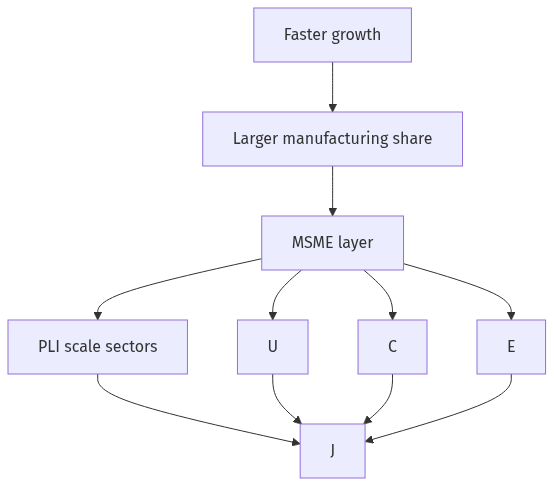
Conclusion
Faster growth needs factories, and factories in India are mostly MSMEs. PLI, Udyam, CGTMSE and PMEGP are the present toolkit. They will work only if credit, payments and supplier links reach the small unit, not only the large PLI winner.
Quick related
Students also ask
-
What is the status of digitalization in the Indian economy? Examine the problems faced in this regard and suggest improvements.
Next question on this syllabus topic (2023 · Q2). View answer →
-
Does PLI replace MSME credit schemes?
No. PLI is for scale in selected sectors. CGTMSE, Udyam and PMEGP remain the tools for the small unit.
-
Why is manufacturing still thin?
Because logistics, power, skills and delayed payments still raise unit cost, so firms stay small or stay in services.
Same topic · past papers
UPSC has asked this before
These previous-year questions sit on the same topic. Open one to practise the earlier ask.
More from this topic
Q17 · UPSC Mains 2026 · GS III · 15 marks · Solution
What are the challenges to solid waste management in India? Discuss the governmental policy framework on solid waste management. Discuss the success/failure cases of Delhi and Indore cities highlighting the salient features of their solid waste management initiatives.
Indian Economy
• Rapid urbanization has made solid waste management a critical environmental and public health crisis in India. • Key challenges include lack of source segregation, inadequate processing infrastructure, reliance on unprotected informal workers, and financially weak urban local bodies. • The policy framework relies on the SWM Rules 2016, Swachh Bharat Mission (Urban), and Plastic Waste Management Rules 2016. • Indore succeeded through 100% source segregation, zero dump-site remediation, and strict enforcement with digital monitoring. • Delhi failed due to overloaded legacy landfills (Ghazipur, Bhalswa), lack of decentralization, and fragmented municipal governance. • A successful transition requires moving to a circular economy focused on source segregation, decentralized processing, and polluter accountability.
Q16 · UPSC Mains 2026 · GS III · 15 marks · Solution
What is Agentic Artificial Intelligence (AI)? Explain its working. Describe its applications with suitable examples. Discuss the advantages, risks and challenges associated with agentic AI systems.
Indian Economy
Agentic Artificial Intelligence represents an advanced paradigm where AI systems operate with autonomy, setting goals and executing complex workflows without constant human prompts. Unlike traditional generative AI that merely responds to queries, agentic AI uses perception, planning, memory, and tool-use to achieve multi-step objectives. Its applications span across autonomous software engineering, supply chain optimization, and automated financial trading. While offering massive productivity gains and dynamic problem-solving, these systems pose significant risks including lack of transparency, alignment failures, security vulnerabilities, and ethical dilemmas. Governance frameworks and robust guardrails are essential to harness their potential safely.
Q15 · UPSC Mains 2026 · GS III · 15 marks · Solution
Mention salient features of 'Mission Drishti'. Discuss the imaging techniques used in the satellite launched on 3rd May 2026. Why is it being considered world's first satellite of its kind?
Indian Economy
Mission Drishti represents a major leap in India's space-based Earth observation capabilities, launched on 3rd May 2026. The mission employs advanced multi-spectral and hyperspectral imaging techniques to capture high-resolution data across various atmospheric and terrestrial layers. It is hailed as a global first due to its unique integration of real-time onboard edge computing with quantum encryption for secure data transmission. The satellite significantly enhances resource management, disaster response, and strategic surveillance. It aligns with India's policy of leveraging space technology for sustainable development and national security.