
Revision summary
Naxalism is rooted in tribal land, forest rights, displacement and State absence, and it is also an armed assault on constitutional authority. Levy, IEDs and jan adalats are security threats, not social work. The corridor has shrunk but residual pockets, IEDs and overground networks remain. A multilayered strategy joins force modernisation with FRA/PESA, roads, schools, surrenders and clean local administration. SAMADHAN-type security checklists fail if predatory officials and empty rights stay in place.
Model answer
Copper italics in this answer — like this — are the key facts. Each one is unpacked in the Facts & figures rail.
Introduction
Naxalism (Left Wing Extremism) began as an agrarian revolt and became a protracted armed challenge in forested, tribal and poorly administered belts. It is both a development failure—land, dignity, schools, mines—and a violent internal security threat that kills civilians, security forces and democratic workers. A multilayered reply must hold both truths. The question paper’s ‘gest’ is suggest.
Body
Social, economic, developmental issue
- Adivasi and dalit margins: insecure forest rights, land alienation, and social humiliation created a constituency that Maoist politics claimed to represent.
- Mining and displacement without consent or a fair share of royalties turned projects into recruitment narratives.
- State absence: schools, primary health, roads, and a non-predatory police were thin; the vacuum was political as well as physical.
- Livelihood: tendu, bamboo and informal forest produce versus a contractor–official nexus; MGNREGA and forest-rights titles are the lawful alternative to ‘janatana sarkar’ taxation.
- Treating Naxalism as only a gun problem repeats the neglect that fed it. Treating it as only a seminar on poverty ignores the gun.
Violent internal security threat
- Armed cadres, IEDs, attacks on police stations, and jan adalats that execute alleged informers are crime and war on the Constitution, not protest.
- Extortion of contractors and ‘levy’ on road and mine work is organised crime fused with insurgency.
- The aim is parallel power, not a petition. Casualties among CRPF, State police and civilians make it a core internal security problem under MHA’s LWE division.
Emerging issues
- Geographic shrink and residual pockets: the ‘Red Corridor’ is narrower than a decade ago, but south Bastar, some Odisha–Jharkhand–Bihar junctions remain lethal.
- Urban overground networks, legal front organisations, and social-media propaganda.
- Weapon and IED sophistication; possible crime-terror logistics on the edges (arms, explosives), without equating every Naxal band with jihadist groups.
- Surrender-and-split dynamics: leadership ageing versus new local recruits over a mining clash.
- Rights-and-security tension: fake encounters would destroy the legitimacy that development needs.
Multilayered strategy
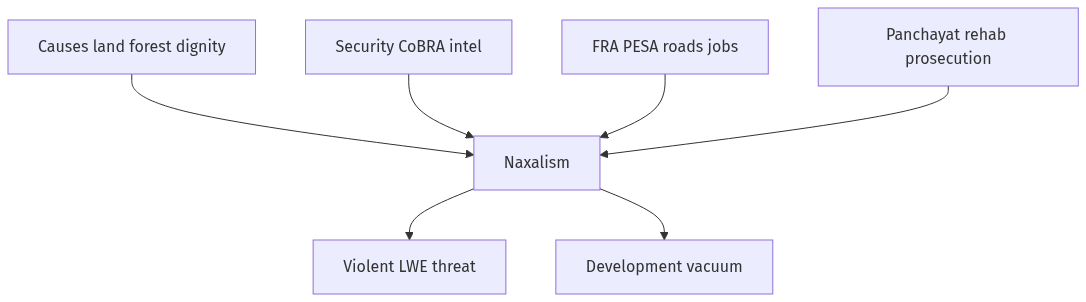
- Security layer: trained CRPF/CoBRA and State police, fortified police stations, road opening, IED management, and unified command—without occupying the village as an enemy.
- Development layer: roads (including LWE road schemes), mobile towers, banks, hostels, PESA and Forest Rights Act implementation in letter, and jobs in the same district.
- Political layer: panchayats that actually sit; space for democratic Adivasi politics so the gun is not the only voice.
- Surrender and rehabilitation: skill, stipend, and protection from revenge—tested State policies exist; they need honesty, not a photo.
- Perception layer: local-language outreach, and prosecution of the contractor–official predator who is the Maoist’s best recruiter.
- Centre–State: MHA assistance, intelligence fusion, and State ownership; Naxalism is not only a Delhi graph of districts.
- SAMADHAN-type doctrines (smart leadership, aggression against violence, motivation, actionable intelligence, dashboard, action plan, no access to financing) are a checklist; they work only if the FRA/PESA limb is real.
Flow diagram
Conclusion
Naxalism is a development wound and a violent challenge to the State. Emerging issues are residual lethal pockets, IEDs, and urban support, even as the map shrinks. A multilayered strategy is security that protects civilians, rights that undercut the narrative, roads and schools in the same block, and politics that is not a camp. Guns without justice recreate the cadre.
Quick related
Students also ask
-
The banning of 'Jammat-e-Islami' in Jammu and Kashmir brought into focus the role of over-ground workers (OGWs) in assisting terrorist organizations. Examine the role played by OGWs in assisting terrorist organizations in insurgency affected areas. Discuss measures to neutralize influence of OGWs.
Next question on this syllabus topic (2019 · Q9). View answer →
-
If violence has declined, is Naxalism over?
No. Residual pockets can still inflict mass-casualty IED attacks. Decline is not disappearance.
-
Is development a substitute for police?
No. Cadres who run parallel courts are a police and prosecution problem. Development dries the pool they recruit from.
Same topic · past papers
UPSC has asked this before
These previous-year questions sit on the same topic. Open one to practise the earlier ask.
-
2021 · Q15 · GS III · 15 marks
What are the research and developmental achievements in applied biotechnology/? How will these achievements help to uplift the poorer sections of the society? -
2016 · Q14 · GS III · 12 marks
Rehabilitation of human settlements is one of the important environmental impacts which always attracts controversy while planning major projects. Discuss the measures suggested for mitigation of this impact while proposing major developmental projects.
More from this topic
Q19 · UPSC Mains 2026 · GS III · 15 marks · Solution
Separatist movements have been one of the major factors contributing to militancy and instability in Jammu & Kashmir (J&K). Bring out actions taken by the Government to bring J&K into national mainstream. Discuss pre and post abrogation status of Articles 370 and 35A. Also bring out positive impacts of abrogation of both articles in mainstreaming the state.
Internal Security and Extremism
• J&K's historical instability stemmed from separatist radicalization and cross-
Q19 · UPSC Mains 2025 · GS III · 15 marks · Solution
What are the major challenges to internal security and peace process in the North-Eastern States? Map the various peace accords and agreements initiated by the government in the past decade.
Internal Security and Extremism
The Northeast’s security problems mix leftover insurgency, ethnic conflict, drugs, migration and Myanmar-China borders. The 2020 Bodo Accord and 2021 Karbi Accord were the big Assam settlements of the decade. The 2015 Naga framework agreement is still not a final peace. The 2020 Bru-Reang deal and 2023 UNLF pact sit beside Manipur’s 2023 ethnic violence. Assam’s border agreements with Meghalaya and Arunachal tried to quiet inter-State maps.
Q10 · UPSC Mains 2025 · GS III · 10 marks · Solution
The Government of India recently stated that Left Wing Extremism (LWE) will be eliminated by 2026. What do you understand by LWE and how are the people affected by it? What measures have been taken by the government to eliminate LWE?
Internal Security and Extremism
Left Wing Extremism in India means the Maoist insurgency centred on central Indian forest-tribal belts. Villagers suffer killings, extortion, closed schools and the crossfire of operations. Official figures show fewer severely affected districts and fewer deaths than at the peak. SAMADHAN combines intelligence, camps, surrenders and connectivity. A 2026 ‘end’ is credible as a shrinking map, not as the death of every idea; development and forest rights decide whether the map stays quiet.