
Revision summary
A cloudburst is an extreme short downpour over a small area, often ~100 mm in an hour on a steep slope. In the Indian subcontinent it is mainly orographic convection in the Himalaya during monsoon or western disturbances. A slow-moving cell plus a narrow catchment turns rain into flash flood and landslide. Kedarnath June 2013 and Leh 6 August 2010 are well-documented cases; Amarnath 8 July 2022 is a later yatra-route example. Nowcasts, radar and keeping settlements off debris fans are the response.
Model answer
Copper italics in this answer — like this — are the key facts. Each one is unpacked in the Facts & figures rail.
Introduction
A cloudburst is an extreme, short-lived downpour over a small area—conventionally of the order of 100 mm in an hour—often on a steep Himalayan slope. The cloud does not ‘burst’ like a bag; rain falls faster than the ground or the drainage can take. In the Indian subcontinent this is mainly an orographic plus convective monsoon hazard.
Body
Mechanism
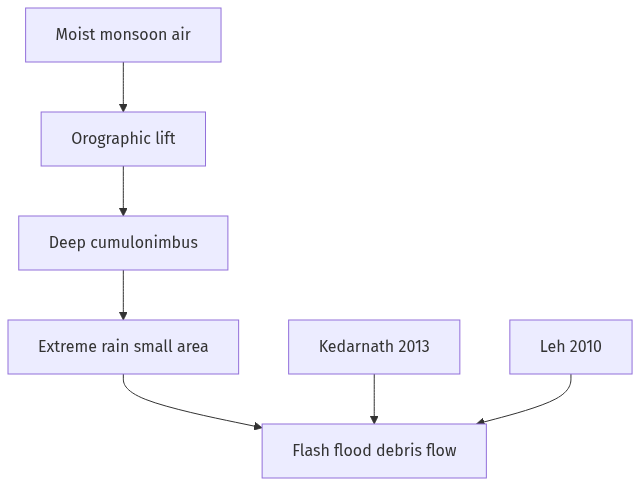
- Moist monsoon or western-disturbance air is forced up a steep hill. Rapid ascent cools the parcel, condensation is intense, and a deep cumulonimbus grows.
- A local convergence or a mesoscale vortex can stack more moisture into the same valley.
- If a weak steering wind holds the cell over one catchment, rain accumulates in minutes rather than being spread along a track.
- Orographic lift plus warm-cloud collision-coalescence yields large drops; the rainfall rate becomes extreme.
- On a slope, the same water becomes flash flood, debris flow and landslide. The disaster is hydrology and geology as much as meteorology.
Occurrence in the subcontinent
- Western and Central Himalaya (Jammu and Kashmir, Himachal, Uttarakhand) in the monsoon, and sometimes with western disturbances.
- North-eastern hills and steep Western Ghat pockets can see similar extreme cells.
- Plains can have very heavy convective rain; the term cloudburst is used most strictly for concentrated mountain downpours.
- Climate warming loads more moisture into the air (Clausius–Clapeyron), which can raise the intensity of such cells; attribution of one event still needs care.
Two well-known examples
- Kedarnath, Uttarakhand, June 2013: extreme rain and glacial-lake / debris-laden flood in the Mandakini catchment destroyed the shrine town and killed large numbers of pilgrims and residents. It is the benchmark Himalayan hydro-meteorological disaster of that decade.
- Leh, Ladakh, 6 August 2010: a cloudburst and flash flood on a high-altitude cold desert, unusual for a rain-shadow town, caused heavy loss of life and damage to the airfield and settlements.
- Amarnath, Jammu and Kashmir, 8 July 2022 is another documented cloudburst-related flash flood on the yatra route (use this if a ‘more recent’ second example is needed beside Kedarnath). Do not invent dates.
Preparedness (brief)
- Doppler weather radar in the hills, nowcasts, restricted building on fans and channels, and pilgrimage caps on forecast days.
Flow diagram
Conclusion
Cloudbursts in the subcontinent are orographic-convective extreme rains held over a small Himalayan catchment. Mechanism is rapid ascent, a stationary cell, and torrents on steep debris. Kedarnath 2013 and Leh 2010 (and Amarnath 2022) are the public memory of that physics. Warning and land-use are the only practical shields.
Quick related
Students also ask
-
What are the maritime security challenges in India ? Discuss the organisational, technical and procedural initiatives taken to improve the maritime security.
Next question on this syllabus topic (2022 · Q10). View answer →
-
Does a cloud physically burst?
No. It is a popular name for a stationary extreme convective downpour.
-
Are cloudbursts only Himalayan?
The worst documented Indian disasters are Himalayan. Steep Ghats and northeast hills can see similar cells.
Same topic · past papers
UPSC has asked this before
These previous-year questions sit on the same topic. Open one to practise the earlier ask.
More from this topic
Q17 · UPSC Mains 2026 · GS III · 15 marks · Solution
What are the challenges to solid waste management in India? Discuss the governmental policy framework on solid waste management. Discuss the success/failure cases of Delhi and Indore cities highlighting the salient features of their solid waste management initiatives.
Indian Economy
• Rapid urbanization has made solid waste management a critical environmental and public health crisis in India. • Key challenges include lack of source segregation, inadequate processing infrastructure, reliance on unprotected informal workers, and financially weak urban local bodies. • The policy framework relies on the SWM Rules 2016, Swachh Bharat Mission (Urban), and Plastic Waste Management Rules 2016. • Indore succeeded through 100% source segregation, zero dump-site remediation, and strict enforcement with digital monitoring. • Delhi failed due to overloaded legacy landfills (Ghazipur, Bhalswa), lack of decentralization, and fragmented municipal governance. • A successful transition requires moving to a circular economy focused on source segregation, decentralized processing, and polluter accountability.
Q16 · UPSC Mains 2026 · GS III · 15 marks · Solution
What is Agentic Artificial Intelligence (AI)? Explain its working. Describe its applications with suitable examples. Discuss the advantages, risks and challenges associated with agentic AI systems.
Indian Economy
Agentic Artificial Intelligence represents an advanced paradigm where AI systems operate with autonomy, setting goals and executing complex workflows without constant human prompts. Unlike traditional generative AI that merely responds to queries, agentic AI uses perception, planning, memory, and tool-use to achieve multi-step objectives. Its applications span across autonomous software engineering, supply chain optimization, and automated financial trading. While offering massive productivity gains and dynamic problem-solving, these systems pose significant risks including lack of transparency, alignment failures, security vulnerabilities, and ethical dilemmas. Governance frameworks and robust guardrails are essential to harness their potential safely.
Q15 · UPSC Mains 2026 · GS III · 15 marks · Solution
Mention salient features of 'Mission Drishti'. Discuss the imaging techniques used in the satellite launched on 3rd May 2026. Why is it being considered world's first satellite of its kind?
Indian Economy
Mission Drishti represents a major leap in India's space-based Earth observation capabilities, launched on 3rd May 2026. The mission employs advanced multi-spectral and hyperspectral imaging techniques to capture high-resolution data across various atmospheric and terrestrial layers. It is hailed as a global first due to its unique integration of real-time onboard edge computing with quantum encryption for secure data transmission. The satellite significantly enhances resource management, disaster response, and strategic surveillance. It aligns with India's policy of leveraging space technology for sustainable development and national security.