
Revision summary
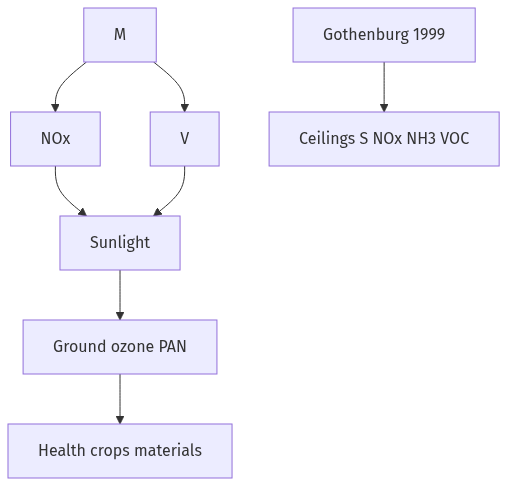
Photochemical smog forms when sunlight acts on NOx and VOCs, producing ground-level ozone and PAN. It peaks downwind in the afternoon under stagnant, sunny conditions. Effects are respiratory harm, crop damage and material cracking; this ozone is not the stratospheric shield. Mitigation is BS emission norms, VOC controls, public transport and regional air-shed policy. The Gothenburg Protocol 1999 under CLRTAP sets national ceilings on sulphur, NOx, ammonia and VOCs to cut acidification, eutrophication and ozone.
Model answer
Copper italics in this answer — like this — are the key facts. Each one is unpacked in the Facts & figures rail.
Introduction
Photochemical smog is a brown, oxidising haze of ozone and peroxyacyl nitrates formed when sunlight cooks nitrogen oxides and volatile organic compounds. It is the Los Angeles-type smog, not the classic London sulphur fog. The Gothenburg Protocol (1999) is a UNECE treaty to cut the gases that make this smog and acid rain in Europe and North America.
Body
Formation
- Primary emissions: NO and NO2 (NOx) from vehicles and combustion; VOCs from petrol, solvents, and some industry and vegetation.
- In sunlight, NO2 photolyses; the oxygen atom makes O3 with O2. VOCs feed peroxy radicals that convert NO back to NO2 without destroying ozone, so ozone accumulates.
- PAN (peroxyacyl nitrates) and aldehydes form in the same radical soup. Peak is typically afternoon, downwind of the city.
- Stagnant high pressure, a basin, and a temperature inversion trap the mix. Indian examples include summer-ozone episodes in some metros, distinct from winter PM2.5 smog.
Effects
- Human health: ozone inflames airways, triggers asthma, and reduces lung function; PAN is a lachrymator.
- Plants: ozone flecks leaves, cuts photosynthesis and crop yield.
- Materials: rubber and some paints crack; visibility falls.
- Ozone at the ground is a pollutant; ozone in the stratosphere is a shield. Do not confuse the two.
Mitigation
- Cut NOx: Bharat Stage emission norms, catalytic converters, inspection of in-use vehicles, power-plant controls.
- Cut VOCs: vapour recovery at petrol pumps, solvent standards, leak control.
- Shift to public transport, electrified fleets, and less congestion; ozone is a regional pollutant, so one city’s fleet is not enough.
- Alert systems and reducing outdoor work on peak ozone days protect health while emissions fall.
Gothenburg Protocol, 1999
- Protocol to the 1979 Convention on Long-Range Transboundary Air Pollution (CLRTAP), adopted at Gothenburg in 1999.
- It sets national emission ceilings for sulphur, NOx, ammonia and VOCs—the precursors of acidification, eutrophication and ground-level ozone.
- Later amendments added fine particulate matter and tightened ceilings. Parties are mainly UNECE (Europe, plus the United States, Canada).
- India is not a party in the European sense; the Protocol is still the model of multi-pollutant, multi-effect ceilings that Indian NOx and VOC policy can learn from.
Flow diagram
Conclusion
Photochemical smog is sunlight plus NOx and VOCs, yielding ozone and PAN that harm lungs and crops. Mitigation is cleaner vehicles, VOC control and regional air-shed action. The 1999 Gothenburg Protocol is the UNECE bargain to cap those same precursors across borders.
Quick related
Students also ask
-
Explain the mechanism and occurrence of cloudburst in the context of the Indian subcontinent. Discuss two recent examples.
Next question on this syllabus topic (2022 · Q8). View answer →
-
Is Delhi winter smog photochemical smog?
Much of it is particulate (PM2.5) from combustion, dust and stubble, trapped by inversion. Photochemical ozone is a sunnier, NOx-VOC problem.
-
Does Gothenburg bind India?
No. It binds UNECE parties. It is still the reference for multi-pollutant emission ceilings.
Same topic · past papers
UPSC has asked this before
These previous-year questions sit on the same topic. Open one to practise the earlier ask.
More from this topic
Q17 · UPSC Mains 2026 · GS III · 15 marks · Solution
What are the challenges to solid waste management in India? Discuss the governmental policy framework on solid waste management. Discuss the success/failure cases of Delhi and Indore cities highlighting the salient features of their solid waste management initiatives.
Indian Economy
• Rapid urbanization has made solid waste management a critical environmental and public health crisis in India. • Key challenges include lack of source segregation, inadequate processing infrastructure, reliance on unprotected informal workers, and financially weak urban local bodies. • The policy framework relies on the SWM Rules 2016, Swachh Bharat Mission (Urban), and Plastic Waste Management Rules 2016. • Indore succeeded through 100% source segregation, zero dump-site remediation, and strict enforcement with digital monitoring. • Delhi failed due to overloaded legacy landfills (Ghazipur, Bhalswa), lack of decentralization, and fragmented municipal governance. • A successful transition requires moving to a circular economy focused on source segregation, decentralized processing, and polluter accountability.
Q16 · UPSC Mains 2026 · GS III · 15 marks · Solution
What is Agentic Artificial Intelligence (AI)? Explain its working. Describe its applications with suitable examples. Discuss the advantages, risks and challenges associated with agentic AI systems.
Indian Economy
Agentic Artificial Intelligence represents an advanced paradigm where AI systems operate with autonomy, setting goals and executing complex workflows without constant human prompts. Unlike traditional generative AI that merely responds to queries, agentic AI uses perception, planning, memory, and tool-use to achieve multi-step objectives. Its applications span across autonomous software engineering, supply chain optimization, and automated financial trading. While offering massive productivity gains and dynamic problem-solving, these systems pose significant risks including lack of transparency, alignment failures, security vulnerabilities, and ethical dilemmas. Governance frameworks and robust guardrails are essential to harness their potential safely.
Q15 · UPSC Mains 2026 · GS III · 15 marks · Solution
Mention salient features of 'Mission Drishti'. Discuss the imaging techniques used in the satellite launched on 3rd May 2026. Why is it being considered world's first satellite of its kind?
Indian Economy
Mission Drishti represents a major leap in India's space-based Earth observation capabilities, launched on 3rd May 2026. The mission employs advanced multi-spectral and hyperspectral imaging techniques to capture high-resolution data across various atmospheric and terrestrial layers. It is hailed as a global first due to its unique integration of real-time onboard edge computing with quantum encryption for secure data transmission. The satellite significantly enhances resource management, disaster response, and strategic surveillance. It aligns with India's policy of leveraging space technology for sustainable development and national security.