
Revision summary
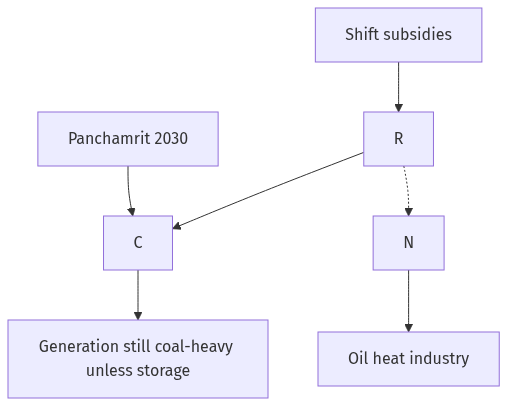
Panchamrit targets 50 per cent of installed electric capacity from non-fossil sources by 2030, including hydro and nuclear. That is not 50 per cent of energy needs, and not even 50 per cent of electricity generation, because solar and wind have lower capacity factors. Half of all energy from renewables by 2030 is unlikely given oil and industrial coal. The capacity target is more plausible if transmission, storage and discom health improve. Shifting subsidies from fossils to renewables and storage helps relative prices and manufacturing; social fuels need targeted DBT, not a blunt cut.
Model answer
Copper italics in this answer — like this — are the key facts. Each one is unpacked in the Facts & figures rail.
Introduction
At Glasgow (COP26) India announced Panchamrit, including a target that 50 per cent of installed electric capacity would come from non-fossil sources by 2030. That is not the same as 50 per cent of energy needs from renewables. Capacity is megawatts on the nameplate; energy needs include heat, transport fuel and electricity actually generated. The answer must keep those words apart.
Body
Capacity versus needs versus generation
- Installed capacity is the rated MW of plants. Solar and wind have lower capacity factors than coal or nuclear, so 50 per cent non-fossil capacity still leaves coal supplying a larger share of kilowatt-hours unless storage and hydro firm the mix.
- Non-fossil in Panchamrit includes large hydro and nuclear, not only solar and wind. Renewables in casual speech often exclude nuclear and sometimes large hydro. Mixing the terms overstates the green share.
- Energy needs (primary or final energy) are dominated by oil in transport, coal in industry and cooking/heat, not only by the power sector. Even a clean grid would not automatically make half of all energy renewable by 2030.
Will India meet ‘50 per cent of energy needs from renewables by 2030’?
- On a strict reading of final or primary energy, no, not as currently on track: oil and coal in non-power uses remain large, and 2030 is close.
- On the official Panchamrit reading—50 per cent non-fossil installed electricity capacity—India has a credible shot because solar auctions, falling module prices, and a large pipeline have already pushed non-fossil capacity to a high share of the total MW. Meeting it still needs transmission, storage, land and a solvent discom.
- So: capacity target, plausible; ‘half of energy needs from renewables’, not the same promise and not the likely 2030 outcome.
How shifting subsidies from fossils to renewables helps
- Fossil subsidies (under-priced coal freight in some periods, ATF and diesel politics, under-recovery in power) keep dirty energy cheap at the point of use and crowd out the relative price signal for solar, wind, storage and electrified transport.
- Moving support to renewables and storage—viability gap for offshore wind, green hydrogen pilots, rooftop solar, and timed PM-KUSUM-type pumps—lowers the levelised cost the buyer sees and builds domestic manufacturing (PLI for modules).
- Redirecting kerosene and untargeted LPG leaks toward clean cooking and targeted DBT cuts indoor air pollution without pretending every fossil rupee is already gone (fertiliser and LPG still have social aims).
- A just transition in coal districts must ride with subsidy reform, or the politics will reverse the shift.
- Subsidy reform is not a magic 50 per cent of energy needs; it is how the power mix and later transport decarbonise faster.
Honest bottom line
- Celebrate the capacity target. Do not write as if India promised half of all energy from solar by 2030.
Flow diagram
Conclusion
Panchamrit’s 50 per cent is about non-fossil electricity capacity, not half of India’s energy needs from renewables. The capacity goal is within reach if grids and storage catch up; the energy-needs phrase is a different, harder test. Shifting subsidies toward renewables and storage improves relative prices; it does not erase oil and industrial coal by 2030.
Quick related
Students also ask
-
What are the salient features of the National Food Security Act, 2013 ? How has the Food Security Bill helped in eliminating hunger and malnutrition in India?
Next question on this syllabus topic (2021 · Q13). View answer →
-
Did India promise 50 per cent of energy from renewables by 2030?
No. The headline 50 per cent is non-fossil share of installed electric capacity, not of total energy needs.
-
Why does 50 per cent green capacity not mean 50 per cent green electricity?
Because a megawatt of solar produces fewer units a year than a megawatt of coal unless storage and hydro firm it.
Same topic · past papers
UPSC has asked this before
These previous-year questions sit on the same topic. Open one to practise the earlier ask.
-
2018 · Q16 · GS III · 15 marks
With growing energy needs should India keep on expanding its nuclear energy programme? Discuss the facts and fears associated with nuclear energy. (250 Words, 15 Marks). -
2016 · Q11 · GS III · 12 marks
Give an account of the current status and the targets to be achieved pertaining to renewable energy sources in the country. Discuss in brief the importance of National Programme on Light Emitting Diodes (LEDs).
More from this topic
Q14 · UPSC Mains 2024 · GS III · 15 marks · Solution
Elucidate the importance of buffer stocks for stabilizing agricultural prices in India. What are the challenges associated with the storage of buffer stock? Discuss.
Farm Subsidies and PDS
Buffer stocks buy rice and wheat at MSP so harvest prices do not crash, and release them through PDS and open sale so retail prices do not spike. FCI and State agencies hold the central cereal pool; a Price Stabilisation Fund is used for some pulses and perishables. Storage challenges: CAP exposure, rodents and fungus, high carrying cost, and stocks piled in a few surplus States. A rice-wheat mountain does not automatically cool onion or tur inflation. Silos, WDRA warehouses and a wider commodity set are the storage reforms that match the price-stability claim.
Q14 · UPSC Mains 2023 · GS III · 15 marks · Solution
What are the direct and indirect subsidies provided to farm sector in India? Discuss the issues raised by the World Trade Organization(WTP) in relation to agricultural subsidies.
Farm Subsidies and PDS
Direct subsidies include fertiliser, power, irrigation, crop-loan subvention, PM-KISAN and insurance premium support. Indirect subsidies include MSP, public procurement, food subsidy, and cheap public research and seed. WTO Amber Box covers trade-distorting price and input support, with 10 per cent de minimis for developing countries. Green Box is uncapped if genuinely non-distorting; Blue Box is production-limiting payments. The peace clause protects public stockholding from disputes pending a permanent solution.
Q3 · UPSC Mains 2022 · GS III · 10 marks · Solution
What are the major challenges of Public Distribution System (PDS) in India ? How can it be made effective and transparent ?
Farm Subsidies and PDS
PDS under NFSA 2013 is a legal grain entitlement, not a discretionary dole. Main challenges are wrong lists, diversion, poor quality, weak last-mile shops, and a rice-wheat nutrition gap. Migrants lose access when the card is locked to one State. Effectiveness needs computerised supply chains, e-PoS, One Nation One Ration Card, social audits, and exception rules when biometrics fail. DBT can complement urban PDS; it is a poor substitute where food markets are thin.