
Revision summary
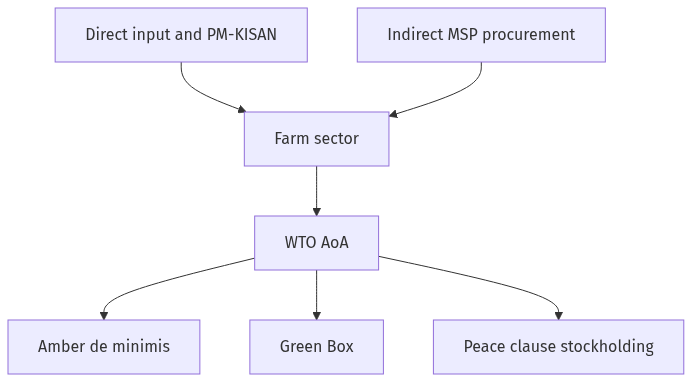
Direct subsidies include fertiliser, power, irrigation, crop-loan subvention, PM-KISAN and insurance premium support. Indirect subsidies include MSP, public procurement, food subsidy, and cheap public research and seed. WTO Amber Box covers trade-distorting price and input support, with 10 per cent de minimis for developing countries. Green Box is uncapped if genuinely non-distorting; Blue Box is production-limiting payments. The peace clause protects public stockholding from disputes pending a permanent solution.
Model answer
Copper italics in this answer — like this — are the key facts. Each one is unpacked in the Facts & figures rail.
Introduction
The Indian State cheapens farm inputs and holds up farm output prices. Both are subsidies in economic effect. The World Trade Organization (WTO) Agreement on Agriculture puts those payments into boxes. India’s fight at WTO is mainly about food security stockholding and the Amber Box ceiling, not about whether a poor farmer may receive help at all.
Body
Direct subsidies
- Fertiliser subsidy (urea and nutrient-based subsidy) paid to companies so the farmer sees a lower bag price.
- Power and irrigation at below cost, often unmetered in some States.
- Interest subvention on short-term crop loans.
- Pradhan Mantri Kisan Samman Nidhi (PM-KISAN): a flat income transfer to eligible landholders.
- Pradhan Mantri Fasal Bima Yojana (PMFBY) premium subsidy.
- Some State farm-loan waivers (occasional, not a standing Union head).
Indirect subsidies
- Minimum Support Price plus Food Corporation of India / State agency procurement: the economic subsidy is the gap versus a market price, plus the cost of storage.
- Cheap credit priority, agri-research and extension, and subsidised seed.
- Food subsidy to consumers under the National Food Security Act is a consumer subsidy that still shapes what the State must buy from farmers.
- Canal water, cheap diesel in some States, and export or stock rules that prop a price.
WTO issues
- Amber Box: trade-distorting support (price support, input subsidies tied to production). Developing countries have a de minimis allowance of 10 per cent of the value of production (product-specific and non-product-specific). India’s MSP-plus-procurement for rice has been argued to breach or crowd that ceiling when calculated at the WTO’s old reference prices.
- Blue Box: payments under production-limiting programmes; little used by India.
- Green Box: research, extension, pest control, decoupled income support, environmental payments — allowed without cap if they fit the criteria. PM-KISAN-type transfers are closer to this logic if truly decoupled from a crop.
- Public stockholding for food security: India and the G-33 want a permanent solution so procuring rice and wheat at administered prices for PDS is not counted as a violation.
- Peace clause (Bali 2013, later rolled over): other members refrain from WTO disputes on this stockholding if transparency conditions are met. It is a shield, not a right.
- Developed members criticise India’s export restrictions and stockholding; India criticises their Green Box scale and cotton support. The dispute is distributional, not a claim that WTO forbids all farm help.
Flow diagram
Conclusion
Direct farm subsidies cheapen fertiliser, power, credit, insurance and PM-KISAN cash. Indirect ones run through MSP, procurement and food subsidy. At WTO the live fight is Amber Box arithmetic and a permanent solution for public stockholding, with the Bali peace clause as a temporary shield.
Quick related
Students also ask
-
What are the major challenges of Public Distribution System (PDS) in India ? How can it be made effective and transparent ?
Next question on this syllabus topic (2022 · Q3). View answer →
-
Does WTO ban MSP?
No. It limits how much price support counts in the Amber Box. The fight is the formula and the 1986–88 reference price, not a ban on MSP.
-
Is food subsidy to consumers an Amber Box farm subsidy?
Consumer food subsidy is separate. The WTO farm issue is the administered price at which grain is bought from farmers for those stocks.
Same topic · past papers
UPSC has asked this before
These previous-year questions sit on the same topic. Open one to practise the earlier ask.
More from this topic
Q14 · UPSC Mains 2024 · GS III · 15 marks · Solution
Elucidate the importance of buffer stocks for stabilizing agricultural prices in India. What are the challenges associated with the storage of buffer stock? Discuss.
Farm Subsidies and PDS
Buffer stocks buy rice and wheat at MSP so harvest prices do not crash, and release them through PDS and open sale so retail prices do not spike. FCI and State agencies hold the central cereal pool; a Price Stabilisation Fund is used for some pulses and perishables. Storage challenges: CAP exposure, rodents and fungus, high carrying cost, and stocks piled in a few surplus States. A rice-wheat mountain does not automatically cool onion or tur inflation. Silos, WDRA warehouses and a wider commodity set are the storage reforms that match the price-stability claim.
Q12 · UPSC Mains 2022 · GS III · 15 marks · Solution
Do you think India will meet 50 percent of its energy needs from renewable energy by 2030 ? Justify your answer. How will the shift of subsidies from fossil fuels to renewables help achieve the above objective ? Explain.
Farm Subsidies and PDS
Panchamrit targets 50 per cent of installed electric capacity from non-fossil sources by 2030, including hydro and nuclear. That is not 50 per cent of energy needs, and not even 50 per cent of electricity generation, because solar and wind have lower capacity factors. Half of all energy from renewables by 2030 is unlikely given oil and industrial coal. The capacity target is more plausible if transmission, storage and discom health improve. Shifting subsidies from fossils to renewables and storage helps relative prices and manufacturing; social fuels need targeted DBT, not a blunt cut.
Q3 · UPSC Mains 2022 · GS III · 10 marks · Solution
What are the major challenges of Public Distribution System (PDS) in India ? How can it be made effective and transparent ?
Farm Subsidies and PDS
PDS under NFSA 2013 is a legal grain entitlement, not a discretionary dole. Main challenges are wrong lists, diversion, poor quality, weak last-mile shops, and a rice-wheat nutrition gap. Migrants lose access when the card is locked to one State. Effectiveness needs computerised supply chains, e-PoS, One Nation One Ration Card, social audits, and exception rules when biometrics fail. DBT can complement urban PDS; it is a poor substitute where food markets are thin.