
Revision summary
China+1 and Indo-Pacific strategy are the two clauses of the Western pitch. Examples: electronics assembly, iCET, Quad and Malabar, production-linked incentives in electronics and pharma. India still depends on Chinese intermediates; decoupling is incomplete. Delhi keeps Russian oil and SCO while taking US technology — strategic autonomy, not a hired counterweight. Galwan pushed maritime and enabling agreements further than 2010 would have allowed. The statement explains a courtship, not a finished alliance.
Model answer
Copper italics in this answer — like this — are the key facts. Each one is unpacked in the Facts & figures rail.
Introduction
After the pandemic, export controls and the Himalayan clash, Western capitals began to say a sentence India had wanted to hear: diversify away from China, and do it with Delhi. The sentence has two clauses — supply chain and strategic ally. Both are real. Neither makes India a spare factory on a US payroll.
Body
Supply chain
China remains the workshop for many active pharmaceutical ingredients, rare earths, solar wafers and electronics assembly.
- Peg: China+1 is the corporate name for not betting the whole firm on one political system; India offers a large market, production-linked incentives, engineers, and a seat in Indo-Pacific economic talks.
- Peg: Apple’s expanded assembly in India, Initiative on Critical and Emerging Technology talks with the United States on chips, generic-drug security after Chinese API scares, and critical-mineral talks with Australia and Washington are the examples.
- Peg: The limit is blunt: a phone finished in Tamil Nadu can still depend on a Chinese part; friend-shoring is a direction, not a completed decoupling.
Strategic ally
The security clause of the same sentence is the Indo-Pacific, not a NATO article.
- Peg: The Quad, Malabar exercises, logistics pacts with the United States, Japan, Australia and France, and shared worry about the South China Sea are the alliance-shaped half of the pitch.
- Peg: After the Galwan clash, maritime domain-awareness sharing and enabling agreements such as COMCASA and BECA went further than would have been thinkable a decade earlier.
- Peg: Washington often describes India as a counterweight; Delhi describes the same relationship as strategic autonomy with better kit.
India’s own sentence
The West fosters India when interests rhyme; India does not volunteer to be only an alternative.
- Peg: India buys Russian oil, sits in the Shanghai Cooperation Organisation and BRICS, and will not become a treaty ally with automatic war.
- Peg: China remains a huge goods partner in many recent years; the alternative is alongside China in some chains, not a replacement.
- Peg: The statement is a Western wish that partly matches Indian industrial policy; it is not a finished dual-use alliance.
Flow diagram
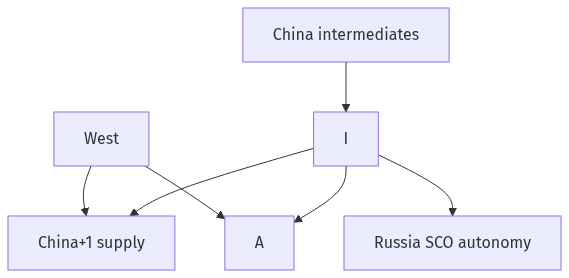
Conclusion
The West is courting India as a China+1 node and as an Indo-Pacific partner. India is using that courtship for production-linked incentives and for kit. It is not volunteering to be only an alternative.
Quick related
Students also ask
-
Critically analyse India's evolving diplomatic, economic and strategic relations with the Central Asian Republics (CARs) highlighting their increasing significance in regional and global geopolitics.
Next question on this syllabus topic (2024 · Q10). View answer →
-
Is India the new China for factories?
Not at China’s scale. It is one of several +1 destinations, competing with Vietnam, Mexico and others.
-
Does the Quad make India a US ally?
It makes India a partner in a minilateral. There is no automatic-war clause.
Same topic · past papers
UPSC has asked this before
These previous-year questions sit on the same topic. Open one to practise the earlier ask.
More from this topic
Q20 · UPSC Mains 2026 · GS II · 15 marks · Solution
"China's Belt and Road Initiative (BRI) has transformed South Asia from a regional space into a theatre of great power competition." Analyse the strategic implications of the BRI for India's security and regional influence in South Asia.
India and its Neighbourhood
China's Belt and Road Initiative has turned South Asia into a zone of great-power rivalry, not just a regional neighbourhood. Ports like Gwadar and Hambantota raise fears of maritime encirclement and pressure on Indian Ocean trade routes. CPEC through Pakistan-Occupied Kashmir directly challenges India's sovereignty and adds a two-front security worry. Debt-heavy Chinese projects in Sri Lanka and Maldives have pushed smaller neighbours to hedge between Beijing and New Delhi. India must respond with trusted connectivity—Chabahar, BIMSTEC, Neighbourhood First aid, and Indo-Pacific partnerships—so development does not come with strategic dependence on China.
Q19 · UPSC Mains 2025 · GS II · 15 marks · Solution
"Energy security constitutes the dominant kingpin of India's foreign policy, and is linked with India's overarching influence in Middle Eastern countries." How would you integrate energy security with India's foreign policy trajectories in the coming years?
India and its Neighbourhood
Imported crude and LNG make energy the hard core of India’s Middle East policy, alongside diaspora and ports. UAE CEPA, I2U2, IMEC and Chabahar are the diplomatic frame around tankers. Risks: Hormuz, Red Sea, Iran sanctions, OPEC+ and over-reliance on any one discount supplier. Future integration: diversified barrels and routes, Gulf green-hydrogen partnerships, naval sea-lane policy, multi-alignment among regional rivals. The kingpin should shrink as the energy mix greener; it cannot be wished away this decade.
Q9 · UPSC Mains 2025 · GS II · 10 marks · Solution
India-Africa digital partnership is achieving mutual respect, co-development and long-term institutional partnerships. Elaborate.
India and its Neighbourhood
The partnership runs on Pan-African e-Network heritage, ITEC training, IAFS, and newer DPI (payments, identity, document rails). Co-development means African adaptation and AU working groups, not a vendor dump. Respect means data under African law, unlike a back-doored hardware grid. Limits: power and connectivity, summit-without-follow-through, and China’s larger cable footprint. Score the relationship by live hospital and payment links.