
Revision summary
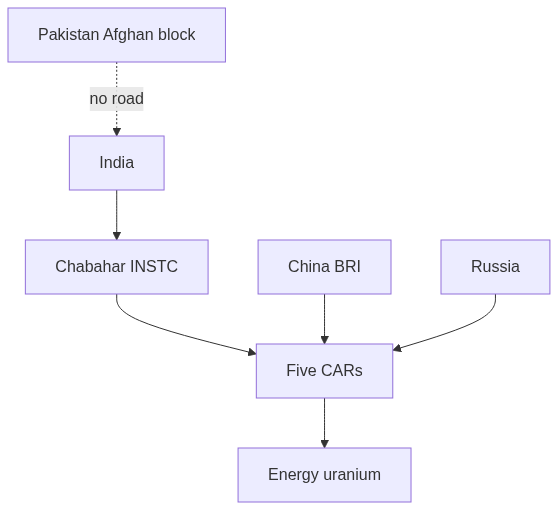
India’s CAR ties: SCO, summits, uranium from Kazakhstan, Chabahar and INSTC, limited defence and training. The region gained weight through energy, critical minerals, Afghanistan after 2021, and China–Russia competition. Trade remains small beside China’s; Pakistan and Afghanistan block the short land route. TAPI and grand Silk Road language have under-delivered. Critical path: logistics via Iran, pharma and education, SCO without camp-following. Significance is real in maps and modest in India’s daily trade.
Model answer
Copper italics in this answer — like this — are the key facts. Each one is unpacked in the Facts & figures rail.
Introduction
The five Central Asian Republics — Kazakhstan, Kyrgyzstan, Tajikistan, Turkmenistan and Uzbekistan — sit on energy, uranium, Islam and a post-Soviet security order. India discovered them late, after 1991, and still reaches them the long way round. Diplomacy has thickened. Cargo has not. That is the critical part of the analysis.
Body
What has evolved
The relationship is a summit vocabulary with a thin invoice.
- Peg: Diplomacy now includes a leaders’ summit format, Shanghai Cooperation Organisation membership, more missions, ITEC training, and a shared line on terrorism and connectivity.
- Peg: Kazakhstan is a uranium supplier; energy talks with Turkmenistan, including the TAPI idea, never quite became a pipe.
- Peg: Chabahar and the International North–South Transport Corridor are the bet that Iran and the Caspian can replace the closed Pakistan land route.
- Peg: Trade remains modest next to China–CAR volumes; Indian firms are not the default miners in the steppe.
Why significance rose
Maps moved faster than India’s trucks.
- Peg: The Ukraine war made Caspian and Central Asian energy a European conversation; uranium and critical minerals matter to reactors and to Western decoupling.
- Peg: A Taliban-run Afghanistan pushed the republics to seek more partners than Moscow.
- Peg: China’s Xinjiang–CAR roads are a strategic fact on India’s northern periphery; CARs are also Eurasian votes and Islamic diplomacy that is not Gulf-only.
The critique
Over-selling civilisational links hides a logistics failure.
- Peg: There is no Indian equivalent of Belt and Road credit; Pakistan denies overland access; Afghanistan is unstable; INSTC is slow.
- Peg: Russian influence in security and Chinese influence in debt and rail will not be talked away at a Delhi summit.
- Peg: Keep Chabahar and INSTC, sell pharma and vaccines, stay in the SCO without being a Russia–China junior, and do not pretend the Silk Road now runs through Mumbai.
Flow diagram
Conclusion
The Central Asian Republics matter more because energy, minerals and Afghanistan do. India’s diplomacy has caught up; its roads and trade have not. The relationship is a long game against a land block and against other people’s belts.
Quick related
Students also ask
-
Discuss the geopolitical and geostrategic importance of Maldives for India, with a focus on global trade and energy flows. Further, also discuss how this relationship affects India's maritime security and regional stability amidst international competition?
Next question on this syllabus topic (2024 · Q20). View answer →
-
Why not send goods through Pakistan?
There is no political corridor. Without it, every container is a detour.
-
Does a Delhi–CAR summit equal influence?
It equals presence. Influence still travels on rail, credit and security guarantees that others already supply.
Same topic · past papers
UPSC has asked this before
These previous-year questions sit on the same topic. Open one to practise the earlier ask.
More from this topic
Q20 · UPSC Mains 2026 · GS II · 15 marks · Solution
"China's Belt and Road Initiative (BRI) has transformed South Asia from a regional space into a theatre of great power competition." Analyse the strategic implications of the BRI for India's security and regional influence in South Asia.
India and its Neighbourhood
China's Belt and Road Initiative has turned South Asia into a zone of great-power rivalry, not just a regional neighbourhood. Ports like Gwadar and Hambantota raise fears of maritime encirclement and pressure on Indian Ocean trade routes. CPEC through Pakistan-Occupied Kashmir directly challenges India's sovereignty and adds a two-front security worry. Debt-heavy Chinese projects in Sri Lanka and Maldives have pushed smaller neighbours to hedge between Beijing and New Delhi. India must respond with trusted connectivity—Chabahar, BIMSTEC, Neighbourhood First aid, and Indo-Pacific partnerships—so development does not come with strategic dependence on China.
Q19 · UPSC Mains 2025 · GS II · 15 marks · Solution
"Energy security constitutes the dominant kingpin of India's foreign policy, and is linked with India's overarching influence in Middle Eastern countries." How would you integrate energy security with India's foreign policy trajectories in the coming years?
India and its Neighbourhood
Imported crude and LNG make energy the hard core of India’s Middle East policy, alongside diaspora and ports. UAE CEPA, I2U2, IMEC and Chabahar are the diplomatic frame around tankers. Risks: Hormuz, Red Sea, Iran sanctions, OPEC+ and over-reliance on any one discount supplier. Future integration: diversified barrels and routes, Gulf green-hydrogen partnerships, naval sea-lane policy, multi-alignment among regional rivals. The kingpin should shrink as the energy mix greener; it cannot be wished away this decade.
Q9 · UPSC Mains 2025 · GS II · 10 marks · Solution
India-Africa digital partnership is achieving mutual respect, co-development and long-term institutional partnerships. Elaborate.
India and its Neighbourhood
The partnership runs on Pan-African e-Network heritage, ITEC training, IAFS, and newer DPI (payments, identity, document rails). Co-development means African adaptation and AU working groups, not a vendor dump. Respect means data under African law, unlike a back-doored hardware grid. Limits: power and connectivity, summit-without-follow-through, and China’s larger cable footprint. Score the relationship by live hospital and payment links.