
Revision summary
UNFCCC and Kyoto framed India as a developing party without Annex I quantified targets, under CBDR. Paris (2015) brought India into universal NDCs while keeping equity and CBDR-RC. COP26 Panchamrit added 500 GW non-fossil, 50 per cent renewable energy share, intensity and billion-tonne language, and net-zero by 2070. The International Solar Alliance is India’s agenda-setting club from COP21, hosted in India. Geopolitics now includes critical minerals, green subsidies and carbon borders, not only COP texts. Clean energy is domestic development plus bargaining power; coal and climate finance remain the continuity.
Model answer
Copper italics in this answer — like this — are the key facts. Each one is unpacked in the Facts & figures rail.
Introduction
India’s international climate policy has moved from a defensive reading of common but differentiated responsibilities to an offer of targets, clubs, and clean-energy diplomacy, without abandoning climate justice. Clean energy is now both a domestic development need and a geopolitical currency in a world of critical minerals, carbon borders, and great-power green industrial policy.
Body
From UNFCCC and Kyoto to Paris
- India joined the UNFCCC (1992) as a developing country: historical responsibility lay with the industrial North, and the right to development was the political core.
- Kyoto (1997) placed quantified emission commitments on Annex I parties, not on India; New Delhi’s line was CBDR, not a shared peaking year.
- The Paris Agreement (2015) replaced Kyoto’s split with nationally determined contributions for all parties, still under equity and CBDR-RC. India accepted that form and filed NDCs, which is the first big procedural change: India became a pledging party, not only a demander of Northern finance.
Panchamrit and the Glasgow shift
- At COP26 in Glasgow, India announced Panchamrit: 500 GW of non-fossil capacity by 2030, 50 per cent of energy requirements from renewables by 2030, a reduction of one billion tonnes of projected carbon emissions by 2030, a 45 per cent cut in emissions intensity from 2005 levels by 2030, and net-zero by 2070.
- That package moved India from intensity-only language toward a net-zero date and a non-fossil capacity number, which partners could put on a slide even while India refused a 2050 net-zero aligned with Europe.
- Updated NDCs later reflected parts of that political announcement; the legal heart remains Paris, not a press conference.
Clubs, solar diplomacy, and issue-linkage
- The International Solar Alliance, launched by India and France at COP21 in Paris and headquartered in India, is New Delhi’s attempt to set an agenda for sunshine countries rather than only receive one.
- The Coalition for Disaster Resilient Infrastructure and the later LiFE (Lifestyle for Environment) framing try to export a development-compatible climate language against a purely carbon-price Western template.
- Clean energy is now tied to technology transfer, green hydrogen, and critical minerals; climate fora overlap WTO-style fights on subsidies and the EU’s carbon border adjustment, which India reads as protectionism unless accompanied by finance.
Geopolitics of the new climate policy
- The United States and the EU use green industrial policy (including large domestic subsidies) while asking emerging Asia to peak faster; India answers with equity, coal-phase-down rather than phase-out language at Glasgow, and a demand that methane and oil-gas producers not hide behind India’s coal.
- China’s scale in solar manufacturing and minerals is both a supply opportunity and a strategic vulnerability; India’s climate diplomacy therefore has an Atmanirbhar and friend-shoring edge, not only a COP speech.
- For the Global South, India still claims leadership by refusing to let climate become a barrier to energy access; for the Quad and G20, it claims leadership by being a large renewables market and a solar-alliance convenor.
- The order of the day is clean energy because fossil import bills, air pollution, and investor screens now coincide with COP pressure — a geopolitical sandwich, not a conversion on the road to Kyoto.
Continuity that has not changed
- Finance and adaptation for the vulnerable remain India’s test of Northern seriousness; changing policy does not mean dropping CBDR.
- Coal remains in the domestic mix even as non-fossil capacity grows; international description should not pretend a full phase-out that India has not pledged.
Flow diagram
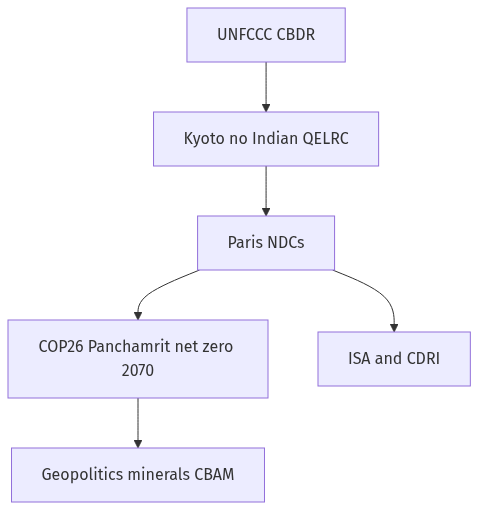
Conclusion
India’s climate policy in international fora has shifted from Kyoto-era exemption to Paris NDCs, Glasgow’s Panchamrit, and institutions such as the International Solar Alliance, while still arguing equity. In geopolitics, clean energy is industrial strategy and alliance politics as much as environmental ethics. The change is real; the justice line is not abandoned.
Quick related
Students also ask
-
"If the last few decades were of Asia's growth story, the next few are expected to be of Africa's." In the light of this statement, examine India's influence in Africa in recent years.
Next question on this syllabus topic (2021 · Q9). View answer →
-
Did India accept a 2050 net-zero at Glasgow?
No. The announced net-zero year was 2070, with nearer-term capacity and intensity pledges.
-
Is the ISA a substitute for the UNFCCC?
No. It is a complementary solar club. The UNFCCC and Paris remain the global legal fora.
Same topic · past papers
UPSC has asked this before
These previous-year questions sit on the same topic. Open one to practise the earlier ask.
More from this topic
Q20 · UPSC Mains 2026 · GS II · 15 marks · Solution
"China's Belt and Road Initiative (BRI) has transformed South Asia from a regional space into a theatre of great power competition." Analyse the strategic implications of the BRI for India's security and regional influence in South Asia.
India and its Neighbourhood
China's Belt and Road Initiative has turned South Asia into a zone of great-power rivalry, not just a regional neighbourhood. Ports like Gwadar and Hambantota raise fears of maritime encirclement and pressure on Indian Ocean trade routes. CPEC through Pakistan-Occupied Kashmir directly challenges India's sovereignty and adds a two-front security worry. Debt-heavy Chinese projects in Sri Lanka and Maldives have pushed smaller neighbours to hedge between Beijing and New Delhi. India must respond with trusted connectivity—Chabahar, BIMSTEC, Neighbourhood First aid, and Indo-Pacific partnerships—so development does not come with strategic dependence on China.
Q19 · UPSC Mains 2025 · GS II · 15 marks · Solution
"Energy security constitutes the dominant kingpin of India's foreign policy, and is linked with India's overarching influence in Middle Eastern countries." How would you integrate energy security with India's foreign policy trajectories in the coming years?
India and its Neighbourhood
Imported crude and LNG make energy the hard core of India’s Middle East policy, alongside diaspora and ports. UAE CEPA, I2U2, IMEC and Chabahar are the diplomatic frame around tankers. Risks: Hormuz, Red Sea, Iran sanctions, OPEC+ and over-reliance on any one discount supplier. Future integration: diversified barrels and routes, Gulf green-hydrogen partnerships, naval sea-lane policy, multi-alignment among regional rivals. The kingpin should shrink as the energy mix greener; it cannot be wished away this decade.
Q9 · UPSC Mains 2025 · GS II · 10 marks · Solution
India-Africa digital partnership is achieving mutual respect, co-development and long-term institutional partnerships. Elaborate.
India and its Neighbourhood
The partnership runs on Pan-African e-Network heritage, ITEC training, IAFS, and newer DPI (payments, identity, document rails). Co-development means African adaptation and AU working groups, not a vendor dump. Respect means data under African law, unlike a back-doored hardware grid. Limits: power and connectivity, summit-without-follow-through, and China’s larger cable footprint. Score the relationship by live hospital and payment links.