
Revision summary
Articles 323A and 323B create tribunals for mass specialised disputes; L. Chandra Kumar keeps High Court judicial review. The need is expertise and volume, not ouster of courts. The Tribunals Reforms Act, 2021, abolished several appellate bodies and restated short tenure and a high minimum age. Madras Bar Association cases (2020–21) insisted on CJI-linked selection and real tenure for judicial members. Rationalisation reduced forums; it did not, by itself, produce independent or faster justice.
Model answer
Copper italics in this answer — like this — are the key facts. Each one is unpacked in the Facts & figures rail.
Introduction
Administrative tribunals are specialised quasi-judicial bodies created under Articles 323A and 323B to provide expert, speedy and accessible justice in technically complex and high-volume disputes. They supplement ordinary courts, while L. Chandra Kumar (1997) preserves High Court judicial review over tribunal decisions.
Body
Need for Administrative Tribunals
- Specialised expertise: Tribunals combine judicial and technical expertise for specialised disputes.
- Example: NGT handles environmental disputes, while TDSAT deals with telecom and related sectoral disputes.
- Speedy justice: Flexible procedures based on natural justice can reduce the procedural rigidity of ordinary courts.
- Decongestion: They function as specialised first forums, reducing the burden on High Courts.
- Example: CAT handles service-related disputes that would otherwise reach constitutional courts.
- Affordable access: Less formal procedures and comparatively lower costs can benefit employees, pensioners and other litigants.
Constitutional Safeguard
- Articles 323A & 323B: Provide the constitutional framework for tribunals.
- L. Chandra Kumar v. Union of India (1997): Held that judicial review by High Courts under Articles 226/227 cannot be excluded.
- Example: A tribunal can be the first forum, but not the final constitutional forum.
Impact of Tribunal Reforms Act, 2021
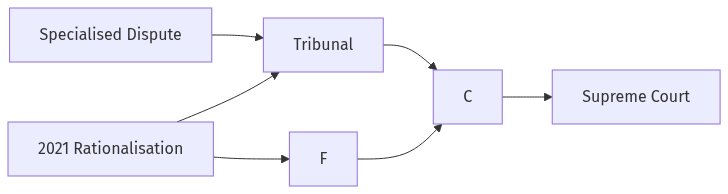
- Rationalisation: The Act abolished specified appellate tribunals and transferred their functions to other judicial forums.
- Example: Abolition of the Film Certification Appellate Tribunal (FCAT) transferred its appellate work to High Courts.
- Administrative efficiency: Reduced overlapping jurisdictions and institutional fragmentation.
- Reverse pendency: Transferring specialised appeals to already burdened High Courts can increase their workload and undermine speedy justice.
Concerns over Institutional Independence
- Short tenure: The four-year tenure raised concerns about security of tenure and institutional independence.
- Age restriction: The 50-year minimum age could restrict the pool of eligible professionals.
- Executive dominance: Excessive executive influence over appointments may compromise judicial independence.
Judicial Intervention
- Madras Bar Association cases: The Supreme Court repeatedly emphasised judicial independence, secure tenure and meaningful judicial participation in appointments.
- 2025 Supreme Court ruling: The Court strengthened constitutional safeguards relating to tribunal appointments and tenure.
- National Tribunals Commission: An independent mechanism for appointments, administration and funding can strengthen tribunal autonomy.
Overall Assessment
- Positive: Rationalisation can reduce duplication, administrative costs and fragmented jurisdiction.
- Negative: Excessive abolition may shift specialised litigation to already burdened High Courts.
- Core principle: Tribunal efficiency must be balanced with specialisation, independence and judicial review.
Flow diagram
Conclusion
Tribunals remain necessary where disputes demand specialised expertise, speedy adjudication and procedural flexibility. However, rationalisation should not simply transfer pendency to High Courts or weaken independence. The way forward is independent appointments, secure tenure, adequate infrastructure and an independent National Tribunals Commission, while preserving constitutional judicial review.
Quick related
Students also ask
-
Discuss the nature of Jammu and Kashmir Legislative Assembly after the Jammu and Kashmir Reorganization Act, 2019. Briefly describe the powers and functions of the Assembly of the Union Territory of Jammu and Kashmir.
Next question on this syllabus topic (2025 · Q4). View answer →
-
Did 2021 end the CAT?
No. The large service and tax forums remain. Several smaller appellate tribunals were wound up.
-
Why not send everything to High Courts?
High Courts already carry a heavy load. Specialist first hearings still make sense if members are independent and posts are filled.
Same topic · past papers
UPSC has asked this before
These previous-year questions sit on the same topic. Open one to practise the earlier ask.
More from this topic
Q15 · UPSC Mains 2026 · GS II · 15 marks · Solution
To what extent do pressure groups, social movements and corporate lobbies deepen pluralistic democracy in India by representing excluded interests? Analyse whether the growing convergence of corporate wealth and political power poses a threat to the autonomy of formal democratic institutions.
Governance and Policy
• Civil society groups and grassroots movements go beyond periodic elections to channel marginalized voices into policy spaces. • Social movements on tribal rights and environmental protection have successfully forced the state to create protective legislation. • Representation is uneven due to a severe resource asymmetry between well-funded corporate lobbies and unorganized labor. • Some interest groups act as elite fronts, subverting public welfare for narrow sectarian gains. • Corporate financial dominance through opaque funding creates severe risks of policy capture and quid pro quo corruption. • Strengthening transparency in political funding and reinforcing regulatory autonomy are essential to safeguard democratic governance.
Q12 · UPSC Mains 2026 · GS II · 15 marks · Solution
What is meant by judicial legislation? In this context, discuss the verdicts of the apex court allowing "passive euthanasia" and a "living will".
Governance and Policy
• Judicial legislation occurs when courts create binding rules to fill policy voids caused by legislative inaction. • The Supreme Court legalized passive euthanasia under Article 21, recognizing the right to die with dignity. • The *Common Cause* (2018) judgment permitted the withdrawal of life support for terminally ill patients with strict medical safeguards. • A living will is an advanced medical directive allowing individuals to pre-state their treatment preferences before incapacitation. • The Supreme Court simplified living will procedures in 2023, replacing complex magistrate approvals with basic notary attestation. • While court guidelines provide immediate relief, they underscore the need for a comprehensive parliamentary statute on end-of-life care. • Codifying these judicial norms through formal legislation ensures democratic legitimacy, ethical debate, and administrative clarity.
Q6 · UPSC Mains 2026 · GS II · 10 marks · Solution
Does India's tribal development policy reflect the aspirations for a socially grounded and equity-based governance? Justify your answer.
Governance and Policy
• India's tribal policy balances constitutional protections with socio-economic development goals. • Fifth and Sixth Schedules provide decentralized autonomy and safeguard tribal lands. • Articles 275(1) and 335 ensure grants-in-aid and reservations to bridge gaps. • PESA (1996) and FRA (2006) mark shifts toward rights-based and culturally sensitive governance. • Gram sabhas are empowered over minor forest produce and community forest rights. • Implementation is hindered by forced displacement without consent and bureaucratic inertia. • True equity requires empowering local institutions rather than relying solely on welfare delivery.