
Revision summary
Civil society organisations are non-State associations, not a fourth branch and not by default enemies of the State. India’s RTI law, disaster relief and many welfare deliveries were built with CSOs. Protest and PIL are adversarial uses of Articles 19 and 32, which the Constitution invites. FCRA tightening and some shutdowns feed the anti-State image; abuse of funds should be prosecuted as abuse, not as a theory of NGOs. The accurate label is non-State; anti-State needs facts.
Model answer
Copper italics in this answer — like this — are the key facts. Each one is unpacked in the Facts & figures rail.
Introduction
Civil Society Organizations (CSOs) are voluntary, autonomous and non-profit associations operating outside the formal State structure to represent citizens’ interests. They are non-State actors by nature, but their advocacy, protests, litigation and resistance to certain policies can make them appear anti-State. However, criticism of State action is not equivalent to opposition to the State itself.
Body
Why CSOs are perceived as anti-State
- Challenging State-led development: CSOs often oppose projects that threaten livelihoods, tribal rights or the environment.
- Example: The Niyamgiri movement mobilised the Dongria Kondh against bauxite mining, with Gram Sabhas playing a decisive role in determining community rights.
- Example: Chhattisgarh Bachao Andolan has challenged mining projects and demanded protection of tribal and forest rights.
- Questioning executive decisions: CSOs use RTI, PILs, protests and public campaigns to demand transparency and accountability.
- Example: MKSS mobilised rural communities for transparency, contributing significantly to the movement that led to the RTI Act, 2005.
- Example: Association for Democratic Reforms (ADR) has used constitutional litigation to challenge electoral practices and demand greater political transparency.
- Conflict over foreign funding: Regulation of foreign contributions can create friction between the State and organisations receiving overseas funds.
- Example: The FCRA, 2010, and its subsequent amendments reflect the State's concern regarding financial transparency, foreign influence and national interest.
- Mobilising dissent: Large-scale protests or campaigns against government policies can create a perception that CSOs are adversarial.
- Example: Environmental, land-rights and civil-liberty organisations may directly challenge government decisions through public mobilisation.
Why CSOs are fundamentally non-State rather than anti-State
- Complementing State capacity: CSOs frequently work with government institutions in areas where administrative capacity is limited.
- Example: Akshaya Patra Foundation has partnered with governments in school meal programmes, demonstrating cooperation rather than opposition.
- Policy innovation: Successful civil-society models can influence and strengthen government programmes.
- Example: SEARCH, associated with Abhay and Rani Bang, contributed to community-health approaches that informed the development of the ASHA programme.
- Evidence-based governance: CSOs generate independent ground-level evidence that helps governments identify policy gaps.
- Example: Pratham's ASER provides large-scale evidence on learning outcomes and informs education policy.
- Social accountability: CSOs enable citizens to monitor implementation and expose leakages without rejecting the State itself.
- Example: Social audits under MGNREGA use community participation to improve transparency and accountability.
- Rights protection: CSOs often strengthen constitutional democracy by ensuring that marginalised groups can access institutions of justice.
- Example: Organisations working on tribal rights, women's rights, child rights and environmental protection frequently use courts and statutory mechanisms rather than extra-constitutional methods.
Critical assessment
- Dissent is not anti-State: Opposition to a particular law, project or government decision can strengthen democratic accountability rather than weaken the State.
- Checks and balances: CSOs perform a watchdog function by exposing corruption, rights violations and administrative failures.
- But anti-State conduct is possible: An organisation can cross the line where there is evidence of unlawful activity, violence, financial misconduct or attempts to undermine constitutional institutions.
- State regulation is therefore legitimate: Transparency in funding, financial accountability and compliance with law are necessary, but regulation should not become a mechanism for suppressing legitimate democratic dissent.
- Ideal relationship: The State should view legitimate CSOs as partners, critics and accountability institutions simultaneously, depending on their particular role.
Flow diagram
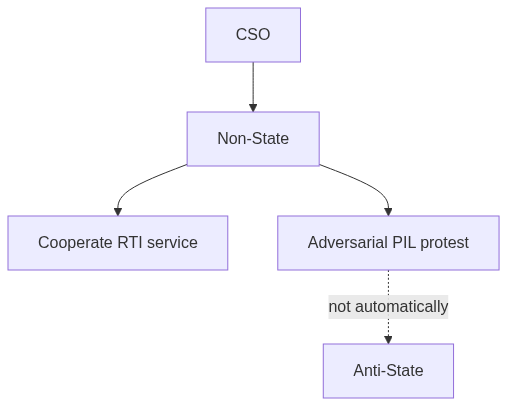
Conclusion
CSOs should be understood as non-State actors with the capacity to cooperate with, complement or challenge the State. Their criticism of government policy is often an expression of democratic participation rather than anti-State behaviour. The appropriate approach is therefore “regulate illegality, accommodate dissent and institutionalise partnership”, so that civil society strengthens rather than weakens democratic governance.
Quick related
Students also ask
-
Discuss the contribution of civil society groups for women's effective and meaningful participation and representation in state legislatures in India.
Next question on this syllabus topic (2023 · Q14). View answer →
-
Is a PIL-filing NGO anti-government?
It is using a State court against a State act. That is constitutional process, not rebellion.
-
Should foreign funds be banned?
Sovereigns may regulate them. A total moral ban would also hit universities and hospitals. The test is transparency and Indian control of political campaigning.
Same topic · past papers
UPSC has asked this before
These previous-year questions sit on the same topic. Open one to practise the earlier ask.
More from this topic
Q14 · UPSC Mains 2023 · GS II · 15 marks · Solution
Discuss the contribution of civil society groups for women's effective and meaningful participation and representation in state legislatures in India.
Development Processes and NGOs
Civil society raises women’s electoral participation through awareness, movements and legal literacy. It trains local-body women as a pipeline and watches party ticket shares. The reservation campaign helped create the climate for the 106th Amendment, which will apply to Assemblies after delimitation. Representation in State legislatures remains limited because parties control nomination and Assembly reservation is not yet operational. Contribution is therefore real on participation and indirect on seats.
Q17 · UPSC Mains 2022 · GS II · 15 marks · Solution
Do you agree with the view that increasing dependence on donor agencies for development reduces the importance of community participation in the development process ? Justify your answer.
Development Processes and NGOs
Donor agencies operate on disbursement cycles and headquarters standards. Those rhythms often turn gram sabhas into consultation checklists rather than decision-makers. Parallel PIUs drain staff and legitimacy from constitutional local bodies. Some donor projects did spread social audit and PRA; that is the exception to design for, not the default. FCRA and NGO chains can shift accountability away from the neighbourhood. Agree with the view as a default risk; reverse it only if the community can change the project.
Q18 · UPSC Mains 2021 · GS II · 15 marks · Solution
Can Civil Society and Non-Governmental Organizations present an alternative model of public service delivery to benefit the common citizen. Discuss the challenges of this alternative model.
Development Processes and NGOs
NGOs already deliver specialised, last-mile and surge services the common citizen uses. They cannot replace PDS-scale entitlements that need tax, law and uniformity. Challenges: donor accountability, FCRA chill, short projects, elite capture, poor coordination, and a split between voice and service. The State must not dump its Article 38 duty onto charities. A regulated partnership with beneficiary boards and honest FCRA administration is the workable alternative, not a shadow government.