
Revision summary
Non-state actors include NGOs, SHGs, media, companies, unions and community bodies that shape public decisions. MGNREGA social audit, NRLM, RTI, RTE partnerships and CSR show they are not merely marginal in delivery and voice. The State still monopolises coercion, tax and all-India administration, and can shrink NGOs through FCRA. Informal power groups can capture local governance without being democratic non-state actors. The statement is therefore half-true at best: marginal in sovereign core, substantial in social-sector governance.
Model answer
Copper italics in this answer — like this — are the key facts. Each one is unpacked in the Facts & figures rail.
Introduction
Non-state actors are organisations and groups outside the formal executive, legislature and judiciary that still shape public decisions: voluntary agencies, self-help groups, trade unions, companies, media, professional bodies, and community organisations. The statement that their role in Indian governance is only marginal is too sweeping. They are central in several delivery and accountability spaces, and still weak where the State monopolises coercion, tax and all-India services.
Body
Where the statement is too strong
- The 73rd and 74th Amendments brought elected local bodies, but implementation of many rural programmes runs through self-help groups, mahila samitis, and NGOs; the National Rural Livelihoods Mission treats SHGs as a governance infrastructure, not as decoration.
- Social audit under the Mahatma Gandhi National Rural Employment Guarantee Act, 2005, and gram sabha roles under PESA, 1996, in Fifth Schedule areas, give non-state and community actors a legal place in watching the State.
- The Right to Information Act, 2005, was itself the product of a grassroots movement; media and civil-society users of RTI are now routine actors in accountability, which is governance, not a side hobby.
- Service delivery in education, health and disaster relief often depends on charitable trusts, missionary and community schools, and philanthropic hospitals, especially where public facilities are thin.
- Corporate social responsibility under Section 135 of the Companies Act, 2013, and public-private partnerships in infrastructure pull companies into quasi-public roles, for better or worse.
- Trade unions, farmer organisations, and professional regulators (Bar Councils, Medical Council / National Medical Commission) make rules that the State then recognises; that is shared governance, not a margin.
- International non-state actors — rating agencies, standard-setting bodies, and global NGOs — influence Indian policy through markets and treaties, which a purely “marginal” thesis cannot explain.
Where the statement still has force
- The core of the Weberian State remains with the Union and the States: defence, currency, All India Services, criminal investigation, and the power to tax. Non-state actors do not replace the district magistrate or the police.
- Many “participatory” committees are invited, funded, and dissolved by departments; they advise, they do not allocate the Consolidated Fund.
- The Foreign Contribution (Regulation) Act, 2010, licence and FCRA cancellation practice can shrink advocacy NGOs, which shows that the State still sets the legal room for non-state politics.
- Informal actors — caste panchayats, strongmen, and unregulated contractors — can capture local governance in ways that are powerful but not legitimate; “non-state” is not always civic virtue.
- Policy design in finance, defence and external affairs is still closed; think tanks comment, they rarely co-author the Cabinet note.
A critical balance
- Indian governance is a State-centred system with a thick non-state fringe that is sometimes the real delivery system, especially in social sectors and in information politics.
- The statement would be accurate for the 1950s licence-permit administration. It is inaccurate after rights-based laws, SHG-led livelihoods, RTI, CSR, and 24-hour media.
- The fair examination is therefore: non-state actors are no longer marginal in voice and last-mile delivery; they remain marginal in sovereign functions and in binding allocation of public money, unless the statute expressly partners them.
Flow diagram
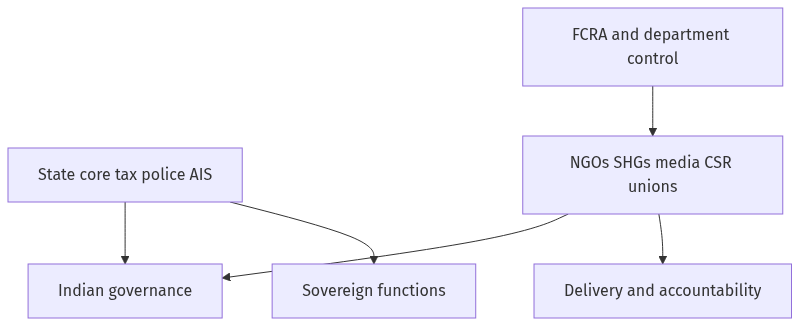
Conclusion
The claim that non-state actors are only marginal does not survive MGNREGA social audits, SHG missions, RTI, CSR, unions and the media. They still do not hold the police power or the budget. Indian governance is State-led and society-entangled. Calling that entanglement “marginal” hides both the democratic gain and the capture risk.
Quick related
Students also ask
-
"Effectiveness of the government system at various levels and people's participation in the governance system are inter-dependent" Discuss their relationship in the context of India.
Next question on this syllabus topic (2016 · Q11). View answer →
-
Are panchayats non-state actors?
Elected panchayats under Part IX are a third tier of the State. Self-help groups, NGOs and gram-sabha social-audit teams that work with them are the non-state or community actors in this question.
-
Does FCRA prove that NGOs are central or that they are weak?
Both. Heavy regulation shows the State still dominates the legal space. The need to regulate also shows that NGOs had become important enough in advocacy and delivery to attract that control.
Same topic · past papers
UPSC has asked this before
These previous-year questions sit on the same topic. Open one to practise the earlier ask.
-
2026 · Q19 · GS II · 15 marks
"India's global diaspora acts as a living bridge, as a critical economic factor and knowledge network in transforming cultural heritage into geopolitical influence and strategic leverage worldwide." Critically examine this statement. -
2025 · Q8 · GS II · 10 marks
Civil Society Organizations are often perceived as being anti-State actors than non-State actors. Do you agree? Justify.
More from this topic
Q15 · UPSC Mains 2026 · GS II · 15 marks · Solution
To what extent do pressure groups, social movements and corporate lobbies deepen pluralistic democracy in India by representing excluded interests? Analyse whether the growing convergence of corporate wealth and political power poses a threat to the autonomy of formal democratic institutions.
Governance and Policy
• Pluralism needs many competing groups so that no single interest dominates policy • Trade unions, farmer bodies and movements such as Chipko and Narmada Bachao Andolan have brought excluded voices into public debate • Movements delivered RTI, Forest Rights and Lokpal laws that give citizens lasting tools • Weak resources and FCRA and protest restrictions limit civil society reach • Corporate influence runs through party funding, lobbying, regulators and media ownership • The electoral bonds scheme was struck down in 2024 for violating citizens' right to information • Institutions such as the Supreme Court, CAG and the Election Commission still check capture, but risks remain • Reforms include funding transparency, a lobbying law, cooling-off periods and protection of dissent
Q12 · UPSC Mains 2026 · GS II · 15 marks · Solution
What is meant by judicial legislation? In this context, discuss the verdicts of the apex court allowing "passive euthanasia" and a "living will".
Governance and Policy
• Judicial legislation is court-made law that fills a legislative vacuum, using Articles 32, 141 and 142 • Vishaka, Prakash Singh and NALSA are common examples, and each invited later legislation • Gian Kaur (1996) denied a right to die but spoke of dying with dignity when death is imminent • Aruna Shanbaug (2011) permitted passive euthanasia with High Court supervision • Common Cause (2018) held the right to die with dignity to be part of Article 21 and recognised living wills • The 2023 modification simplified attestation, board composition and timelines • The tension is between dignity under Article 21 and the legislature's domain on a sensitive moral issue • A national statute on terminal illness would replace interim court guidelines
Q6 · UPSC Mains 2026 · GS II · 10 marks · Solution
Does India's tribal development policy reflect the aspirations for a socially grounded and equity-based governance? Justify your answer.
Governance and Policy
• Constitution: Fifth and Sixth Schedules create tribal self-rule, with Tribes Advisory Councils and autonomous district councils. • Law: PESA 1996 makes the Gram Sabha central and FRA 2006 recognises individual and community forest rights. • Welfare: DAPST, Article 275(1) grants, Eklavya schools, PM JANMAN and the sickle cell mission target the gap. • Weakness: mining, dams and forest clearance rules often override Gram Sabha consent. • Weakness: delayed PESA rules, FRA claim rejections and diverted funds blunt equity. • Security: LWE districts show the cost of land alienation and weak service delivery. • Verdict: strong legal design, uneven delivery, so equity is partial and conditional. • Way ahead: enforce consent, social audit, benefit-sharing through District Mineral Foundations.