
Revision summary
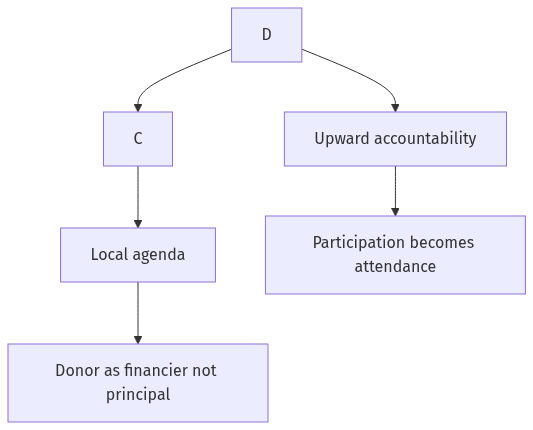
Donor agencies operate on disbursement cycles and headquarters standards. Those rhythms often turn gram sabhas into consultation checklists rather than decision-makers. Parallel PIUs drain staff and legitimacy from constitutional local bodies. Some donor projects did spread social audit and PRA; that is the exception to design for, not the default. FCRA and NGO chains can shift accountability away from the neighbourhood. Agree with the view as a default risk; reverse it only if the community can change the project.
Model answer
Copper italics in this answer — like this — are the key facts. Each one is unpacked in the Facts & figures rail.
Introduction
Donor agencies — multilateral banks, bilateral aid, and large philanthropic funds — bring money, procurement rules, and logframes. Community participation brings knowledge of the watershed, the slum, and the caste veto that no consultant captures. Dependence on the first often thins the second, unless the project is deliberately designed the other way round.
Body
Why the view is largely right
- Donor cycles run on appraisal, disbursement, and closing dates. Gram sabhas and ward committees run on seasons, funerals, and harvests. When the cycle wins, meetings become attendance sheets for a mission, not decisions.
- English logframes, environmental and social standards written in headquarters, and fly-in experts shift agenda-setting to those who can write a “results framework,” which is rarely the self-help group that will maintain the handpump.
- Counterpart funding and conditionalities can turn the panchayat into a contractor of a pre-decided package, which is the opposite of Article 243A gram-sabha primacy and of PESA’s resource consent in scheduled areas.
- FCRA and domestic NGO funding chains can make local organisations more accountable to a Delhi or foreign compliance unit than to the neighbourhood they claim to represent.
Mechanisms that crowd out participation
- Parallel project implementation units pay better than the panchayat secretary; talent and information leave the constitutional local body.
- Consultations are front-loaded to tick a safeguard box, then design is frozen; later “participation” is unpaid labour for a scheme the village did not choose.
- Success is measured in kilometres of pipe and number of trainings, not in whether the user group still meets after the donor leaves.
Why the view is not always right
- Some donor-funded projects introduced social audit, community scorecards, and participatory rural appraisal into Indian practice, which State departments then copied.
- Money with a participation condition can force a reluctant line department to sit with women and Dalits it would otherwise skip.
- Community participation without resources can be empty ritual; a well-governed external fund can finance the tank the gram sabha already voted for.
Justification and the design test
- The statement should be accepted as the default risk of dependence, not as a metaphysical law.
- The test is who can change the project: if the gram sabha cannot drop a component, participation is decorative.
- Indian development already has constitutional community institutions — panchayats, municipalities, forest rights gram sabhas, cooperatives. Donors should finance those institutions’ choices, not replace them with PIUs.
- Domestic resource mobilisation (SFC devolution, property tax, user charges with accountability) is the structural alternative to a permanent donor hinge.
Justify in one line of policy
- Increase community power first (information, veto, maintenance funds), then take donor money as a servant of that power; reversing the order does reduce participation, and that is why the view deserves agreement with the caveat above.
Flow diagram
Conclusion
Yes, increasing dependence on donor agencies tends to reduce real community participation, because time, language, and accountability shift upward. The tendency can be reversed only when constitutional local bodies hold the agenda and donors fund that agenda, rather than the other way around.
Quick related
Students also ask
-
Can Civil Society and Non-Governmental Organizations present an alternative model of public service delivery to benefit the common citizen. Discuss the challenges of this alternative model.
Next question on this syllabus topic (2021 · Q18). View answer →
-
Is all foreign funding hostile to participation?
No. Funding that follows a gram sabha decision and uses local maintenance can deepen participation. Dependence plus a frozen logframe is what thins it.
-
Can the Union ban donors and restore community power automatically?
No. Without SFC money and real 243G functions, the vacuum is filled by departments, not by the village.
Same topic · past papers
UPSC has asked this before
These previous-year questions sit on the same topic. Open one to practise the earlier ask.
More from this topic
Q8 · UPSC Mains 2025 · GS II · 10 marks · Solution
Civil Society Organizations are often perceived as being anti-State actors than non-State actors. Do you agree? Justify.
Development Processes and NGOs
Civil society organisations are non-State associations, not a fourth branch and not by default enemies of the State. India’s RTI law, disaster relief and many welfare deliveries were built with CSOs. Protest and PIL are adversarial uses of Articles 19 and 32, which the Constitution invites. FCRA tightening and some shutdowns feed the anti-State image; abuse of funds should be prosecuted as abuse, not as a theory of NGOs. The accurate label is non-State; anti-State needs facts.
Q14 · UPSC Mains 2023 · GS II · 15 marks · Solution
Discuss the contribution of civil society groups for women's effective and meaningful participation and representation in state legislatures in India.
Development Processes and NGOs
Civil society raises women’s electoral participation through awareness, movements and legal literacy. It trains local-body women as a pipeline and watches party ticket shares. The reservation campaign helped create the climate for the 106th Amendment, which will apply to Assemblies after delimitation. Representation in State legislatures remains limited because parties control nomination and Assembly reservation is not yet operational. Contribution is therefore real on participation and indirect on seats.
Q18 · UPSC Mains 2021 · GS II · 15 marks · Solution
Can Civil Society and Non-Governmental Organizations present an alternative model of public service delivery to benefit the common citizen. Discuss the challenges of this alternative model.
Development Processes and NGOs
NGOs already deliver specialised, last-mile and surge services the common citizen uses. They cannot replace PDS-scale entitlements that need tax, law and uniformity. Challenges: donor accountability, FCRA chill, short projects, elite capture, poor coordination, and a split between voice and service. The State must not dump its Article 38 duty onto charities. A regulated partnership with beneficiary boards and honest FCRA administration is the workable alternative, not a shadow government.