
Revision summary
Public charitable trusts hold property for poverty relief, education, medical aid and general public utility. They already run a large share of Indian schools, hospitals and asylums, and sit beside Waqf and CSR. Inclusion is possible when the beneficiary is a class, not a lineage. Capture, capitation, opaque accounts and foreign-contribution abuse are the other half of the comment. State supervision — registration, audits, removal of trustees — is what makes the potential real. The form relates to vital public issues because the deed says so; delivery is a separate fact.
Model answer
Copper italics in this answer — like this — are the key facts. Each one is unpacked in the Facts & figures rail.
Introduction
A public charitable trust is property held for a purpose the law calls charitable — relief of poverty, education, medical relief, and other objects of general public utility — not for a family’s private gain. India already runs a large part of its schools, hospitals and disability homes on that form. The comment is that the form can make development more inclusive, and that it often does not, unless the State watches the deed.
Body
Why the form can include
Government cannot staff every rare-disease clinic or every hostel the budget misses.
- Peg: Trusts and societies, and Section 8 companies, sit in education, eye care, leprosy and mental-health homes, Scheduled Tribe hostels and disaster relief.
- Peg: Article 26 protects denominations’ right to manage their own affairs; many public temples and maths are still public trusts under State Acts on the Maharashtra Public Trusts Act pattern.
- Peg: Waqf is a parallel Islamic charitable form; corporate social responsibility under Section 135 of the Companies Act now parks company money in similar objects.
- Peg: Where the object is a public issue — girls’ schooling, tuberculosis, palliative care — the trust can move faster than a budget line.
The catch
Inclusive on the deed can be exclusive in the pew.
- Peg: Caste trusts, capitation-fee colleges, and hospitals that are charitable at the gate and commercial in the ward show capture of the form.
- Peg: Opaque accounts, related-party leases and Foreign Contribution (Regulation) Act controversies showed that charity can be a political channel.
- Peg: Temple gold and land are public in law and often private in fact; who is trustee of a public deity is a running constitutional file.
- Peg: Tightening of foreign contribution cut some genuine welfare pipes as well as some political ones; a comment that only cheers “civil society” skips that.
What makes the potential real
The deed is infrastructure for inclusion, not inclusion itself.
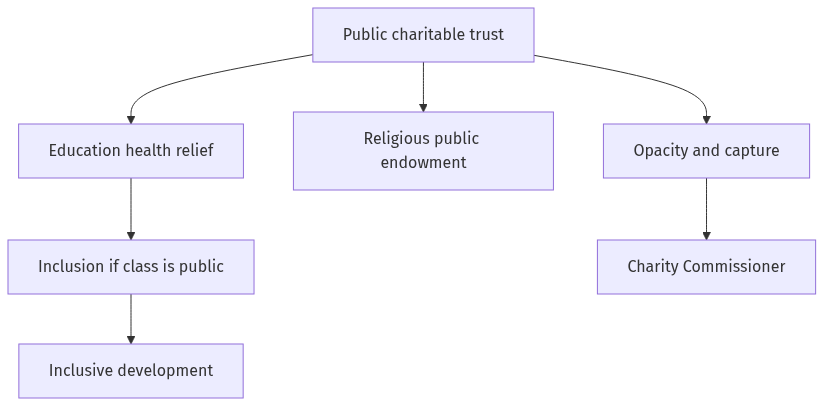
- Peg: Registration, audited accounts, a public beneficiary class, and a Charity Commissioner who can remove a trustee are the comment’s other half.
- Peg: They deliver when the beneficiary is a class, not a family.
Flow diagram
Conclusion
The trust form can carry education, health and relief to people the budget misses. It becomes inclusive only when the object is public and the accounts are. Otherwise it is a tax-preferred private club.
Quick related
Students also ask
-
The Doctrine of Democratic Governance makes it necessary that the public perception of the integrity and commitment of civil servants becomes absolutely positive. Discuss.
Next question on this syllabus topic (2024 · Q8). View answer →
-
Is every voluntary body a public charitable trust?
No. Societies, Section 8 companies and trusts are different forms. Charity is in the object, not in the letterhead.
-
Are temple trusts public issues?
When the deity’s property serves a denomination or the public, yes. When it is a family estate, the law still tries to call it public and often fails in fact.
Same topic · past papers
UPSC has asked this before
These previous-year questions sit on the same topic. Open one to practise the earlier ask.
-
2019 · Q8 · GS II · 10 marks
Implementation of information and Communication Technology (ICT) based Projects / Programmes usually suffers in terms of certain vital factors. Identify these factors, and suggest measures for their effective implementation. -
2019 · Q6 · GS II · 10 marks
Despite Consistent experience of High growth, India still goes with the lowest indicators of human development. Examine the issues that make balanced and inclusive development elusive.
More from this topic
Q15 · UPSC Mains 2026 · GS II · 15 marks · Solution
To what extent do pressure groups, social movements and corporate lobbies deepen pluralistic democracy in India by representing excluded interests? Analyse whether the growing convergence of corporate wealth and political power poses a threat to the autonomy of formal democratic institutions.
Governance and Policy
• Civil society groups and grassroots movements go beyond periodic elections to channel marginalized voices into policy spaces. • Social movements on tribal rights and environmental protection have successfully forced the state to create protective legislation. • Representation is uneven due to a severe resource asymmetry between well-funded corporate lobbies and unorganized labor. • Some interest groups act as elite fronts, subverting public welfare for narrow sectarian gains. • Corporate financial dominance through opaque funding creates severe risks of policy capture and quid pro quo corruption. • Strengthening transparency in political funding and reinforcing regulatory autonomy are essential to safeguard democratic governance.
Q12 · UPSC Mains 2026 · GS II · 15 marks · Solution
What is meant by judicial legislation? In this context, discuss the verdicts of the apex court allowing "passive euthanasia" and a "living will".
Governance and Policy
• Judicial legislation occurs when courts create binding rules to fill policy voids caused by legislative inaction. • The Supreme Court legalized passive euthanasia under Article 21, recognizing the right to die with dignity. • The *Common Cause* (2018) judgment permitted the withdrawal of life support for terminally ill patients with strict medical safeguards. • A living will is an advanced medical directive allowing individuals to pre-state their treatment preferences before incapacitation. • The Supreme Court simplified living will procedures in 2023, replacing complex magistrate approvals with basic notary attestation. • While court guidelines provide immediate relief, they underscore the need for a comprehensive parliamentary statute on end-of-life care. • Codifying these judicial norms through formal legislation ensures democratic legitimacy, ethical debate, and administrative clarity.
Q6 · UPSC Mains 2026 · GS II · 10 marks · Solution
Does India's tribal development policy reflect the aspirations for a socially grounded and equity-based governance? Justify your answer.
Governance and Policy
• India's tribal policy balances constitutional protections with socio-economic development goals. • Fifth and Sixth Schedules provide decentralized autonomy and safeguard tribal lands. • Articles 275(1) and 335 ensure grants-in-aid and reservations to bridge gaps. • PESA (1996) and FRA (2006) mark shifts toward rights-based and culturally sensitive governance. • Gram sabhas are empowered over minor forest produce and community forest rights. • Implementation is hindered by forced displacement without consent and bureaucratic inertia. • True equity requires empowering local institutions rather than relying solely on welfare delivery.