
Revision summary
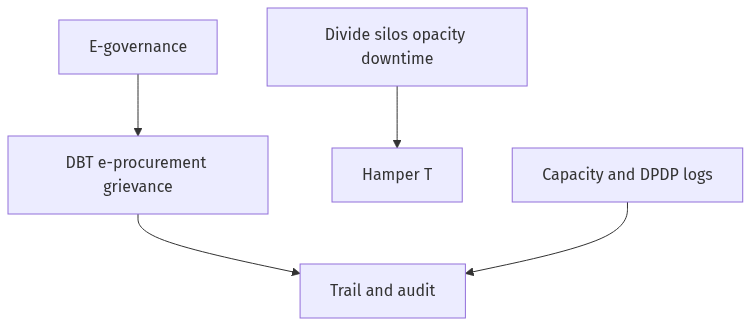
DBT, GeM, e-procurement and grievance portals improved speed and audit trails. The digital divide and kiosk dependence recreate intermediaries. Departmental silos and app-only design cut effectiveness. Dashboards without speaking orders and without access logs cut transparency and accountability. Capacity, cyber risk and incomplete data-protection practice are the institutional brakes.
Model answer
Copper italics in this answer — like this — are the key facts. Each one is unpacked in the Facts & figures rail.
Introduction
E-governance is the use of digital systems to deliver public services, records, and payments. It has improved speed and traceability where Aadhaar-seeded Direct Benefit Transfer, online grievance portals, and e-procurement actually run; inadequacies in design, access, and law still cap those gains.
Body
Gains that set the test
- Direct Benefit Transfer on the Aadhaar and Jan Dhan rails cut ghost beneficiaries in several subsidy streams and made the payment trail auditable.
- Government e-Marketplace, e-procurement, and the Right to Information online filing improved price discovery and a paper trail.
- MyGov, Centralised Public Grievance Redress and Monitoring System, and State service-plus portals shortened some citizen-to-department paths.
- Effectiveness, transparency, and accountability therefore rise when the digital record is complete, open to audit, and tied to a named officer.
Inadequacies of access and design
- Digital divide by language, disability, gender, and rural connectivity leaves the same citizen dependent on a kiosk operator, which recreates the old middleman on a screen.
- Data standards differ across departments, so a land record, a ration card, and a police FIR do not talk to each other; effectiveness falls when the citizen still visits three offices.
- Platform downtime, weak last-mile Common Service Centres, and exclusive app-only design exclude users whom the service law still treats as entitled.
Inadequacies of transparency and accountability
- Dashboards can display counts without publishing the rule, the fee, or the officer who rejected the file; that is visibility without transparency.
- Algorithmic targeting in welfare and policing is often opaque; the citizen cannot contest a silent rejection when no speaking order is generated.
- The Digital Personal Data Protection Act, 2023, and still-evolving data-retention practice have not yet produced a clear, citizen-facing log of who accessed whose record.
- Cyber incidents, vendor lock-in, and poorly audited private partners create new fiduciary risks that paper files did not have in the same form.
- RTI exclusions, poorly maintained public databases, and the gap between a computerised token and a reasoned order hamper accountability even when the portal is live.
Institutional inadequacies
- Capacity of Block and municipality staff to use systems is uneven; hardware missions without process re-engineering digitise delay.
- Inter-State and Union–State platforms (GSTN is the strong exception) remain silos, so federal services do not look like one government to the user.
Flow diagram
Conclusion
E-governance has raised effectiveness, transparency, and accountability where payments, procurement, and grievances leave a complete digital trail. Inadequacies of access, interoperable records, speaking orders, data protection, and local capacity still hamper those three features.
Quick related
Students also ask
-
"Right of movement and residence throughout the territory of India are freely available to the Indian citizens, but these rights are not absolute. " Comment.
Next question on this syllabus topic (2022 · Q2). View answer →
-
Does a live portal equal transparency?
No. Transparency needs the rule, the fee, the speaking order, and a way to audit who saw the file, not only a status bar.
-
Is Aadhaar-based DBT enough for accountability?
It reduces ghost names and shows a payment trail. It does not by itself explain an exclusion or replace a reasoned rejection order.
Same topic · past papers
UPSC has asked this before
These previous-year questions sit on the same topic. Open one to practise the earlier ask.
-
2023 · Q13 · GS II · 15 marks
Account for the legal and political factors responsible for the reduced frequency of using Article 356 by the Union Governments since mid 1990s. -
2017 · Q8 · GS II · 10 marks
Hunger and Poverty are the biggest challenges for good governance in India still today. Evaluate how far successive governments have progressed in dealing with these humongous problems. Suggest measures for improvement.
More from this topic
Q16 · UPSC Mains 2026 · GS II · 15 marks · Solution
"Transparency and accountability in governance are not about controlling corruption but about creating the trust of stakeholders in the policy process by following the Rule of Law and Participatory Governance." Comment.
Transparency and e-Governance
• Transparency and accountability go beyond stopping corruption to build positive systemic trust and institutional legitimacy. • They anchor the Rule of Law by ensuring predictable policies, preventing arbitrary executive abuse, and offering procedural fairness. • Participatory governance transforms top-down administration into a collaborative compact through citizen engagement. • Pre-legislative consultations and platforms like MyGov allow substantive public input before laws are finalized. • Social audits, such as those under MGNREGA, empower grassroots stakeholders to verify implementation and course-correct locally. • State machinery functions best when administrative actions are justifiable, fair, and rooted in public interest. • Embedding these elements into administrative DNA fulfills the constitutional promise of securing justice and fraternity for all.
Q7 · UPSC Mains 2025 · GS II · 10 marks · Solution
e-governance projects have a built-in bias towards technology and back-end integration than user-centric designs. Examine.
Transparency and e-Governance
User-centric e-governance starts from the citizen’s journey; many projects start from ID, ledger and dashboard. NeGP, GSTN, Aadhaar and PFMS are strong backs; language, OTP-on-one-phone and failed biometrics are weak fronts. 2nd ARC, Sevottam and public-service guarantee laws already asked for time-bound citizen outcomes. DPDP and RPwD add consent and accessibility duties. Correction: assisted kiosks, local language, offline fallback, and the same data for the ward as for the secretary.
Q18 · UPSC Mains 2024 · GS II · 15 marks · Solution
e-governance is not just about the routine application of digital technology in service delivery process. It is as much about multifarious interactions for ensuring transparency and accountability. In this context, evaluate the role of the 'Interactive Service Model' of e-governance.
Transparency and e-Governance
E-governance is not only digitising a counter; it is multi-way interaction for transparency and accountability. The Interactive Service Model is two-way apply–track–grieve–reply, the top of the usual model ladder. Indian examples: UMANG, CPGRAMS, Passport Seva, RTI Online, GST replies, GeM. Gains: time-stamped trails. Losses: digital divide, kiosk touts, privacy risk, vanity dashboards. Assisted access and honest back-ends decide whether the model is real. Direct Benefit Transfer is interactive only when failure can be queried.