
Revision summary
E-governance is not only digitising a counter; it is multi-way interaction for transparency and accountability. The Interactive Service Model is two-way apply–track–grieve–reply, the top of the usual model ladder. Indian examples: UMANG, CPGRAMS, Passport Seva, RTI Online, GST replies, GeM. Gains: time-stamped trails. Losses: digital divide, kiosk touts, privacy risk, vanity dashboards. Assisted access and honest back-ends decide whether the model is real. Direct Benefit Transfer is interactive only when failure can be queried.
Model answer
Copper italics in this answer — like this — are the key facts. Each one is unpacked in the Facts & figures rail.
Introduction
Putting a form on a website is digitisation. E-governance, in the line of United Nations and Indian administrative writing, is also who can speak back. The Interactive Service Model is the end of that ladder: the State and the citizen transact and query each other, not only download a PDF. Transparency and accountability live or die in that loop.
Body
More than routine technology
A portal is not a republic.
- Peg: Back-end integration can be excellent and still opaque to the user.
- Peg: Multifarious interactions mean government-to-citizen, government-to-business, government-to-government and citizen-to-government — grievance, consultation, tracking, and the right to see one’s own file.
The Interactive Service Model
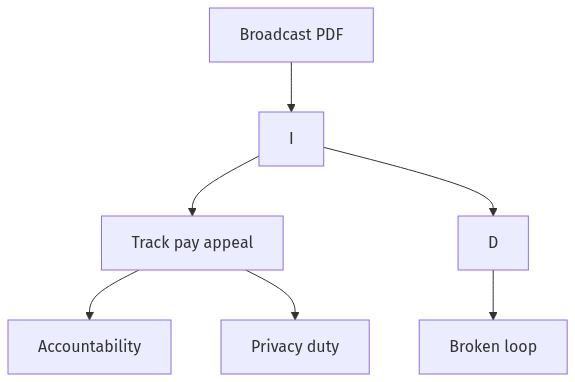
Typologies used in Indian administrative teaching climb from broadcast to two-way service.
- Peg: A broadcasting model only pushes information; a critical-flow model sends selected data; comparative analysis and e-advocacy sit in between.
- Peg: The interactive service model is two-way: the citizen applies, pays, tracks, rates and appeals, and the department’s clock is visible on the same screen.
- Peg: Indian pieces of that loop include UMANG, CPGRAMS, RTI Online, Passport Seva SMS, e-District, Government e-Marketplace and GST notices that can be answered online.
- Peg: Direct Benefit Transfer is interactive only when a failed payment can be queried and corrected, not when money is merely pushed.
Evaluation
A visible queue is more transparent than a peon’s memory; a fake dashboard is not.
- Peg: A time-stamped grievance identity is evidence a newspaper or a court can use — accountability as a trail.
- Peg: Passport, railway tickets and pension correction work where the loop actually closes.
- Peg: Limits: low-literacy and remote households need assisted kiosks, or a new tout appears; green dashboards can hide a shut field office; after Puttaswamy a State that logs every click carries a privacy duty; an algorithm that rejects a scheme can still be hidden.
- Peg: The model is the right aspiration; it works when the back-end is honest and the front-end is assisted. Technology without that loop is only routine application.
Flow diagram
Conclusion
- E-governance as interaction is the Interactive Service Model: two-way transactions with a visible clock. It can discipline the file. It fails when the divide, the tout and the fake dashboard take the citizen’s place in the loop.
Quick related
Students also ask
-
E-governance, as a critical tool of governance, has ushered in effectiveness, transparency and accountability in governments. What inadequacies hamper the enhancement of these features?
Next question on this syllabus topic (2023 · Q8). View answer →
-
Is Direct Benefit Transfer an interactive model?
The push of money is one-way. It becomes interactive when failure, KYC and grievance can be closed by the beneficiary online or at an assisted point.
-
Does more data always mean more accountability?
Only if someone can read, challenge and audit it. A dashboard without a remedy is a broadcast model in fancy clothes.
Same topic · past papers
UPSC has asked this before
These previous-year questions sit on the same topic. Open one to practise the earlier ask.
-
2021 · Q18 · GS II · 15 marks
Can Civil Society and Non-Governmental Organizations present an alternative model of public service delivery to benefit the common citizen. Discuss the challenges of this alternative model. -
2025 · Q11 · GS II · 15 marks
"Constitutional morality is the fulcrum which acts as an essential check upon the high functionaries and citizens alike…"In view of the above observation of the Supreme Court, explain the concept of constitutional morality and its application to ensure balance between judicial independence and judicial accountability in India.
More from this topic
Q16 · UPSC Mains 2026 · GS II · 15 marks · Solution
"Transparency and accountability in governance are not about controlling corruption but about creating the trust of stakeholders in the policy process by following the Rule of Law and Participatory Governance." Comment.
Transparency and e-Governance
• Transparency and accountability go beyond stopping corruption to build positive systemic trust and institutional legitimacy. • They anchor the Rule of Law by ensuring predictable policies, preventing arbitrary executive abuse, and offering procedural fairness. • Participatory governance transforms top-down administration into a collaborative compact through citizen engagement. • Pre-legislative consultations and platforms like MyGov allow substantive public input before laws are finalized. • Social audits, such as those under MGNREGA, empower grassroots stakeholders to verify implementation and course-correct locally. • State machinery functions best when administrative actions are justifiable, fair, and rooted in public interest. • Embedding these elements into administrative DNA fulfills the constitutional promise of securing justice and fraternity for all.
Q7 · UPSC Mains 2025 · GS II · 10 marks · Solution
e-governance projects have a built-in bias towards technology and back-end integration than user-centric designs. Examine.
Transparency and e-Governance
User-centric e-governance starts from the citizen’s journey; many projects start from ID, ledger and dashboard. NeGP, GSTN, Aadhaar and PFMS are strong backs; language, OTP-on-one-phone and failed biometrics are weak fronts. 2nd ARC, Sevottam and public-service guarantee laws already asked for time-bound citizen outcomes. DPDP and RPwD add consent and accessibility duties. Correction: assisted kiosks, local language, offline fallback, and the same data for the ward as for the secretary.
Q16 · UPSC Mains 2024 · GS II · 15 marks · Solution
The Citizens' charter has been a landmark initiative in ensuring citizen-centric administration. But it is yet to reach its full potential. Identify the factors hindering the realisation of its promise and suggest measures to overcome them.
Transparency and e-Governance
Citizens’ Charters, after the 1997 Chief Ministers’ conference, promise standards, time, information and grievance. They stall for want of legal force, measurable clocks, compensation, staff ownership and public awareness. Sevottam tried quality certification; many charters remain posters. State Right to Service Acts with penalties are the working Indian upgrade. Dashboards, local-language co-drafting and third-party audit would close the gap. RTI is about information; a charter is about the service clock — they stack.