
Revision summary
The 73rd and 74th Amendments constitutionalised panchayats and municipalities, with SECs and fixed tenure. The Eleventh and Twelfth Schedules list functions but Articles 243G and 243W leave devolution to the State. State Finance Commissions exist in the text and are often late or only partly implemented. Political presence of women and SC/ST persons at the local level is the clearest change. Fiscal and administrative autonomy remains limited, so the extent of change in daily governance is partial.
Model answer
Copper italics in this answer — like this — are the key facts. Each one is unpacked in the Facts & figures rail.
Introduction
The Constitution (Seventy-third and Seventy-fourth Amendment) Acts, 1992, made panchayats and municipalities a constitutional third tier and listed functions in the Eleventh and Twelfth Schedules. Grassroots governance has changed in elections, reservations, and the gram sabha’s legal existence; it has changed much less in money, staff, and exclusive control of those listed functions.
Body
What has changed
- Part IX and Part IXA ended the old pattern in which local bodies could be superseded at will without a constitutional duty to hold elections; Article 243E and 243U fix duration, and State Election Commissions under Articles 243K and 243ZA run local polls.
- Reservations for Scheduled Castes, Scheduled Tribes, and women in seats and chairperson offices have altered who sits in the gram panchayat and the municipal ward, which is a real change in political presence at the grassroots.
- The gram sabha in Article 243A, and ward committees in large cities, created a legal forum below the elected council, even where meetings are irregular.
- Centrally sponsored schemes now often route work through panchayats (for example MGNREGA’s gram sabha role), so the third tier is visible in delivery even when the scheme is Union-designed.
Functions: Eleventh and Twelfth Schedules
- The Eleventh Schedule lists 29 panchayat subjects and the Twelfth Schedule lists 18 municipal subjects; Articles 243G and 243W leave it to the State legislature to endow those bodies with powers.
- Devolution is therefore discretionary: many States notify overlapping schemes, keep parallel directorates, and leave the panchayat as an implementing agency rather than a government of the subject.
- District Planning Committees under Article 243ZD were meant to consolidate rural and urban plans; they are unevenly active, so grassroots planning is still often a departmental annual plan.
Funds, functionaries, and the State Finance Commission
- Article 243I and 243Y require a State Finance Commission every five years to recommend distribution of taxes and grants to panchayats and municipalities.
- Delayed constitution, delayed reports, and partial acceptance of awards mean local bodies still live on tied scheme money and a thin property-tax or assigned-tax base.
- Staff remain largely State cadres on deputation; the secretary of the gram panchayat answers upward more than to the sarpanch.
- The Fifteenth Finance Commission’s local grants improved predictability of Union money, but they do not replace a State’s refusal to share own tax.
Extent: a measured answer
- Decentralisation has changed the electoral and representative face of grassroots governance more than it has changed fiscal federalism inside the State.
- Where PESA, 1996, and active gram sabhas meet a willing State, natural-resource and minor-forest decisions are more local; where parastatals run water and planning, the 74th Amendment is a form without a function.
- The extent is therefore partial: constitutional local government exists; autonomous local government is still the exception.
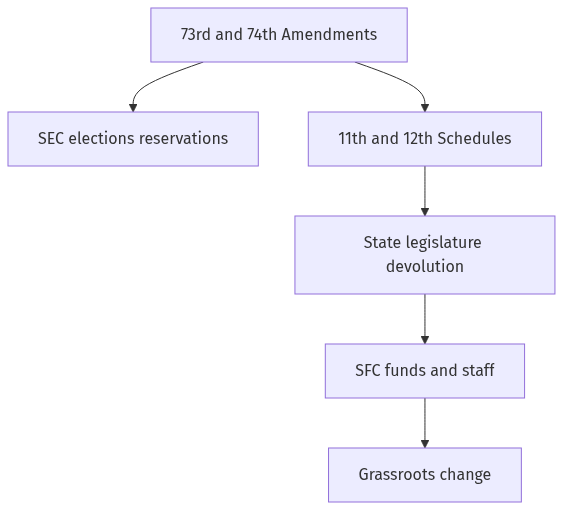
Flow diagram
Conclusion
The 73rd and 74th Amendments changed who is elected and how often, and they named functions in the Eleventh and Twelfth Schedules. Grassroots governance will have changed in substance only when State Finance Commission awards, staff, and exclusive functions follow those lists, which in most States they still do not.
Quick related
Students also ask
-
The Gati-Shakti Yojana needs meticulous coordination between the government and the private sector to achieve the goal of connectivity. Discuss.
Next question on this syllabus topic (2022 · Q6). View answer →
-
Can the Union force a State to transfer all 29 Eleventh Schedule subjects?
No. Article 243G addresses the State legislature. Union grants can only incentivise devolution.
-
Is the State Election Commission the same as the ECI?
No. Local elections are superintended by the SEC under Articles 243K and 243ZA; the ECI’s Article 324 mandate is for Parliament and State legislatures.
Same topic · past papers
UPSC has asked this before
These previous-year questions sit on the same topic. Open one to practise the earlier ask.
More from this topic
Q15 · UPSC Mains 2026 · GS II · 15 marks · Solution
To what extent do pressure groups, social movements and corporate lobbies deepen pluralistic democracy in India by representing excluded interests? Analyse whether the growing convergence of corporate wealth and political power poses a threat to the autonomy of formal democratic institutions.
Governance and Policy
• Civil society groups and grassroots movements go beyond periodic elections to channel marginalized voices into policy spaces. • Social movements on tribal rights and environmental protection have successfully forced the state to create protective legislation. • Representation is uneven due to a severe resource asymmetry between well-funded corporate lobbies and unorganized labor. • Some interest groups act as elite fronts, subverting public welfare for narrow sectarian gains. • Corporate financial dominance through opaque funding creates severe risks of policy capture and quid pro quo corruption. • Strengthening transparency in political funding and reinforcing regulatory autonomy are essential to safeguard democratic governance.
Q12 · UPSC Mains 2026 · GS II · 15 marks · Solution
What is meant by judicial legislation? In this context, discuss the verdicts of the apex court allowing "passive euthanasia" and a "living will".
Governance and Policy
• Judicial legislation occurs when courts create binding rules to fill policy voids caused by legislative inaction. • The Supreme Court legalized passive euthanasia under Article 21, recognizing the right to die with dignity. • The *Common Cause* (2018) judgment permitted the withdrawal of life support for terminally ill patients with strict medical safeguards. • A living will is an advanced medical directive allowing individuals to pre-state their treatment preferences before incapacitation. • The Supreme Court simplified living will procedures in 2023, replacing complex magistrate approvals with basic notary attestation. • While court guidelines provide immediate relief, they underscore the need for a comprehensive parliamentary statute on end-of-life care. • Codifying these judicial norms through formal legislation ensures democratic legitimacy, ethical debate, and administrative clarity.
Q6 · UPSC Mains 2026 · GS II · 10 marks · Solution
Does India's tribal development policy reflect the aspirations for a socially grounded and equity-based governance? Justify your answer.
Governance and Policy
• India's tribal policy balances constitutional protections with socio-economic development goals. • Fifth and Sixth Schedules provide decentralized autonomy and safeguard tribal lands. • Articles 275(1) and 335 ensure grants-in-aid and reservations to bridge gaps. • PESA (1996) and FRA (2006) mark shifts toward rights-based and culturally sensitive governance. • Gram sabhas are empowered over minor forest produce and community forest rights. • Implementation is hindered by forced displacement without consent and bureaucratic inertia. • True equity requires empowering local institutions rather than relying solely on welfare delivery.