
Revision summary
Civil society raises women’s electoral participation through awareness, movements and legal literacy. It trains local-body women as a pipeline and watches party ticket shares. The reservation campaign helped create the climate for the 106th Amendment, which will apply to Assemblies after delimitation. Representation in State legislatures remains limited because parties control nomination and Assembly reservation is not yet operational. Contribution is therefore real on participation and indirect on seats.
Model answer
Copper italics in this answer — like this — are the key facts. Each one is unpacked in the Facts & figures rail.
Introduction
Participation is campaigning, voting, and being heard; representation is winning and holding a seat in the Legislative Assembly. Civil society groups have done more on the first than on the second, because State legislatures still lack the constitutional reservation that Panchayats have.
Body
What civil society has contributed to participation
- Women’s organisations, from older bodies such as the All India Women’s Conference to later groups such as SEWA, the National Federation of Indian Women, and issue-based NGOs, have run literacy, legal-literacy, and voter-awareness campaigns that raise turnout and candidate confidence.
- Movement groups on domestic violence, liquor, and wages (including the anti-arrack movement and self-help-group federations) trained women to speak in public, which is the skill an Assembly campaign later needs.
- Election-watch and feminist research groups publish candidate lists, track tickets given to women, and name parties that keep women at the bottom of the list, which is public pressure on gatekeepers.
- Legal-aid and rights groups use the National Commission for Women, State commissions, and the 73rd Amendment experience to argue that local reservation should be a pipeline into Assemblies, not a ceiling.
- Media and campus groups have made safety, harassment, and care work election issues, so women’s participation is not reduced to a single reserved ward.
What they have contributed to representation
- Advocacy for a women’s reservation law in Parliament and Assemblies was a decades-long civil-society demand, carried by joint fronts of women’s groups across party lines, and it shaped the political climate for the Constitution (106th Amendment) Act, 2023.
- Training programmes for women sarpanches and councillors, often run with State election departments or NGOs, create a pool of women who can seek Assembly tickets.
- Some groups support independent or party women candidates with funds, security advice, and affidavit help, which partly offsets the cost and violence of Assembly elections.
- Civil society cannot itself allot tickets; parties and male incumbents still control nomination, so representation in State legislatures remains far below local-body shares.
Limits
- Many NGOs are urban, donor-dependent, and weak in Assembly-seat booth work.
- Caste and religious fragmentation splits “women’s vote” so that a single civil-society slate rarely wins.
- Without reservation in force in Assemblies, contribution stays at pressure, training, and issue-setting.
Recommendations
- Fund multi-year leadership schools that move women from Panchayat chairs to Assembly tickets, with parties required to publish the share of women candidates.
- Protect women candidates against booth violence and online abuse through Election Commission directions that civil-society monitors can feed.
- Use State Commissions for Women as statutory allies of Assembly ethics and petition committees, so participation continues after the oath.
Flow diagram
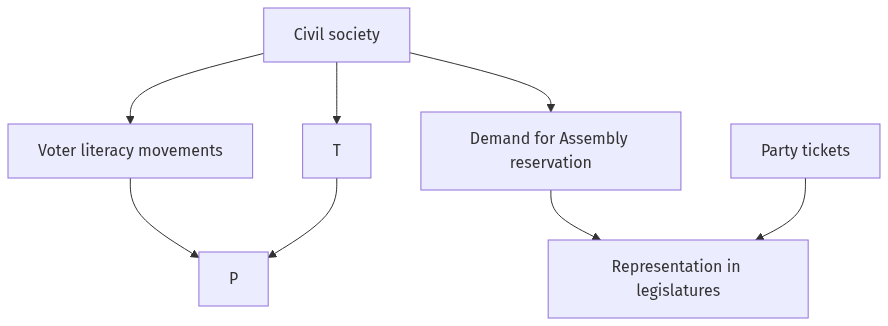
Conclusion
Civil society has enlarged women’s participation through literacy, movements, election-watch, and the long campaign for legislative reservation. Meaningful representation in State legislatures still depends on party tickets and on reservation coming into force, which NGOs can demand but cannot grant.
Quick related
Students also ask
-
Do you agree with the view that increasing dependence on donor agencies for development reduces the importance of community participation in the development process ? Justify your answer.
Next question on this syllabus topic (2022 · Q17). View answer →
-
Why is local reservation not enough for Assemblies?
Panchayat seats are reserved by the Constitution. Assembly tickets are party decisions. Many women leaders stop at the block because parties do not promote them.
-
Can an NGO field a full Assembly slate?
It can support independents or a small party. Winning a House needs organisation, money and a symbol, which social groups rarely match.
Same topic · past papers
UPSC has asked this before
These previous-year questions sit on the same topic. Open one to practise the earlier ask.
-
2015 · Q8 · GS II · 12 marks
Examine critically the recent changes in the rule governing foreign funding of NGOs under the Foreign Contribution (Regulation) Act (FCRA), 1976. -
2025 · Q8 · GS II · 10 marks
Civil Society Organizations are often perceived as being anti-State actors than non-State actors. Do you agree? Justify. -
2021 · Q18 · GS II · 15 marks
Can Civil Society and Non-Governmental Organizations present an alternative model of public service delivery to benefit the common citizen. Discuss the challenges of this alternative model.
More from this topic
Q8 · UPSC Mains 2025 · GS II · 10 marks · Solution
Civil Society Organizations are often perceived as being anti-State actors than non-State actors. Do you agree? Justify.
Development Processes and NGOs
Civil society organisations are non-State associations, not a fourth branch and not by default enemies of the State. India’s RTI law, disaster relief and many welfare deliveries were built with CSOs. Protest and PIL are adversarial uses of Articles 19 and 32, which the Constitution invites. FCRA tightening and some shutdowns feed the anti-State image; abuse of funds should be prosecuted as abuse, not as a theory of NGOs. The accurate label is non-State; anti-State needs facts.
Q17 · UPSC Mains 2022 · GS II · 15 marks · Solution
Do you agree with the view that increasing dependence on donor agencies for development reduces the importance of community participation in the development process ? Justify your answer.
Development Processes and NGOs
Donor agencies operate on disbursement cycles and headquarters standards. Those rhythms often turn gram sabhas into consultation checklists rather than decision-makers. Parallel PIUs drain staff and legitimacy from constitutional local bodies. Some donor projects did spread social audit and PRA; that is the exception to design for, not the default. FCRA and NGO chains can shift accountability away from the neighbourhood. Agree with the view as a default risk; reverse it only if the community can change the project.
Q18 · UPSC Mains 2021 · GS II · 15 marks · Solution
Can Civil Society and Non-Governmental Organizations present an alternative model of public service delivery to benefit the common citizen. Discuss the challenges of this alternative model.
Development Processes and NGOs
NGOs already deliver specialised, last-mile and surge services the common citizen uses. They cannot replace PDS-scale entitlements that need tax, law and uniformity. Challenges: donor accountability, FCRA chill, short projects, elite capture, poor coordination, and a split between voice and service. The State must not dump its Article 38 duty onto charities. A regulated partnership with beneficiary boards and honest FCRA administration is the workable alternative, not a shadow government.