
Revision summary
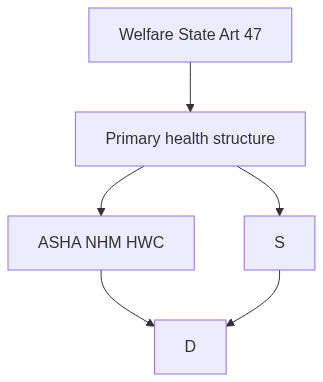
Primary health is a Welfare-State moral duty under Article 47 and Article 21’s dignity reading. It is also a pre-condition for sustainable development: schooling, labour, epidemic control and household poverty all turn on the first mile. NHM and ASHAs are the community spine; Ayushman Bharat adds HWCs and PM-JAY insurance. Insurance without PHC staff and drugs still fails the poor. Fund Health and Wellness Centres as infrastructure, not as a leftover after tertiary schemes.
Model answer
Copper italics in this answer — like this — are the key facts. Each one is unpacked in the Facts & figures rail.
Introduction
A Welfare State that leaves the first mile of health to chance fails Article 47 and the Preamble’s justice. Primary health structure is also economic infrastructure: without it, learning, labour productivity and sustainable development goals remain paper.
Body
Moral imperative of the Welfare State
- Article 47 directs the State to raise nutrition and living standards and to improve public health; primary care is how that directive becomes a clinic, not a slogan.
- Alma-Ata’s primary health care idea — access, prevention, community workers — is the ethical minimum of a Republic that promises dignity under Article 21 as read in health-related cases.
- Out-of-pocket spending that pushes households into poverty is a Welfare-State failure even when tertiary hospitals glitter in capital cities.
Pre-condition for sustainable development
- Healthy children attend school; healthy adults stay in the workforce; reduced stunting and infection are growth policies, not only clinic policies, which is why SDG 3 sits inside any serious sustainable-development strategy.
- Epidemic surveillance, immunisation, and maternal care at the sub-centre and PHC stop crises that later consume fiscal space and destroy livelihoods, as COVID-19 showed when the first mile was thin.
- Environmental and occupational health — water, air, farm chemicals — are managed, if at all, at the primary level closest to the village.
Indian architecture: NHM, ASHA, Ayushman
- The National Health Mission funds rural and urban primary systems, including the ASHA community worker who is the last-mile link for immunisation, maternal care and health education.
- Ayushman Bharat tries to complete the stack: Health and Wellness Centres for comprehensive primary care, and PM-JAY for secondary–tertiary insurance, so primary structure is not abandoned for hospital packages alone.
- Gaps remain: doctor and drug shortages, weak diagnostics, and an urban bias; insurance without a functioning PHC still dumps the poor at a distant ward.
- Recommendation: freeze a larger share of health spending on HWCs, ASHAs’ pay and drugs, because sustainable development is lost if primary care is the residual after tertiary schemes.
Flow diagram
Conclusion
Primary health structure is a Welfare-State duty under Article 47 and a pre-condition for sustainable development because human capital, epidemic control and household solvency all begin at the first mile. NHM, ASHA and Ayushman Bharat are the right stack only if Health and Wellness Centres, not only hospital insurance, get the money and the staff.
Quick related
Students also ask
-
"'Earn while you learn' scheme needs to be strengthened to make vocational education and skill training meaningful." Comment.
Next question on this syllabus topic (2021 · Q7). View answer →
-
Can PM-JAY replace primary health centres?
No. Insurance pays for episodes in hospitals. Prevention, immunisation and routine maternal care need a standing primary structure.
-
Why call primary health a pre-condition for sustainable development?
Because stunting, untreated infection and catastrophic health spending destroy the labour and learning that growth models assume.
Same topic · past papers
UPSC has asked this before
These previous-year questions sit on the same topic. Open one to practise the earlier ask.
-
2020 · Q18 · GS II · 15 marks
National Education Policy 2020 is in conformity with the Sustainable Development Goal-4 (2030). It intends to restructure and reorient education system in India. Critically examine the statement. -
2016 · Q9 · GS II · 12 marks
Professor Amartya Sen has advocated important reforms in the realms of primary education and primary health care. What are your suggestions to improve their status and performance?
More from this topic
Q18 · UPSC Mains 2026 · GS II · 15 marks · Solution
Should education be treated primarily as a welfare obligation of the state or as a strategic investment for building a globally competitive, knowledge-driven nation? Critically evaluate.
Health, Education and Human Resources
Education is both a welfare duty and a strategic asset. The state must secure access, equity and foundational learning first, then build skills, universities and research. NEP 2020 tries to combine the two, but it needs higher spending, teacher capacity and accountability for learning outcomes.
Q7 · UPSC Mains 2026 · GS II · 10 marks · Solution
Malnutrition in India is not merely a public health concern; it is also a challenge of social equity, human development and effective welfare governance. Discuss.
Health, Education and Human Resources
• Public health: NFHS-5 shows stunting around 35.5 per cent, wasting 19.3 per cent and high anaemia among women and children. • Equity: malnutrition is higher among Scheduled Tribes, Scheduled Castes, poorer households and backward states. • Gender: early marriage, low food share and weak maternity support create an intergenerational cycle. • WASH link: unsafe water and sanitation cause infections that stop absorption of food. • Human capital: stunted children learn and earn less, reducing the demographic dividend. • Welfare: ICDS, Poshan 2.0, NFSA and PM POSHAN give scale but are cereal-heavy and unevenly delivered. • Governance: leakages, overloaded Anganwadi workers, weak convergence and data gaps limit impact. • Way ahead: first 1000 days, eggs and pulses, WASH convergence, reliable data, social audit.
Q17 · UPSC Mains 2024 · GS II · 15 marks · Solution
In a crucial domain like the public healthcare system, the Indian State should play a vital role to contain the adverse impact of marketization of the system. Suggest some measures through which the State can enhance the reach of public healthcare at the grassroots level.
Health, Education and Human Resources
Private-heavy care and out-of-pocket spend are the face of marketization in Indian health. Information asymmetry and cream-skimming make a pure market unsafe for the poor. Grassroots State role: Health and Wellness Centres, ASHA and ANM, district hospitals, public colleges, pooled drugs, ambulances. Insurance purchases care; it does not replace a public provider that sets a price floor. Article 47 and Article 21 emergency-care cases already treat basic health as a State duty. Capex on buildings is not enough; people who stay and drugs that exist are the reach.