
Revision summary
India under-invested in learning, skill quality, and health relative to physical capital. NEP 2020 sets a 6 per cent of GDP education target and a foundational literacy mission. PMKVY and Skill India must link to apprenticeship and wages, not only certificates. The National Health Mission and child nutrition are part of the same human-capital stock. A district scorecard of learning, placement, female work, and health staff can correct the inadequacy.
Model answer
Copper italics in this answer — like this — are the key facts. Each one is unpacked in the Facts & figures rail.
Introduction
Human resource development is education, skill, health, and the chance to work. India’s growth has often spent more on physical capital than on these heads, which is why learning poverty, informal work, and uneven health outcomes still sit beside high GDP numbers.
Body
The inadequacy
- Public spending on education has stayed below the National Education Policy, 2020, target of 6 per cent of GDP, and many State schools still lack teachers and grade-level learning.
- The Annual Status of Education Report has repeatedly shown that enrolment is not the same as literacy and numeracy.
- Skill programmes have certified large numbers, yet employers still report a gap between certificates and shop-floor ability.
- Health is part of human capital: the National Health Mission improved rural facilities, but specialist posts, nutrition, and mental health remain thin.
- Women’s labour-force participation and early childhood care have not been treated as core infrastructure, so half the talent pool is under-used.
Measures
- Implement the National Education Policy, 2020, with Foundational Literacy and Numeracy, the National Curriculum Framework, and the multiple-exit higher-education structure, backed by actual 6 per cent of GDP, not only a target line.
- Tie the Pradhan Mantri Kaushal Vikas Yojana and the Skill India Mission to apprenticeship under the Apprentices Act, 1961, as amended, and to industry-led Sector Skill Councils, so assessment is by placement and wage, not by number of short certificates.
- Use Samagra Shiksha and the Right of Children to Free and Compulsory Education Act, 2009, to finish the unfinished elementary cycle, including neighbourhood schools and pupil–teacher norms.
- Expand the National Health Mission and related human-resource for health cadres, and treat school nutrition and the Integrated Child Development Services as human-capital programmes, not residual welfare.
- Raise female participation through childcare at worksites, safe transport, and skilling that matches local employers, because HRD that ignores women is incomplete.
- Align labour codes’ skilling and portable social security with the e-Shram database so informal workers can re-enter training without losing identity.
Recommendations
- Publish an annual human-resource scorecard: learning outcomes, apprenticeship uptake, female LFPR, and district health-worker density, and attach Finance Commission incentives to improvement.
- Merge overlapping skill missions at district level under one employment exchange and one industry committee, so education, skill, and placement are one pipeline.
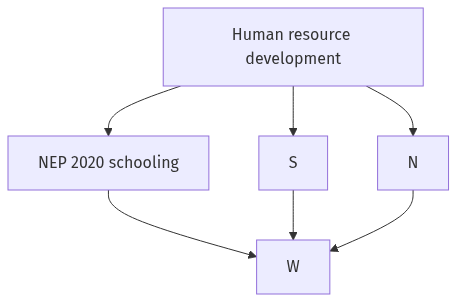
Flow diagram
Conclusion
Inadequate attention to human resource development shows up as weak learning, thin skills, and incomplete health cover. The measures that work are funded NEP 2020 schooling, apprenticeship-linked Skill India and PMKVY, and National Health Mission cadres, judged by outcomes rather than enrolment counts.
Quick related
Students also ask
-
Skill development programs have succeed in increasing human resources supply to various sectors. In the context of the statement analyze the linkages between education, skill and employment.
Next question on this syllabus topic (2023 · Q18). View answer →
-
Is HRD only schooling?
No. It includes skills, health, nutrition, and women’s participation in work. Schooling is the base, not the whole.
-
Does PMKVY by itself solve the skill gap?
Not if certificates are short and unlinked to apprenticeship and employers. Placement and wage are the test.
Same topic · past papers
UPSC has asked this before
These previous-year questions sit on the same topic. Open one to practise the earlier ask.
-
2025 · Q18 · GS II · 15 marks
The National Commission for Protection of Child Rights has to address the challenges faced by children in the digital era. Examine the existing policies and suggest measures the Commission can initiate to tackle the issue. -
2018 · Q17 · GS II · 15 marks
How far do you agree with the view that the focus on lack of availability of food as the main cause of hunger takes the attention away from ineffective human development policies in India? (15). -
2026 · Q5 · GS II · 10 marks
Do constitutional bodies like the National Commission for Scheduled Castes (NCSC) and the National Commission for Scheduled Tribes (NCST) possess adequate enforcement powers to secure substantive social equality? Suggest measures to enhance their institutional effectiveness. -
2026 · Q13 · GS II · 15 marks
How far has the Indian federal framework been successful in accommodating regional and cultural diversities? Highlight the role of asymmetric federalism and suggest measures to make dispute resolution mechanisms more effective. -
2024 · Q13 · GS II · 15 marks
What changes has the Union Government recently introduced in the domain of Centre-State relations? Suggest measures to be adopted to build the trust between the Centre and the States and for strengthening federalism.
More from this topic
Q18 · UPSC Mains 2026 · GS II · 15 marks · Solution
Should education be treated primarily as a welfare obligation of the state or as a strategic investment for building a globally competitive, knowledge-driven nation? Critically evaluate.
Health, Education and Human Resources
Education in India balances a constitutional welfare duty with economic utility. Article 21A
Q7 · UPSC Mains 2026 · GS II · 10 marks · Solution
Malnutrition in India is not merely a public health concern; it is also a challenge of social equity, human development and effective welfare governance. Discuss.
Health, Education and Human Resources
• **Social Inequity:** Malnutrition heavily affects marginalised castes, tribal groups, and low-income households due to deep-rooted social stratification. • **Gender Bias:** Intra-household food discrimination and early motherhood create an intergenerational cycle of undernutrition for women and girls. • **Human Capital Loss:** Early childhood stunting causes irreversible cognitive damage, directly lowering educational outcomes and workforce productivity. • **Demographic Risk:** Without urgent nutritional interventions, India's demographic dividend risks turning into a socioeconomic liability. • **Governance Failures:** Administrative leakages in the Public Distribution System (PDS) and Integrated Child Development Services (ICDS) weaken last-mile delivery. • **Siloed Approach:** Poor coordination among health, sanitation, and rural development departments reduces the effectiveness of welfare schemes. • **Way Forward:** Success requires shifting from basic food security to nutritional justice through POSHAN Abhiyaan convergence and Article 21 rights.
Q17 · UPSC Mains 2024 · GS II · 15 marks · Solution
In a crucial domain like the public healthcare system, the Indian State should play a vital role to contain the adverse impact of marketization of the system. Suggest some measures through which the State can enhance the reach of public healthcare at the grassroots level.
Health, Education and Human Resources
Private-heavy care and out-of-pocket spend are the face of marketization in Indian health. Information asymmetry and cream-skimming make a pure market unsafe for the poor. Grassroots State role: Health and Wellness Centres, ASHA and ANM, district hospitals, public colleges, pooled drugs, ambulances. Insurance purchases care; it does not replace a public provider that sets a price floor. Article 47 and Article 21 emergency-care cases already treat basic health as a State duty. Capex on buildings is not enough; people who stay and drugs that exist are the reach.