
Revision summary
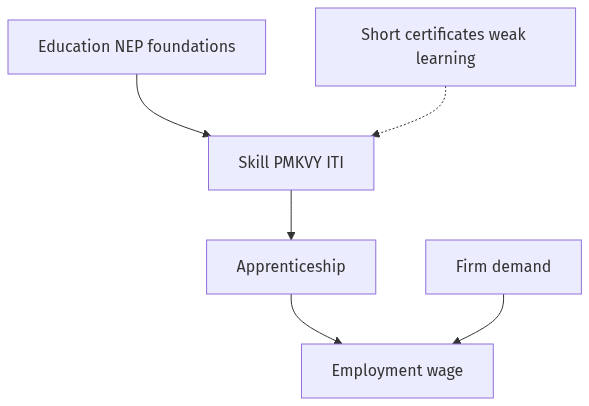
Education, skill and employment are a pipeline, not three separate missions. PMKVY and Skill India increased certified supply in several sectors. NEP 2020 wants vocational exposure inside schooling so skill does not start after dropout. Apprenticeship is the strongest education–skill–job link. Breaks are weak foundations, short courses, informal hiring and weak labour demand. Success should be measured by placement and wage, not by certificates issued.
Model answer
Copper italics in this answer — like this — are the key facts. Each one is unpacked in the Facts & figures rail.
Introduction
Education builds foundations, skill programmes add job-ready tasks, and employment is the demand for those tasks at a wage. India’s missions have increased certified supply; the linkage fails when schooling is weak, certificates are short, and firms do not hire.
Body
The three links
- School and higher education under the National Education Policy, 2020, are supposed to provide literacy, numeracy, and multiple-exit credentials that already include vocational exposure.
- Skill India, the National Skill Development Mission, and the Pradhan Mantri Kaushal Vikas Yojana provide short-term training and Recognition of Prior Learning for those who left school or who need a trade certificate.
- Employment is created by firms, farms, public works, and self-employment; the State can match through apprenticeships, employment exchanges, and public hiring, but it cannot invent private demand by printing certificates.
Where programmes increased supply
- PMKVY and related courses have produced large numbers of trained or certified workers in construction, logistics, beauty, electronics, and healthcare support.
- Industrial Training Institutes, polytechnics, and the National Apprenticeship Promotion Scheme feed manufacturing and services more slowly but with longer workshop hours.
- Sector Skill Councils were meant to write employer-led National Occupational Standards so that a certificate matches a shop-floor role.
Breaks in the chain
- Foundational learning is still weak; a short PMKVY course cannot repair missing Grade 8 mathematics.
- Many certificates are too brief for employable competence; employers retrain or ignore the card.
- Informal enterprises hire on networks, not on National Skills Qualifications Framework levels, so supply does not meet the actual hiring channel.
- Female trainees face safety, hostel, and care constraints, so supply statistics overstate the labour that can take a night or factory shift.
- On the demand side, slow manufacturing employment and capital-intensive growth mean that even a good plumber or fitter may not find a formal contract.
Making the linkage work
- NEP 2020’s integration of vocational education from the school years is the right structural fix: skill should not begin only after dropout.
- Apprenticeship under the Apprentices Act, 1961, with stipend support, is the proven link because the workplace teaches what the classroom cannot.
- Outcome funding — payment to trainers for placement and surviving wage, not for enrolment — aligns Skill India with employment.
- Portable social security and the e-Shram database help informal workers re-enter training without losing identity.
- District industry–ITI–college clusters, rather than parallel missions, close the last-mile match.
Flow diagram
Conclusion
Skill programmes have expanded certified supply, but education, skill and employment link only when foundations, apprenticeship and real vacancies move together. Certificates without NEP-level schooling and without employer demand are a stock of paper, not a labour market.
Quick related
Students also ask
-
The Right of Children to Free and Compulsory Education Act, 2009 remains inadequate in promoting incentive-based system for children's education without generating awareness about the importance of schooling. Analyse.
Next question on this syllabus topic (2022 · Q18). View answer →
-
Has PMKVY solved unemployment?
It increased trained supply. Unemployment also depends on investment, firm demand and matching. Certification is not a job.
-
Why is apprenticeship stressed over a short course?
The workplace supplies machines, quality norms and discipline that a two-month classroom cannot. Stipend plus a job trial is the link to employment.
Same topic · past papers
UPSC has asked this before
These previous-year questions sit on the same topic. Open one to practise the earlier ask.
More from this topic
Q18 · UPSC Mains 2026 · GS II · 15 marks · Solution
Should education be treated primarily as a welfare obligation of the state or as a strategic investment for building a globally competitive, knowledge-driven nation? Critically evaluate.
Health, Education and Human Resources
Education in India balances a constitutional welfare duty with economic utility. Article 21A
Q7 · UPSC Mains 2026 · GS II · 10 marks · Solution
Malnutrition in India is not merely a public health concern; it is also a challenge of social equity, human development and effective welfare governance. Discuss.
Health, Education and Human Resources
• **Social Inequity:** Malnutrition heavily affects marginalised castes, tribal groups, and low-income households due to deep-rooted social stratification. • **Gender Bias:** Intra-household food discrimination and early motherhood create an intergenerational cycle of undernutrition for women and girls. • **Human Capital Loss:** Early childhood stunting causes irreversible cognitive damage, directly lowering educational outcomes and workforce productivity. • **Demographic Risk:** Without urgent nutritional interventions, India's demographic dividend risks turning into a socioeconomic liability. • **Governance Failures:** Administrative leakages in the Public Distribution System (PDS) and Integrated Child Development Services (ICDS) weaken last-mile delivery. • **Siloed Approach:** Poor coordination among health, sanitation, and rural development departments reduces the effectiveness of welfare schemes. • **Way Forward:** Success requires shifting from basic food security to nutritional justice through POSHAN Abhiyaan convergence and Article 21 rights.
Q17 · UPSC Mains 2024 · GS II · 15 marks · Solution
In a crucial domain like the public healthcare system, the Indian State should play a vital role to contain the adverse impact of marketization of the system. Suggest some measures through which the State can enhance the reach of public healthcare at the grassroots level.
Health, Education and Human Resources
Private-heavy care and out-of-pocket spend are the face of marketization in Indian health. Information asymmetry and cream-skimming make a pure market unsafe for the poor. Grassroots State role: Health and Wellness Centres, ASHA and ANM, district hospitals, public colleges, pooled drugs, ambulances. Insurance purchases care; it does not replace a public provider that sets a price floor. Article 47 and Article 21 emergency-care cases already treat basic health as a State duty. Capex on buildings is not enough; people who stay and drugs that exist are the reach.