
Revision summary
SDG-4 is inclusive, equitable quality education and lifelong learning by 2030. NEP 2020 maps onto ECCE, universal schooling, vocational and higher-education flexibility, and a 6 per cent GDP spend goal. Restructuring is 5+3+3+4, board-exam reform, multidisciplinary colleges and a proposed HECI. Equity, language, digital divide and unmet public finance are the critical gaps. Conformity of intent is high; conformity of 2030 outcome was unproven in 2020.
Model answer
Copper italics in this answer — like this — are the key facts. Each one is unpacked in the Facts & figures rail.
Introduction
SDG-4 asks States to ensure inclusive, equitable, quality education and lifelong learning by 2030. NEP 2020 is India’s first full education policy of the twenty-first century and it writes that SDG language into its opening. Conformity is real on paper — 5+3+3+4, ECCE, foundational literacy, multiple pathways. Restructuring will succeed only if States, teachers, and budgets follow, which is the critical part of the examination.
Body
SDG-4 and what conformity means
- Target 4.1: free, equitable, quality primary and secondary completion. NEP’s universalisation to Grade 12 and the Right to Education spirit (with a proposed extension of age) speak to that.
- Target 4.2: quality early childhood. NEP’s 3–6 years in the 5+3+3+4 design and Anganwadi–school linkage is the ECCE match.
- Targets 4.3–4.4: affordable technical, vocational, tertiary, and relevant skills. NEP’s credit banks, academic bank of credits, multidisciplinary colleges, and vocational integration from middle school are the map.
- Target 4.5: gender and vulnerable-group equality; 4.6 adult literacy; 4.7 sustainable development and global citizenship. NEP chapters on equity, adult education, and a ‘light but tight’ regulation claim those spaces.
- Target 4.a–4.c: safe facilities, scholarships, qualified teachers. NEP’s 6 per cent of GDP public spend ambition and teacher professional standards are the resource clause.
How NEP intends to restructure and reorient
- School: foundational literacy and numeracy mission, board-exam reform toward core competencies, mother-tongue where possible in the early years, and exit options that are not a single fail-point.
- Higher education: large multidisciplinary universities, four-year undergraduate with multiple exits, National Research Foundation, and a single-regulator idea (HECI) replacing fragmented UGC/AICTE-era silos.
- Reorientation: from rote and early specialisation toward flexibility, Indian languages, and an ‘Indian-ness’ of curriculum that the Policy names as cultural rootedness plus global skill.
Critical gaps versus SDG-4
- SDG-4 is inclusion-first; NEP’s three-language formula and early English anxiety can, if poorly implemented, worsen equity for first-generation learners even while the text praises multilingualism.
- Digital-intensive delivery, accelerated by COVID-19 in 2020, collides with SDG-4’s equity if connectivity and devices stay uneven — NEP’s technology chapter needs a public device-and-connectivity floor.
- Six per cent of GDP is an old promise (Kothari) still unmet; without it, 5+3+3+4 is a diagram.
- Education is concurrent; States must rewrite curriculum and teacher training. A Union policy is not a 2030 outcome.
- Examination and coaching markets may absorb ‘competency’ language without changing what a Class-12 student actually faces.
- Privatisation and philanthropy windows can help capacity; they can also threaten SDG-4’s free-equitable core if the public school is left as a residual.
Balanced finding
- The statement is largely true as a design claim: NEP 2020 is written to SDG-4’s architecture of lifelong, flexible, quality learning.
- It is not yet true as an outcome claim in 2020: restructuring is a decade of State action, teacher supply, and finance.
- Critical examination therefore accepts conformity of intent and flags the implementation and equity tests that decide 2030.
Flow diagram
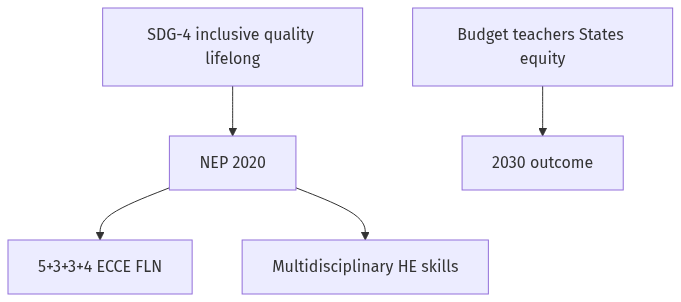
Conclusion
- NEP 2020 is in textual conformity with SDG-4: ECCE, universal secondary, skills, equity language, and lifelong learning. It does intend to restructure stages, regulation, and pedagogy. Whether India meets SDG-4 by 2030 depends on money, teachers, federal uptake, and a digital divide that 2020 already exposed. Policy conformity is the start of reorientation, not the finish.
Quick related
Students also ask
-
Appropriate local community level healthcare intervention is a prerequisite to achieve 'Health for All' in India. Explain.
Next question on this syllabus topic (2018 · Q7). View answer →
-
Does NEP 2020 amend the RTE Act by itself?
No. It is policy. RTE changes need legislation. Conformity with SDG-4 is therefore still a legal and fiscal project.
-
Is vocationalisation at odds with SDG-4?
SDG-4 includes skills for work. The risk is tracking poor children into a low stream; NEP’s text promises multiple exits without a caste of vocational dead-ends.
Same topic · past papers
UPSC has asked this before
These previous-year questions sit on the same topic. Open one to practise the earlier ask.
More from this topic
Q18 · UPSC Mains 2026 · GS II · 15 marks · Solution
Should education be treated primarily as a welfare obligation of the state or as a strategic investment for building a globally competitive, knowledge-driven nation? Critically evaluate.
Health, Education and Human Resources
Education is both a welfare duty and a strategic asset. The state must secure access, equity and foundational learning first, then build skills, universities and research. NEP 2020 tries to combine the two, but it needs higher spending, teacher capacity and accountability for learning outcomes.
Q7 · UPSC Mains 2026 · GS II · 10 marks · Solution
Malnutrition in India is not merely a public health concern; it is also a challenge of social equity, human development and effective welfare governance. Discuss.
Health, Education and Human Resources
• Public health: NFHS-5 shows stunting around 35.5 per cent, wasting 19.3 per cent and high anaemia among women and children. • Equity: malnutrition is higher among Scheduled Tribes, Scheduled Castes, poorer households and backward states. • Gender: early marriage, low food share and weak maternity support create an intergenerational cycle. • WASH link: unsafe water and sanitation cause infections that stop absorption of food. • Human capital: stunted children learn and earn less, reducing the demographic dividend. • Welfare: ICDS, Poshan 2.0, NFSA and PM POSHAN give scale but are cereal-heavy and unevenly delivered. • Governance: leakages, overloaded Anganwadi workers, weak convergence and data gaps limit impact. • Way ahead: first 1000 days, eggs and pulses, WASH convergence, reliable data, social audit.
Q17 · UPSC Mains 2024 · GS II · 15 marks · Solution
In a crucial domain like the public healthcare system, the Indian State should play a vital role to contain the adverse impact of marketization of the system. Suggest some measures through which the State can enhance the reach of public healthcare at the grassroots level.
Health, Education and Human Resources
Private-heavy care and out-of-pocket spend are the face of marketization in Indian health. Information asymmetry and cream-skimming make a pure market unsafe for the poor. Grassroots State role: Health and Wellness Centres, ASHA and ANM, district hospitals, public colleges, pooled drugs, ambulances. Insurance purchases care; it does not replace a public provider that sets a price floor. Article 47 and Article 21 emergency-care cases already treat basic health as a State duty. Capex on buildings is not enough; people who stay and drugs that exist are the reach.