
Revision summary
Russia, China and other powers are already entrenched in Central Asia through security, pipelines and BRI. India’s land path is blocked, so it uses Connect Central Asia, SCO, INSTC and Chabahar. The Ashgabat Agreement is a multimodal transit pact; India acceded in 2018. Accession offers legal corridor access toward Central Asia via Iran, not an instant rival to BRI. Iran sanctions and missing rail-customs links are the tests that will decide if 2018 was a turning point or a paper.
Model answer
Copper italics in this answer — like this — are the key facts. Each one is unpacked in the Facts & figures rail.
Introduction
Central Asia sits on energy, transit and a post-Soviet security board that India cannot ignore. Russia, China, the United States, Turkey and the European energy market have all dug in through bases, pipelines, the Shanghai Cooperation Organisation and the Belt and Road. India’s accession to the Ashgabat Agreement in 2018 is a modest but concrete attempt to enter that board through law of transit, not through a rival military bloc.
Body
Outside powers in a zone of Indian interest
- Russia remains the security first-mover through the Collective Security Treaty Organisation, labour ties, and residual political influence in several capitals.
- China has entrenched itself through BRI roads, pipelines, lending, and the SCO, of which India became a member in 2017; connectivity with Chinese characteristics is already on the ground.
- The United States, after years of Afghanistan logistics, still shapes the region’s security weather; European demand shapes gas politics.
- Turkey, Iran and extra-regional energy firms add further layers. Pakistan sits on India’s land path, which is why New Delhi’s Central Asia policy has to go west by sea and through Iran.
- India’s own tools have been the Connect Central Asia Policy (2012), SCO membership, development partnerships, and the International North–South Transport Corridor (INSTC).
What the Ashgabat Agreement is
- The Ashgabat Agreement is a multimodal transport and transit pact among Oman, Iran, Turkmenistan and Uzbekistan, later joined by Kazakhstan and Pakistan; India deposited its instrument of accession in 2018.
- It aims at a corridor from the Indian Ocean and the Gulf toward Central Asia, using sea, road and rail, rather than a single flagship highway branded as BRI.
- For India it is meant to sit beside Chabahar port in Iran and the INSTC, so that cargo can move from India’s west coast toward Afghanistan and the five Central Asian republics without depending on Pakistani territory.
Implications of joining in 2018
- Legal access: accession is a seat at the transit table; it does not by itself lay a rail, but it reduces the chance that Indian cargo is a guest with no document trail.
- Synergy with Chabahar and INSTC: Ashgabat’s Iran–Turkmenistan–Uzbekistan leg can feed the same Iranian gateway that India has been building at Chabahar, which is India’s answer to a blocked land border.
- Strategic balance, not a match for BRI volume: India cannot outspend China in the region; it can offer an alternative rule-set for transit and a link to Iranian ports that some Central Asian states want as a hedge.
- Energy and trade: better transit is a precondition for uranium, oil, gas and farm trade, and for TAPI-like ideas that have stayed on paper for want of security and rights of way.
- Timing with Iran sanctions: in 2018 the United States left the JCPOA and tightened Iran sanctions, which immediately tests Chabahar and any Iran-centred corridor; joining Ashgabat is therefore also a diplomatic bet that the corridor will survive great-power energy conflict.
- Pakistan’s presence in the same agreement is a reminder that the pact is about corridors, not about a clean geopolitical club; India still needs Iran and the sea.
Way forward
- Finish Chabahar operational links, harmonise customs with INSTC, and run scheduled Indian cargo so the Agreement is a timetable, not a communiqué.
- Use SCO and bilateral energy talks with Kazakhstan, Uzbekistan and Turkmenistan to fill the corridor with actual freight.
- Keep a sanctions-aware Iran policy so the 2018 accession does not become a stranded legal asset.
Flow diagram
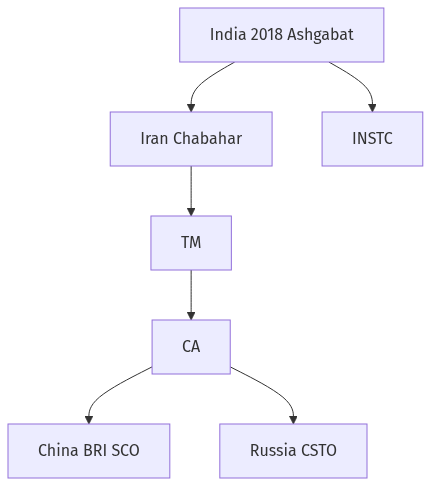
Conclusion
Outside powers are already dug into Central Asia; India’s interest is connectivity and energy without a Pakistani land gate. Joining the Ashgabat Agreement in 2018 gives India a transit-law foothold that can join Chabahar and INSTC. The implication is opportunity plus homework: the paper corridor will matter only if ships, rails and Iran policy keep moving.
Quick related
Students also ask
-
Indian and USA are two large democracies. Examine the basic tenets on which the two political systems are based. (15).
Next question on this syllabus topic (2018 · Q13). View answer →
-
Does joining Ashgabat give India a land route through Pakistan?
The Agreement is about agreed transit among members, not about opening the India–Pakistan political border. India’s practical path remains sea-plus-Iran.
-
Is Ashgabat a military alliance against China?
No. It is a transport pact. The strategic implication is a thinner alternative corridor, not a CSTO- or NATO-style bloc.
Same topic · past papers
UPSC has asked this before
These previous-year questions sit on the same topic. Open one to practise the earlier ask.
More from this topic
Q15 · UPSC Mains 2026 · GS II · 15 marks · Solution
To what extent do pressure groups, social movements and corporate lobbies deepen pluralistic democracy in India by representing excluded interests? Analyse whether the growing convergence of corporate wealth and political power poses a threat to the autonomy of formal democratic institutions.
Governance and Policy
• Pluralism needs many competing groups so that no single interest dominates policy • Trade unions, farmer bodies and movements such as Chipko and Narmada Bachao Andolan have brought excluded voices into public debate • Movements delivered RTI, Forest Rights and Lokpal laws that give citizens lasting tools • Weak resources and FCRA and protest restrictions limit civil society reach • Corporate influence runs through party funding, lobbying, regulators and media ownership • The electoral bonds scheme was struck down in 2024 for violating citizens' right to information • Institutions such as the Supreme Court, CAG and the Election Commission still check capture, but risks remain • Reforms include funding transparency, a lobbying law, cooling-off periods and protection of dissent
Q12 · UPSC Mains 2026 · GS II · 15 marks · Solution
What is meant by judicial legislation? In this context, discuss the verdicts of the apex court allowing "passive euthanasia" and a "living will".
Governance and Policy
• Judicial legislation is court-made law that fills a legislative vacuum, using Articles 32, 141 and 142 • Vishaka, Prakash Singh and NALSA are common examples, and each invited later legislation • Gian Kaur (1996) denied a right to die but spoke of dying with dignity when death is imminent • Aruna Shanbaug (2011) permitted passive euthanasia with High Court supervision • Common Cause (2018) held the right to die with dignity to be part of Article 21 and recognised living wills • The 2023 modification simplified attestation, board composition and timelines • The tension is between dignity under Article 21 and the legislature's domain on a sensitive moral issue • A national statute on terminal illness would replace interim court guidelines
Q6 · UPSC Mains 2026 · GS II · 10 marks · Solution
Does India's tribal development policy reflect the aspirations for a socially grounded and equity-based governance? Justify your answer.
Governance and Policy
• Constitution: Fifth and Sixth Schedules create tribal self-rule, with Tribes Advisory Councils and autonomous district councils. • Law: PESA 1996 makes the Gram Sabha central and FRA 2006 recognises individual and community forest rights. • Welfare: DAPST, Article 275(1) grants, Eklavya schools, PM JANMAN and the sickle cell mission target the gap. • Weakness: mining, dams and forest clearance rules often override Gram Sabha consent. • Weakness: delayed PESA rules, FRA claim rejections and diverted funds blunt equity. • Security: LWE districts show the cost of land alienation and weak service delivery. • Verdict: strong legal design, uneven delivery, so equity is partial and conditional. • Way ahead: enforce consent, social audit, benefit-sharing through District Mineral Foundations.