
Revision summary
The party system moved from Congress dominance to coalitions and then to a new national majority, without erasing State-level regional parties. Presidential campaign style collides with parliamentary collective responsibility. The Tenth and 91st Amendments curb defection and cabinet size but strengthen high commands. National and state party labels under the Symbols Order do not match the mixed federal reality. The transition is therefore full of legal and political paradoxes, not a clean model change.
Model answer
Copper italics in this answer — like this — are the key facts. Each one is unpacked in the Facts & figures rail.
Introduction
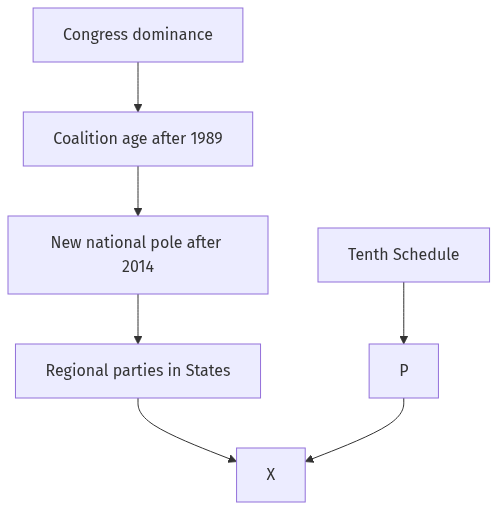
India’s party system has moved from one-party Congress dominance after 1952, through a long coalition age after 1989, to a new national pole after 2014, while regional parties, the Tenth Schedule, and internal party autocracy all remain. The transition is real; so are the contradictions, because parliamentary rules, federal society, and presidential-style campaigns do not move in one line.
Body
The transition
- The first two decades after the Constitution were a Congress system in Rajni Kothari’s sense: a dominant party with factions, not a rigid two-party model.
- 1967, 1977 and 1989 broke that monopoly; hung Houses, National Front and United Front experiments, and then NDA and UPA coalitions made coalition federalism the working form of Article 75 government.
- 2014 and 2019 produced a single-party majority in the Lok Sabha again, yet regional parties still decide many State Assemblies and several Rajya Sabha arithmetic problems, so the system is not a simple return to 1952.
- The Election Commission’s recognition rules under the Election Symbols (Reservation and Allotment) Order, 1968, and the Representation of the People Act, 1951, still sort “national” and “state” parties by vote and seat tests that lag behind political reality.
Contradictions and paradoxes
- Parliamentary government needs collective responsibility and a working majority; campaigns have become leader-centred and presidential in style, which sits oddly with Articles 75 and 164.
- The Tenth Schedule, added by the 52nd Amendment, 1985, and tightened by the 91st Amendment, 2003, punishes defection but also freezes dissent inside the legislature, so party bosses gain while inner-party democracy stays weak.
- Anti-defection does not regulate the high command’s power to issue a whip on every ordinary vote, which turns MPs into numbers rather than representatives, even as voters are told they chose a person.
- Regional parties demand federal autonomy in the States and then bargain for Union ministries in Delhi; they are both defenders of State rights and players in central coalition rent.
- A national party can dominate the Lok Sabha and still lose a string of States, which is a federal paradox, not a failure of the Election Commission.
- Social cleavage parties (caste, region, language) coexist with a catch-all national appeal on development and security; the same voter may split a Lok Sabha choice from an Assembly choice.
- The 91st Amendment capped Council of Ministers at 15 per cent of the House, which cut oversized coalition cabinets, but it did not end the use of extra-constitutional posts, parliamentary secretaries, or outside props to reward allies.
- Inner-party elections under the Election Commission’s guidelines and under Section 29A registration are often formal; dynastic succession in several parties contradicts the language of political equality in the Preamble.
What the paradoxes mean
- The system is transitional because no stable two-party Westminster pattern has arrived, and because federal society keeps producing State-level systems that do not mirror the national result.
- Law can police symbols, splits and minister numbers; it cannot by itself create programmatic parties. That gap is the deepest paradox of the Indian party system.
Flow diagram
Conclusion
India is leaving a long coalition interval without becoming a classic two-party system. Majority at the Centre, regional strength in the States, anti-defection without inner democracy, and presidential campaigns inside a parliamentary Constitution are the live contradictions. The transition will look paradoxical until parties themselves become more internally democratic and more programmatically federal.
Quick related
Students also ask
-
Discuss each adjective attached to the word 'Republic' in the 'Preamble'. Are they defendable in the present circumstances?
Next question on this syllabus topic (2016 · Q5). View answer →
-
Did 2014 end the coalition era in the States as well?
No. A Lok Sabha majority can coexist with coalition or opposition governments in many States. That split is the federal paradox in the question.
-
Does the Tenth Schedule create inner-party democracy?
No. It punishes legislators who leave or defy the party. It does not force parties to hold real internal elections or to limit the whip to confidence and money bills.
Same topic · past papers
UPSC has asked this before
These previous-year questions sit on the same topic. Open one to practise the earlier ask.
More from this topic
Q15 · UPSC Mains 2026 · GS II · 15 marks · Solution
To what extent do pressure groups, social movements and corporate lobbies deepen pluralistic democracy in India by representing excluded interests? Analyse whether the growing convergence of corporate wealth and political power poses a threat to the autonomy of formal democratic institutions.
Governance and Policy
• Pluralism needs many competing groups so that no single interest dominates policy • Trade unions, farmer bodies and movements such as Chipko and Narmada Bachao Andolan have brought excluded voices into public debate • Movements delivered RTI, Forest Rights and Lokpal laws that give citizens lasting tools • Weak resources and FCRA and protest restrictions limit civil society reach • Corporate influence runs through party funding, lobbying, regulators and media ownership • The electoral bonds scheme was struck down in 2024 for violating citizens' right to information • Institutions such as the Supreme Court, CAG and the Election Commission still check capture, but risks remain • Reforms include funding transparency, a lobbying law, cooling-off periods and protection of dissent
Q12 · UPSC Mains 2026 · GS II · 15 marks · Solution
What is meant by judicial legislation? In this context, discuss the verdicts of the apex court allowing "passive euthanasia" and a "living will".
Governance and Policy
• Judicial legislation is court-made law that fills a legislative vacuum, using Articles 32, 141 and 142 • Vishaka, Prakash Singh and NALSA are common examples, and each invited later legislation • Gian Kaur (1996) denied a right to die but spoke of dying with dignity when death is imminent • Aruna Shanbaug (2011) permitted passive euthanasia with High Court supervision • Common Cause (2018) held the right to die with dignity to be part of Article 21 and recognised living wills • The 2023 modification simplified attestation, board composition and timelines • The tension is between dignity under Article 21 and the legislature's domain on a sensitive moral issue • A national statute on terminal illness would replace interim court guidelines
Q6 · UPSC Mains 2026 · GS II · 10 marks · Solution
Does India's tribal development policy reflect the aspirations for a socially grounded and equity-based governance? Justify your answer.
Governance and Policy
• Constitution: Fifth and Sixth Schedules create tribal self-rule, with Tribes Advisory Councils and autonomous district councils. • Law: PESA 1996 makes the Gram Sabha central and FRA 2006 recognises individual and community forest rights. • Welfare: DAPST, Article 275(1) grants, Eklavya schools, PM JANMAN and the sickle cell mission target the gap. • Weakness: mining, dams and forest clearance rules often override Gram Sabha consent. • Weakness: delayed PESA rules, FRA claim rejections and diverted funds blunt equity. • Security: LWE districts show the cost of land alienation and weak service delivery. • Verdict: strong legal design, uneven delivery, so equity is partial and conditional. • Way ahead: enforce consent, social audit, benefit-sharing through District Mineral Foundations.