
Revision summary
The Preamble’s adjectives of the Republic are Sovereign, Socialist, Secular and Democratic. Sovereign remains sound despite treaties, because Article 368 and domestic law stay Indian. Socialist, added by the 42nd Amendment, is defendable as welfare and equality, not as a closed economy. Secularism is basic structure after Bommai, and is tested by equal enforcement of Articles 14, 15 and 25. Democratic form survives through elections and responsible government, even when money and criminality weaken its quality.
Model answer
Copper italics in this answer — like this — are the key facts. Each one is unpacked in the Facts & figures rail.
Introduction
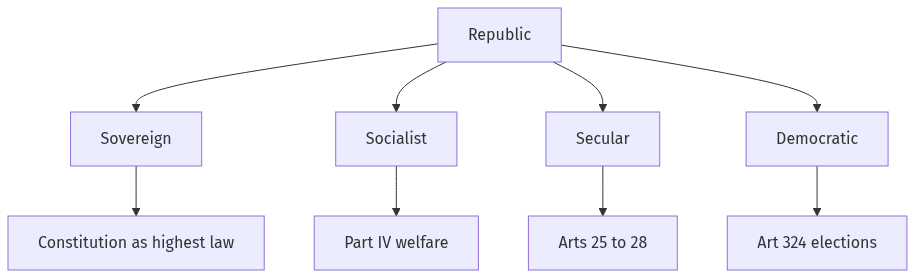
The Preamble describes India as a Sovereign Socialist Secular Democratic Republic. Those four adjectives qualify the Republic: the head of State is not a monarch, and the Republic is meant to be independent, socially just, religiously even-handed, and based on popular mandate. Each word is still defendable in law, even where daily practice is imperfect.
Body
Sovereign
- Sovereignty means the Republic is not a colony or a dominion; the Constitution is the highest law, and external affairs sit with the Union under Article 246 and the Union List.
- Membership of the United Nations, the WTO, and treaty regimes under Article 253 does not surrender the power to make or unmake those commitments; it is pooled sovereignty by consent.
- Present stresses — cross-border terrorism, economic interdependence, and extra-territorial data or tax disputes — test capacity, not the legal fact of sovereignty.
- The adjective remains defendable because no external authority can repeal an Indian statute or an amendment under Article 368.
Socialist
- “Socialist” was inserted by the Constitution (Forty-second Amendment) Act, 1976, and read with the Directive Principles in Part IV, especially Articles 38, 39 and 43.
- It does not mean a command economy. After 1991 liberalisation, the Supreme Court in cases such as Excel Wear and later economic judgments treated socialism as a commitment to reduce inequality and to keep a welfare floor, not as a ban on private industry.
- MGNREGA under the Mahatma Gandhi National Rural Employment Guarantee Act, 2005, the National Food Security Act, 2013, and rights-based schemes show a welfare Republic, even as markets allocate most capital.
- The adjective is defendable if socialism is read as social and economic justice, not as 1970s licence raj; it is weaker if judged as public ownership of the means of production.
Secular
- “Secular” was also inserted by the 42nd Amendment, but the Court in Kesavananda Bharati and S.R. Bommai had already treated secularism as part of basic structure, based on Articles 25 to 28 and the equality clauses.
- Indian secularism is equal respect and reform of religion, not a wall that ignores faith; personal laws, minority educational rights under Article 30, and the Uniform Civil Code direction in Article 44 live in tension.
- Present controversies over hate speech, place-of-worship politics, and selective enforcement test the adjective hard.
- It remains defendable in the constitutional text and in Bommai’s dismissal-on-secularism logic; it is only as strong as equal application of Articles 14, 15, 21 and 25 by governments and courts.
Democratic
- Democracy here is representative: adult suffrage, periodic elections under Article 324, and responsible government under Articles 75 and 164.
- The Representation of the People Act, 1951, the 73rd and 74th Amendments, and the Right to Information Act, 2005, thicken democracy beyond a five-year vote.
- Present stresses include money power, criminal candidates, delayed local elections, and pressure on dissent; they injure quality, they do not repeal the democratic form.
- The adjective is defendable because governments still fall on the floor of the House and on the ballot, which is the minimum meaning of a democratic Republic.
Taken together
- A Republic without those adjectives would still have an elected President under Articles 52 to 62 instead of a hereditary king; the adjectives tell us what kind of Republic the Preamble wants.
- They are defendable as constitutional promises and as basic-structure values. They are not self-executing slogans, and present circumstances require statute, scheme and court to keep them honest.
Flow diagram
Conclusion
Sovereign, Socialist, Secular and Democratic still describe the Indian Republic in the Preamble and in basic-structure doctrine. Sovereignty and the democratic form are the easiest to defend in present law. Socialist and secular content is defendable as justice and equal citizenship, and is strained wherever inequality or unequal religious treatment becomes official practice.
Quick related
Students also ask
-
What is quasi judicial body? Explain with the help of concrete examples.
Next question on this syllabus topic (2016 · Q8). View answer →
-
Is the President the only meaning of ‘Republic’ here?
Republic means an elected head of State, not a monarch. The question asks about the adjectives attached to that Republic: Sovereign, Socialist, Secular and Democratic.
-
Did 1991 reforms repeal ‘Socialist’ in the Preamble?
No. The word remains. Courts and governments now read it as social justice and a welfare floor, not as a ban on private enterprise.
Same topic · past papers
UPSC has asked this before
These previous-year questions sit on the same topic. Open one to practise the earlier ask.
-
2018 · Q3 · GS II · 10 marks
Under what circumstances can the Financial Emergency be proclaimed by the President of India? What consequences follow when such a declaration remains in force? -
2024 · Q10 · GS II · 10 marks
Critically analyse India's evolving diplomatic, economic and strategic relations with the Central Asian Republics (CARs) highlighting their increasing significance in regional and global geopolitics.
More from this topic
Q15 · UPSC Mains 2026 · GS II · 15 marks · Solution
To what extent do pressure groups, social movements and corporate lobbies deepen pluralistic democracy in India by representing excluded interests? Analyse whether the growing convergence of corporate wealth and political power poses a threat to the autonomy of formal democratic institutions.
Governance and Policy
• Pluralism needs many competing groups so that no single interest dominates policy • Trade unions, farmer bodies and movements such as Chipko and Narmada Bachao Andolan have brought excluded voices into public debate • Movements delivered RTI, Forest Rights and Lokpal laws that give citizens lasting tools • Weak resources and FCRA and protest restrictions limit civil society reach • Corporate influence runs through party funding, lobbying, regulators and media ownership • The electoral bonds scheme was struck down in 2024 for violating citizens' right to information • Institutions such as the Supreme Court, CAG and the Election Commission still check capture, but risks remain • Reforms include funding transparency, a lobbying law, cooling-off periods and protection of dissent
Q12 · UPSC Mains 2026 · GS II · 15 marks · Solution
What is meant by judicial legislation? In this context, discuss the verdicts of the apex court allowing "passive euthanasia" and a "living will".
Governance and Policy
• Judicial legislation is court-made law that fills a legislative vacuum, using Articles 32, 141 and 142 • Vishaka, Prakash Singh and NALSA are common examples, and each invited later legislation • Gian Kaur (1996) denied a right to die but spoke of dying with dignity when death is imminent • Aruna Shanbaug (2011) permitted passive euthanasia with High Court supervision • Common Cause (2018) held the right to die with dignity to be part of Article 21 and recognised living wills • The 2023 modification simplified attestation, board composition and timelines • The tension is between dignity under Article 21 and the legislature's domain on a sensitive moral issue • A national statute on terminal illness would replace interim court guidelines
Q6 · UPSC Mains 2026 · GS II · 10 marks · Solution
Does India's tribal development policy reflect the aspirations for a socially grounded and equity-based governance? Justify your answer.
Governance and Policy
• Constitution: Fifth and Sixth Schedules create tribal self-rule, with Tribes Advisory Councils and autonomous district councils. • Law: PESA 1996 makes the Gram Sabha central and FRA 2006 recognises individual and community forest rights. • Welfare: DAPST, Article 275(1) grants, Eklavya schools, PM JANMAN and the sickle cell mission target the gap. • Weakness: mining, dams and forest clearance rules often override Gram Sabha consent. • Weakness: delayed PESA rules, FRA claim rejections and diverted funds blunt equity. • Security: LWE districts show the cost of land alienation and weak service delivery. • Verdict: strong legal design, uneven delivery, so equity is partial and conditional. • Way ahead: enforce consent, social audit, benefit-sharing through District Mineral Foundations.