
Revision summary
Britain took India into World War II without Congress consent, and the provincial ministries resigned. The Cripps Mission of 1942 offered post-war status without a real wartime national government. The AICC in Bombay on 8 August 1942 launched Quit India, and leaders were jailed the next day. Mass action, sabotage and local parallel governments followed, and then heavy repression followed those actions. The Muslim League gained organisational space, and the government’s claim to quiet rule did not recover. Independence in 1947 had many causes. 1942 was the mass proof that delay had a political price.
Model answer
Copper italics in this answer — like this — are the key facts. Each one is unpacked in the Facts & figures rail.
Introduction
Quit India did not begin without warning in August 1942. It was the Congress answer to a world war that had taken India in without consent, to the failure of the Cripps Mission, and to Gandhi’s view that British power would not bargain while it still felt secure. The results were mixed in the short run and large in the long run. The government crushed open protest, but it could no longer claim that India was a quiet colony.
Body
Events that led to August 1942
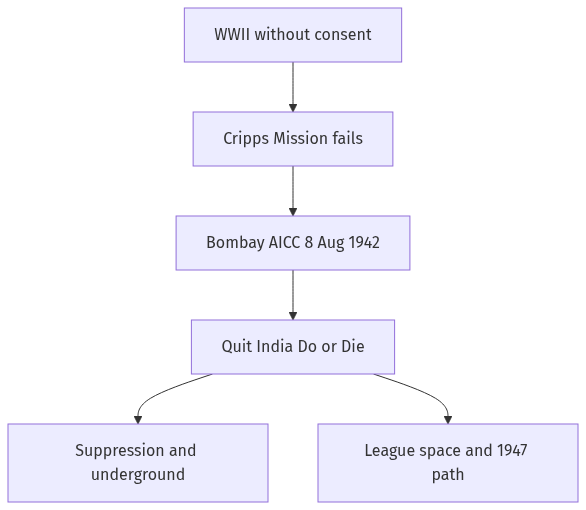
Britain declared India’s war in 1939 without the provincial Congress ministries. Those ministries resigned. The Individual Satyagraha of 1940–41 tested civil liberty. It was not yet a mass revolt. The Atlantic Charter spoke of freedom, but the empire did not apply that promise fully to India. After Pearl Harbor, Japan advanced to Burma. Fear of invasion led London to send Stafford Cripps in March 1942. Cripps offered a post-war dominion-style constitution and a right of provinces to opt out. He refused a responsible national government in wartime. Congress rejected the offer as a post-dated cheque. Gandhi’s articles and the Wardha working-committee line then moved to a demand that the British leave India. The AICC at Bombay on 8 August 1942 passed the Quit India resolution. Gandhi’s phrase “Do or Die” named the mood. Leaders were arrested on 9 August. The movement that followed was therefore both a planned call and a rising that soon lost its top leaders.
- War without consent: The events of 1939 and the collapse of provincial office taught Congress that the Raj would not share power in a crisis.
- Cripps failure: There was no immediate national cabinet. The secession clause also killed negotiation.
- Military fear: Japan at the border made delay look like a British use of Indian soldiers and resources, not a partnership.
Results
In the weeks after the arrests, students, peasants and workers struck. Rails were cut. Parallel governments appeared in places such as Ballia, Tamluk (Midnapore) and Satara (Prati Sarkar). The government used lathi, shooting and jail on a scale that broke open revolt by 1943. Congress was banned. The Muslim League expanded its organisation in that vacuum. Gandhi was in detention. Talks with Jinnah later failed. War inflation and the Bengal famine of 1943 stood beside the political crackdown. The famine had more causes than Quit India.
- Short run: There was heavy suppression. Thousands were jailed. The Congress High Command was off the field.
- Political map: The League grew. Communal arithmetic toward Partition became harder.
- Long run: Britain’s moral claim was weaker. After the war, the INA trials, the RIN ratings, and Labour’s exhaustion made exit thinkable. 1947 was not caused by 1942 alone. 1942 did show that India could not be held by police forever.
Quit India failed as an immediate seizure of power. It succeeded as a national refusal that the empire never fully recovered from.
Flow diagram
Conclusion
Cripps’s empty wartime offer, a war declared without Indian consent, and Gandhi’s call produced Quit India. The government put down the streets in 1942. It lost the claim that India was a loyal barracks. Independence still needed the post-war crisis. Public life did not return to the quiet that had existed before 1942.
Quick related
Students also ask
-
What was the difference between Mahatma Gandhi and Rabindranath Tagore in their approach towards education and nationalism?
Next question on this syllabus topic (2023 · Q2). View answer →
-
Was Quit India a success?
It did not throw the British out in 1942. It showed that mass India would not wait politely, which mattered after the war.
-
Why did the Muslim League gain?
Congress leaders were in jail and the organisation was banned, while the League remained legal and grew in the provinces.
Same topic · past papers
UPSC has asked this before
These previous-year questions sit on the same topic. Open one to practise the earlier ask.
-
2025 · Q10 · GS I · 10 marks
Do you think that globalization results in only an aggressive consumer culture? Justify your answer.
More from this topic
Q3 · UPSC Mains 2026 · GS I · 10 marks · Solution
The significance of the Gandhian movements lay in the masses they mobilized. Elucidate.
The Freedom Struggle
• Shifted the national movement from elite-led constitutionalism to grassroots mass mobilization. • Integrated peasants and rural populations through indigenous symbols like khadi and the charkha. • Engaged women extensively in direct actions such as salt law violations and liquor shop picketing. • Linked the anti-imperialist struggle with social reform, focusing on the upliftment of marginalized classes. • Transformed ordinary Indians from passive colonial subjects into active, politically conscious citizens. • Laid the foundational socio-political bedrock for a resilient and inclusive post-independence democracy.
Q12 · UPSC Mains 2025 · GS I · 15 marks · Solution
Trace India's consolidation process during early phase of independence in terms of polity, economy, education and international relations.
The Freedom Struggle
Princely integration and the 1950 Constitution, with the first general election, built the political union. The Planning Commission and the First Plan set a mixed, public-investment economy after Partition's economic cut. Radhakrishnan and Mudaliar commissions and IIT Kharagpur began a national education architecture. Non-alignment, Panchsheel and Bandung defined an independent foreign policy while Kashmir stayed live. Consolidation was simultaneous on all four fronts. Land, food and literacy remained unfinished, so the process was real and incomplete.
Q2 · UPSC Mains 2023 · GS I · 10 marks · Solution
What was the difference between Mahatma Gandhi and Rabindranath Tagore in their approach towards education and nationalism?
The Freedom Struggle
Gandhi’s Wardha scheme of 1937 put mother tongue, craft, and character at the centre of schooling. Tagore’s Santiniketan and Visva-Bharati put nature, art, and world learning at the centre. Gandhi’s nationalism was mass satyagraha and village swaraj. Tagore’s nationalism was freedom without the cult of the nation. Both opposed colonial rule; they split on industrial civilisation and on how open India should stay.