
Revision summary
The Chandellas built Khajuraho as a Nagara temple city in Bundelkhand. High-relief sandstone figures of gods, dancers, animals and ordinary work give the walls movement. Mithuna couples are one auspicious register, not the whole meaning of the site. Kandariya Mahadeva and the Jain group share the same workshop vigour. The quote is right when the temple is read as a populated cosmos, not as a single theme. Trade and agrarian surplus on the plateau paid for that sculptural boom.
Model answer
Copper italics in this answer — like this — are the key facts. Each one is unpacked in the Facts & figures rail.
Introduction
The Chandellas of Bundelkhand, between the ninth and thirteenth centuries, built a temple city at Khajuraho. Their sandstone still looks as if it might move. The quote is fair. Sculptors filled the walls with bodies at work and at play, which is vigour. They also showed a whole social world, which is breadth of life.
Body
Vigour on the Nagara wall
- Bundelkhand setting: The Chandella court sat on a plateau between the Ganga plains and Deccan roads.
- Khajuraho cluster: A Nagara temple city rose with mountains of shikharas in high sandstone relief.
- Living flesh: Belts, jewellery, and turned heads make figures look restless rather than stiff.
- Gods and courts: Vishnu, Shiva, and their attendants share cornices with musicians and dancers.
- Animals in motion: Elephants and horses give weight and movement to the same wall.
- Mithuna band: Couples mark auspicious plenty in a tantric vocabulary, not the whole meaning of the site.
- Daily work: Potters, soldiers, teachers, and letter-writers place the bazaar on the sacred mountain.
- Deep cut stone: Regional sandstone takes fine drilling, so drapery can look almost like lace.
- Kandariya Mahadeva: The largest Shiva temple is the Hindu peak of this workshop vigour.
- Lakshmana and Chaturbhuj: Other Hindu temples share the same restless chisel language.
- Jain group: Parshvanatha and Adinatha use the same flesh and motion for tirthankara iconography.
Breadth of life and how to read the quote
- Trade surplus: Agrarian and trade wealth paid for competing temple workshops.
- Shilpa canon: Sculptors worked inside shared rules but kept narrative overflow on the wall.
- Hunt and dance: Multi-frame stories stop the wall from becoming a stiff frontal row.
- Not only sex: Reading Khajuraho as erotic temples alone misses most panels.
- Not only theology: Reading only gods misses workers, animals, and social breadth.
- Populated cosmos: Gods have hips, animals have weight, and ordinary people belong on the mountain.
- Exam elucidation: Resilient vigour is living body in stone; breadth of life is the full social world on that stone.
Flow diagram
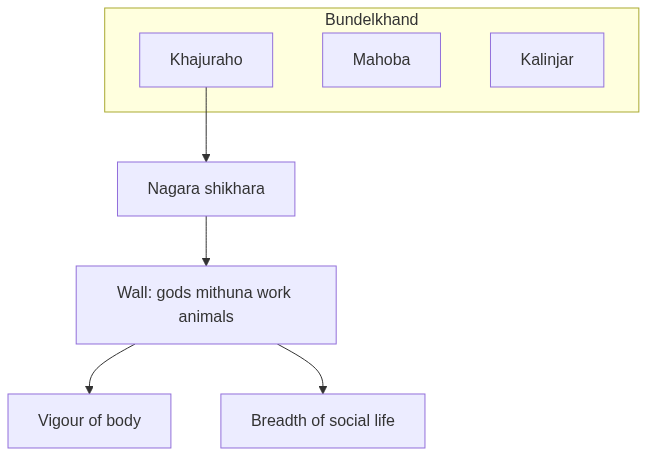
Conclusion
Chandella sculptors at Khajuraho packed Nagara walls with gods, animals, workers, and mithuna. The sandstone looks alive, which is resilient vigour. The breadth of life is the whole social world climbing the same sacred mountain.
Quick related
Students also ask
-
How does smart city in India, address the issues of urban poverty and distributive justice?
Next question on this syllabus topic (2025 · Q8). View answer →
-
Are Khajuraho temples only about erotic art?
No. Erotic mithuna is a band on some walls. Most panels are gods, attendants, animals and daily life.
-
Did Jain patrons use a different style?
The iconography changes. The chisel and the sense of living flesh stay Chandella.
More from this topic
Q11 · UPSC Mains 2026 · GS I · 15 marks · Solution
Vijayanagara architecture exemplifies the amalgamation of past traditions with contemporary practices. Elucidate with examples.
Indian Heritage and Culture
• The Vijayanagara architectural style (14th–17th centuries) brilliantly synthesized classical Dravidian traditions with contemporary Deccan innovations. • It preserved grand spatial layouts, towering gopurams, and enclosed prakaras inspired by earlier Chola and Pandya idioms. • Sacred centers maintained canonical sanctum alignments while expanding peripheral structures to encourage greater public participation. • Secular buildings, such as the Lotus Mahal and Elephant Stables, integrated Islamic arched vaults and domes. • Builders utilized locally available hard granite, shifting ornamentation techniques toward bold, deep-relief stone carving. • Innovative structural typologies included multi-shafted composite pillars featuring rearing yalis, horse riders, and hanging brackets. • The Vittalaswami Temple at Hampi showcased pioneering acoustic engineering through famous resonant musical pillars.
Q1 · UPSC Mains 2026 · GS I · 10 marks · Solution
Analyze the importance of Ashokan inscriptions for reconstructing Mauryan history.
Indian Heritage and Culture
Ashokan inscriptions serve as the bedrock for reconstructing Mauryan history by offering authentic, contemporaneous evidence directly from the emperor. Written primarily in Brahmi, Kharosthi, Aramaic, and Greek scripts, they illuminate Ashoka's administrative reach, socio-religious policies, and the moral framework of Dhamma. Distributed across the Indian subcontinent and beyond, these edicts document spatial boundaries, diplomatic ties with Hellenistic kingdoms, and the socio-economic milieu. They bridge the gap between literary accounts and archaeological finds, providing an invaluable indigenous chronology.
Q15 · UPSC Mains 2025 · GS I · 15 marks · Solution
How can Artificial Intelligence (AI) and drones be effectively used along with GIS and RS techniques in locational and areal planning?
Indian Heritage and Culture
Remote sensing supplies pictures of land and water; GIS stores them with administrative boundaries. Drones add cheap, repeatable local maps for disasters, utilities and village layouts. Artificial intelligence classifies pixels and can forecast flood, heat or sprawl on that GIS base. Indian platforms such as Bhuvan and Gati Shakti already try to combine these tools. Planning still needs ground checks and a public purpose, or the map only watches the poor. The four tools are a chain: locate, refresh, read, then choose the public use.