
Revision summary
The Constitution envisages special provision in education, jobs, legislatures, and local bodies for historically excluded groups. Indra Sawhney, Mandal, panchayat reservations, and the PoA Act thickened that design. Public employment shrank and contractualised, so the classic quota ladder lost rungs. Private and gig work, intra-group capture, and weak atrocity enforcement block full benefit. ST exclusion is also land and language, not only a roster in the secretariat. The comment is unfinished implementation. It is not an absence of policy on paper.
Model answer
Copper italics in this answer — like this — are the key facts. Each one is unpacked in the Facts & figures rail.
Introduction
The Indian Constitution allows special provision for historically excluded groups in education, public employment, and local bodies. It did not stop at the formal equality of Article 14. It added 15(4), 16(4), 16(4A), and 46, reservations in legislatures and panchayats, and watchdog bodies under 338 and 338A. Policies then multiplied: scholarships, hostels, the PoA Act, OBC reservation after Mandal, and later EWS. Scheduled Castes, Scheduled Tribes, many OBCs, women at the intersection, and persons with disabilities still meet empty posts, captured benefits, and a private sector that the quota does not enter. The comment is about implementation and power. It is not about a missing preamble.
Body
What was envisaged
Affirmative action was meant to repair historic exclusion in education, jobs, and voice, and to give social justice a Directive principle with legal teeth. Indra Sawhney upheld OBC reservation and the creamy layer idea for OBCs, trying to aim the tool. Panchayat reservations were meant to create a local elite of the excluded. The Scheduled Castes and Scheduled Tribes (Prevention of Atrocities) Act, 1989 was meant to make the right to dignity justiciable. On paper the architecture is among the world’s most elaborate.
- Representation: The design covers legislatures, services, and local bodies.
- Capability: Education and scholarships were meant to build skill.
- Dignity: Criminal law against caste atrocity was meant to protect honour and safety.
Why benefits do not fully arrive
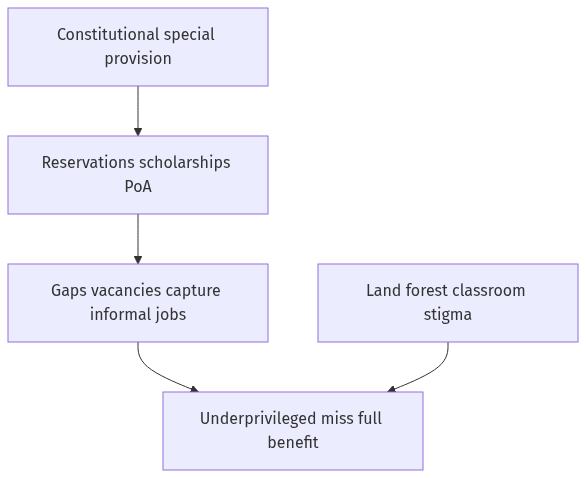
Vacancies in reserved posts, contractualisation of government work, and the shrinkage of public employment mean the classic 16(4) ladder has fewer rungs. The private sector and gig work, where new jobs are, remain largely outside reservation. Creamy layer and intra-group inequality, which the Rohini exercise on OBC sub-categorisation points to, let the relatively better-off among the listed classes take the seat. ST communities face land alienation and a school that does not speak their language. A roster in a distant secretariat does not restore the forest. Women of these groups meet a double bind. Reservation for women may go to dominant-caste women unless designed with intersection.
Leakage and stigma persist. Fake certificates, poor hostels, discrimination in classrooms, and delayed scholarships remain common. Poor targeting of schemes, digital exclusion, and frontline bias reproduce the old queue. Judicial and political backlash cycles create uncertainty. EWS added a new claimant class without automatically deepening SC and ST reach.
- Job structure: There are fewer stable public posts. There is no general private-sector quota.
- Capture: Heterogeneity inside SC, ST, and OBC lists allows uneven benefit.
- Social veto: Atrocity, segregation, and marriage bans continue. No roster dissolves them.
Comment
The Constitution’s promise is not a failure of vision. It is a partial delivery. Affirmative action works where the state still hires, where schools function, and where a local movement watches the roster. It fails where the economy informalised, where land and forest rights were not secured, and where prejudice treats a reserved candidate as lesser. Comprehensive policy without budget, data, sub-quotas where just, and a labour market that is not only private privilege will always undershoot. The honest comment is unfinished justice. It is not a reason to scrap the tool.
Flow diagram
Conclusion
Affirmative action is written deep in the Constitution. Underprivileged citizens still miss its full benefit because jobs moved out of public employment, benefits were captured inside lists, and dignity law is weakly enforced. The remedy is sharper delivery and a wider social floor. It is not a return to a caste-blind market that India never had.
Quick related
Students also ask
-
Do you think marriage as a sacrament in loosing its value in Modern India?
Next question on this syllabus topic (2023 · Q8). View answer →
-
Has reservation failed because poverty remains?
Poverty has many causes. Reservation was never the sole anti-poverty tool; it is a representation and access tool that still works where posts exist.
-
Would ending reservation restore merit?
Merit is trained in unequal schools. Ending the tool without equalising those schools would freeze historic advantage.
Same topic · past papers
UPSC has asked this before
These previous-year questions sit on the same topic. Open one to practise the earlier ask.
-
2025 · Q8 · GS I · 10 marks
How does smart city in India, address the issues of urban poverty and distributive justice?
More from this topic
Q19 · UPSC Mains 2026 · GS I · 15 marks · Solution
Critically examine the challenges of demographic transition in contemporary India.
Indian Society and Diversity
India's demographic transition presents a complex picture of falling fertility rates and a rising working-age population, yet regional divergences undermine uniform gains. While southern and western states face rapid population ageing, northern and central states grapple with youth bulges that risk becoming liabilities without robust human capital investments. Critical bottlenecks include persistent gender imbalances, under-employment, and inadequate skilling infrastructure. Harnessing the demographic dividend requires targeted policy interventions in health, education, and employment generation rather than relying on population numbers alone. Ultimately, sustainable growth depends on transforming quantity into quality through inclusive regional development.
Q9 · UPSC Mains 2026 · GS I · 10 marks · Solution
How do you understand disability? Substantiate the need for inclusive policy framework in India in this regard.
Indian Society and Diversity
• Shifts understanding of disability from an individual medical deficit to a social construct caused by environmental and attitudinal barriers. • Adopts a rights-based paradigm that views persons with disabilities as active citizens entitled to dignity and equality rather than charity. • Fulfils constitutional mandates, notably Article 41, which directs the State to secure rights to work, education, and public assistance. • Addresses the demographic reality of over 2.68 crore disabled individuals in India as per Census 2011 through targeted resource allocation. • Overcomes multisectoral physical, educational, and employment barriers by enforcing the Rights of Persons with Disabilities Act, 2016. • Promotes universal design principles to ensure substantive equality, eliminate social exclusion, and drive inclusive national growth.
Q20 · UPSC Mains 2025 · GS I · 15 marks · Solution
Does tribal development in India centre around two axes, those of displacement and of rehabilitation? Give your opinion.
Indian Society and Diversity
Dams, mines and some conservation projects have made displacement a central tribal experience. Rehabilitation has often been a plot or cash that did not restore forest-based life. Those two axes therefore dominate the political meaning of tribal development. They are not sufficient: education, health, forest rights and PESA voice are development without a bulldozer. Opinion: treat displacement as a last resort with just rehab, and do not reduce all Adivasi policy to oustee management. Secure habitat plus citizenship is the fuller centre.