
Revision summary
Regional disparity is systematic inequality of development outcomes by place. Diversity is cultural, linguistic, and ecological plurality, which the Constitution protects. A diverse region can be prosperous. A culturally compact region can be poor. India’s inter-State and intra-State gaps in income, health, and infrastructure remain large. Colonial geography, agrarian revolutions, and metro services helped freeze the map. Finance Commissions and aspirational-district missions admit the seriousness. They have not ended it.
Model answer
Copper italics in this answer — like this — are the key facts. Each one is unpacked in the Facts & figures rail.
Introduction
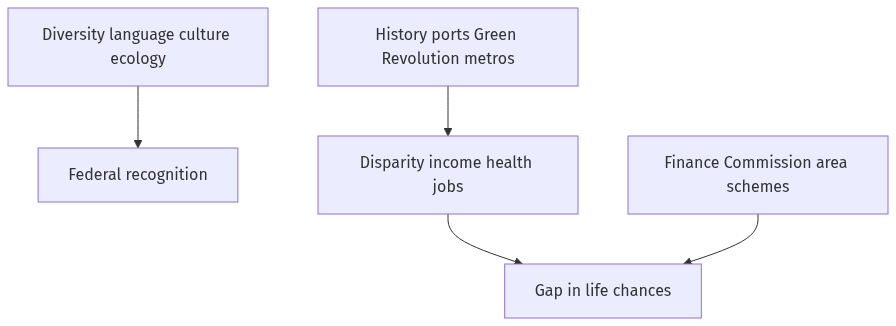
Regional disparity means systematic gaps in income, health, education, and infrastructure between different parts of a country. India is also culturally diverse in language, faith, ecology, and custom. Those two facts are not the same. Treating them as the same hides the development gap behind a slogan. Diversity is protected by the Constitution under the Eighth Schedule and federalism. Disparity remains a serious problem even after decades of Finance Commissions and area programmes.
Body
Regional disparity
Disparity means systematic gaps among regions, including States, districts, hills, forests, and interiors, in income, jobs, infrastructure, health, education, and voice. It is measured in per capita income, poverty, IMR, literacy, urbanisation, bank credit, and quality of public goods. It can be inter-State, as between the coastal south and west and pockets of the north and east. It can also be intra-State, as between a booming capital district and a neglected hinterland. It is produced by history. Colonial ports, post-Independence industrial licensing, Green Revolution geography, and the later services boom in a few metros all helped to produce it.
- Outcome gaps: The issue is not taste or dialect. It is who lives longer and who earns more.
- Scales: Gaps appear at State, district, and rural–urban levels inside the same State.
- Persistence: Rankings move slowly. Some old BIMARU labels aged. They did not all vanish.
How it differs from diversity
Diversity is plurality. It means many languages, faiths, cuisines, kinship forms, and agro-climates. The Constitution protects it through Articles 29–30, linguistic States, and the Fifth and Sixth Schedules. A diverse region can be rich. Parts of the south are culturally distinct and have strong human-development numbers. A homogeneous region can be poor. Mixing the two treats the Northeast’s cultures or tribal difference as if they were the cause of poverty. The cause is often political incorporation, connectivity, and resource rights.
- Diversity: Difference is to be recognised.
- Disparity: Difference in advantage is to be reduced.
- Policy error: Unity that flattens culture, or diversity used as an excuse for neglect, both fail.
How serious in India
The gap is serious enough to shape migration, politics, and insurgency. Per capita NSDP still differs several-fold across States. Aspirational Districts exist because intra-State failure is clear. The east and interior lag on industry and sometimes on health. The Himalayan and tribal belts lag on infrastructure. Urban agglomerations pull talent away. Finance Commission devolution, GST compensation politics, and special category memory all admit the gap. Women’s labour force and nutrition maps often follow regional development, not only culture.
It is not hopeless. Several once-lagging States have improved literacy and growth. It is not trivial. A single national labour market without comparable schools keeps disparity in place. Climate stress will widen water and heat gaps.
- High seriousness: Life outcomes still track region strongly.
- Federal tools exist: Transfers, area schemes, and local government exist. Implementation is the leak.
- Political stake: Regional parties and demands for special packages are symptoms. They are not only noise.
Regional disparity is therefore a first-order GS-I society and geography problem. It is distinct from the celebration of diversity.
Flow diagram
Conclusion
Diversity is India’s plurality. Disparity is India’s uneven development. The second remains serious. States and districts still offer unequal lives. Federal finance and area missions are the constitutional response. They work only if diversity is respected as identity and disparity is reduced as injustice.
Quick related
Students also ask
-
Despite comprehensive policies for equity and social justice, underprivileged sections are not yet getting the full benefits of affirmative action envisaged by the Constitution. Comment.
Next question on this syllabus topic (2024 · Q18). View answer →
-
Is the Northeast poor because it is diverse?
No. Connectivity, conflict, and how resources and citizenship were managed explain far more than language or tribe as such.
-
Has disparity disappeared with GST and software exports?
Some States closed gaps. Services and tax reform did not equalise districts; metros still concentrate opportunity.
Same topic · past papers
UPSC has asked this before
These previous-year questions sit on the same topic. Open one to practise the earlier ask.
More from this topic
Q19 · UPSC Mains 2026 · GS I · 15 marks · Solution
Critically examine the challenges of demographic transition in contemporary India.
Indian Society and Diversity
India's demographic transition presents a complex picture of falling fertility rates and a rising working-age population, yet regional divergences undermine uniform gains. While southern and western states face rapid population ageing, northern and central states grapple with youth bulges that risk becoming liabilities without robust human capital investments. Critical bottlenecks include persistent gender imbalances, under-employment, and inadequate skilling infrastructure. Harnessing the demographic dividend requires targeted policy interventions in health, education, and employment generation rather than relying on population numbers alone. Ultimately, sustainable growth depends on transforming quantity into quality through inclusive regional development.
Q9 · UPSC Mains 2026 · GS I · 10 marks · Solution
How do you understand disability? Substantiate the need for inclusive policy framework in India in this regard.
Indian Society and Diversity
• Shifts understanding of disability from an individual medical deficit to a social construct caused by environmental and attitudinal barriers. • Adopts a rights-based paradigm that views persons with disabilities as active citizens entitled to dignity and equality rather than charity. • Fulfils constitutional mandates, notably Article 41, which directs the State to secure rights to work, education, and public assistance. • Addresses the demographic reality of over 2.68 crore disabled individuals in India as per Census 2011 through targeted resource allocation. • Overcomes multisectoral physical, educational, and employment barriers by enforcing the Rights of Persons with Disabilities Act, 2016. • Promotes universal design principles to ensure substantive equality, eliminate social exclusion, and drive inclusive national growth.
Q20 · UPSC Mains 2025 · GS I · 15 marks · Solution
Does tribal development in India centre around two axes, those of displacement and of rehabilitation? Give your opinion.
Indian Society and Diversity
Dams, mines and some conservation projects have made displacement a central tribal experience. Rehabilitation has often been a plot or cash that did not restore forest-based life. Those two axes therefore dominate the political meaning of tribal development. They are not sufficient: education, health, forest rights and PESA voice are development without a bulldozer. Opinion: treat displacement as a last resort with just rehab, and do not reduce all Adivasi policy to oustee management. Secure habitat plus citizenship is the fuller centre.