
Revision summary
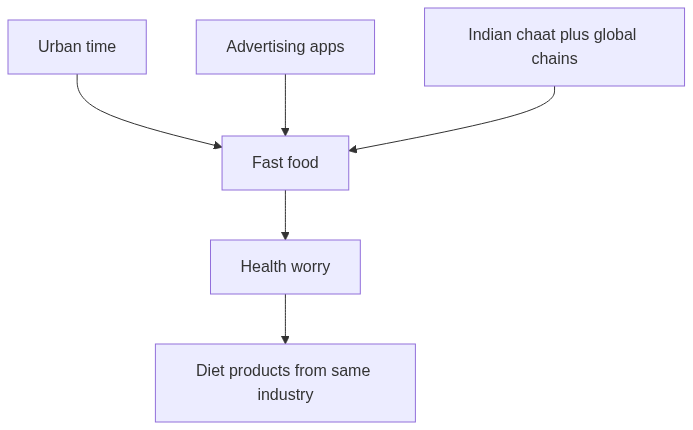
Fast food grows where work is hurried, advertising is loud, and delivery is cheap, even when health knowledge rises. The same industry sells indulgence and low-calorie versions. India mixed global chains, vegetarian localisation, and older fried snacks on delivery platforms. NFHS-type data show more overweight and diabetes while undernutrition remains, a double burden. The paradox is social and economic, not a simple failure of willpower. Policy labels lag the scooter, so the market still sets the daily meal.
Model answer
Copper italics in this answer — like this — are the key facts. Each one is unpacked in the Facts & figures rail.
Introduction
Modern societies talk more about sugar, oil and heart disease than any generation before them. They also eat more food designed in a factory and served in minutes. That is not hypocrisy only. It is a social machine of time, advertising, class and a city that no longer cooks at noon. India has joined that machine without dropping its own snacks.
Body
Why the industry grows beside the clinic
- Urban work time: Short lunches make a packaged or counter meal the rational choice for many workers.
- Care and kitchen shift: Women's paid work without public kitchens moves cooking off the midday timetable.
- Youth identity: Food becomes dating, status and peer culture, not only calories.
- Advertising: Brands link fried and sweet food to success, comfort and belonging.
- Cheap calories: Vegetable oil and sugar make high-energy meals profitable at low price points.
- Second market: Health worry creates salads, sugar-free lines and grilled options, so the same industry sells indulgence and the cure.
- Discounted future risk: The burger is now; the heart attack is later, which is why knowledge does not automatically stop demand.
The Indian experience
- Older fast foods: Chaat, vada, samosa and biryani already trained urban India in speed and street oil.
- Global chains: McDonald's, KFC, Domino's and Subway localised with McAloo Tikki, vegetarian lines and limited beef presence.
- Domestic brands and cloud kitchens: Delivery-only kitchens cut dining space and push branded food into smaller cities.
- Swiggy and Zomato: Scooter delivery made a tandoor or a burger a phone tap away from the gated colony and many mixed neighbourhoods.
- Mall hangout: Air-conditioned outlets sell time and status as much as a meal.
- Double burden: NFHS and ICMR-linked evidence shows rising overweight, diabetes and hypertension while undernutrition remains in the same country.
- Policy lag: FSSAI labels and school-food rules move slower than the delivery scooter.
Accounting for the paradox
- Speed fits the city: Fast food matches urban time even when clinics warn about fat and sugar.
- Aspiration and caste-neutral eating: Public branded counters can feel modern and socially open.
- Health talk is also a market: Concern expands product lines; it does not close the main market.
- Sociology, not willpower alone: The growth is about work, apps and advertising, not only weak personal resolve.
Flow diagram
Conclusion
Fast food expands because urban time, advertising and delivery make it easy, even as clinics talk of sugar and fat. India's experience is global chains plus local snacks on an app, beside a double burden of obesity and hunger.
Quick related
Students also ask
-
Does tribal development in India centre around two axes, those of displacement and of rehabilitation? Give your opinion.
Next question on this syllabus topic (2025 · Q20). View answer →
-
Is street chaat the same as a multinational burger?
Sociologically both can be fast and oily. The global firm adds branding, capital and a delivery algorithm.
-
Will health warnings stop the industry?
They shape a niche. They have not stopped the main market anywhere that cities run on short time.
Same topic · past papers
UPSC has asked this before
These previous-year questions sit on the same topic. Open one to practise the earlier ask.
More from this topic
Q19 · UPSC Mains 2026 · GS I · 15 marks · Solution
Critically examine the challenges of demographic transition in contemporary India.
Indian Society and Diversity
India's demographic transition presents a complex picture of falling fertility rates and a rising working-age population, yet regional divergences undermine uniform gains. While southern and western states face rapid population ageing, northern and central states grapple with youth bulges that risk becoming liabilities without robust human capital investments. Critical bottlenecks include persistent gender imbalances, under-employment, and inadequate skilling infrastructure. Harnessing the demographic dividend requires targeted policy interventions in health, education, and employment generation rather than relying on population numbers alone. Ultimately, sustainable growth depends on transforming quantity into quality through inclusive regional development.
Q9 · UPSC Mains 2026 · GS I · 10 marks · Solution
How do you understand disability? Substantiate the need for inclusive policy framework in India in this regard.
Indian Society and Diversity
• Shifts understanding of disability from an individual medical deficit to a social construct caused by environmental and attitudinal barriers. • Adopts a rights-based paradigm that views persons with disabilities as active citizens entitled to dignity and equality rather than charity. • Fulfils constitutional mandates, notably Article 41, which directs the State to secure rights to work, education, and public assistance. • Addresses the demographic reality of over 2.68 crore disabled individuals in India as per Census 2011 through targeted resource allocation. • Overcomes multisectoral physical, educational, and employment barriers by enforcing the Rights of Persons with Disabilities Act, 2016. • Promotes universal design principles to ensure substantive equality, eliminate social exclusion, and drive inclusive national growth.
Q20 · UPSC Mains 2025 · GS I · 15 marks · Solution
Does tribal development in India centre around two axes, those of displacement and of rehabilitation? Give your opinion.
Indian Society and Diversity
Dams, mines and some conservation projects have made displacement a central tribal experience. Rehabilitation has often been a plot or cash that did not restore forest-based life. Those two axes therefore dominate the political meaning of tribal development. They are not sufficient: education, health, forest rights and PESA voice are development without a bulldozer. Opinion: treat displacement as a last resort with just rehab, and do not reduce all Adivasi policy to oustee management. Secure habitat plus citizenship is the fuller centre.