
Revision summary
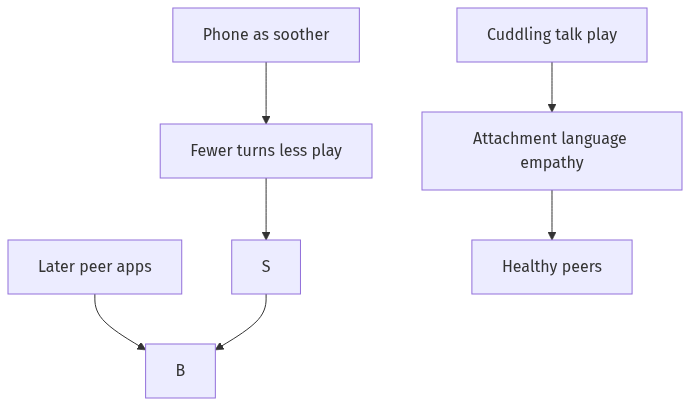
Early socialisation needs holding, talk, and play with people. Phones used as soothers cut those turns and can slow language and empathy. Peer life then moves to games and short video, with bullying and sleep loss. Distance calls and co-viewed stories can still help when an adult is present. Policy and parents should mediate screens, not only ban them after the harm is done.
Model answer
Copper italics in this answer — like this — are the key facts. Each one is unpacked in the Facts & figures rail.
Introduction
Cuddling, eye contact, and play are how infants first learn trust, language, and rules. When a phone replaces that holding, socialisation does not stop, but it starts with a screen instead of a person.
Body
Early attachment and language
- Infants learn faces, tone, and turn-taking from being held; a parent who stares at a phone gives fewer of those turns, which can slow speech and emotional reading.
- WHO and paediatric advice is especially strict under two years because the brain then expects people, not fast video.
- Anganwadi and NEP 2020 early childhood care still assume a talking adult; the home screen can undo that hour of care.
Play, empathy, and the peer group
- Free play with siblings and neighbours teaches sharing, losing, and body skill; phones offer solitary, designed reward instead of that negotiation.
- Empathy grows when a child is comforted and then comforts others; a device that soothes with video skips that loop.
- Later, school WhatsApp groups, games, and short video set peer rank by likes, which can mean cyberbullying, sleep loss, and fear of missing out.
- Joint-family cuddling by grandparents is thinner in many urban flats, so the phone fills a gap that housing and work hours created.
Not only harm
- Shared video calls can keep migrants’ children in touch with kin, which is a form of socialisation across distance.
- Age-fit educational apps can support letters and stories when an adult sits with the child, which is mediation, not replacement.
Way forward
- Keep phones out of infant soothing, and use NEP 2020 ECCE, POSHAN, and anganwadi workers to coach parents on talk and play.
- Set family screen rules, sleep hours, and playground time so the peer group is not only online.
- Treat cheap data as a public fact, and teach schools to talk about cyber safety without shaming the child.
Flow diagram
Conclusion
Replacing cuddling with phones weakens attachment, language, and face-to-face play, which are the base of socialisation. The way forward is adult-mediated screens, not a fantasy that childhood can go back to a pre-mobile village for everyone.
Quick related
Students also ask
-
What were the major technological changes introduced during the Sultanate period? How did those technological changes influence the Indian society?
Next question on this syllabus topic (2023 · Q12). View answer →
-
Is every use of a phone harmful to socialisation?
No. A call to a parent abroad or a story watched with an adult can support bonds. Harm rises when the phone replaces holding and play.
-
Can schools fix this alone?
Schools can teach safety and play. Infants are socialised at home, so parents and anganwadis matter first.
Same topic · past papers
UPSC has asked this before
These previous-year questions sit on the same topic. Open one to practise the earlier ask.
-
2023 · Q17 · GS I · 15 marks
From being net food importer in 1960s, India has emerged as a net food exporter to the world. Provide reasons. -
2021 · Q5 · GS I · 10 marks
Despite India being one of the countries of the Gondwanaland, its mining industry contributes much less to its Gross Domestic Product(GDP) in percentage. Discuss.
More from this topic
Q19 · UPSC Mains 2026 · GS I · 15 marks · Solution
Critically examine the challenges of demographic transition in contemporary India.
Indian Society and Diversity
India's demographic transition presents a complex picture of falling fertility rates and a rising working-age population, yet regional divergences undermine uniform gains. While southern and western states face rapid population ageing, northern and central states grapple with youth bulges that risk becoming liabilities without robust human capital investments. Critical bottlenecks include persistent gender imbalances, under-employment, and inadequate skilling infrastructure. Harnessing the demographic dividend requires targeted policy interventions in health, education, and employment generation rather than relying on population numbers alone. Ultimately, sustainable growth depends on transforming quantity into quality through inclusive regional development.
Q9 · UPSC Mains 2026 · GS I · 10 marks · Solution
How do you understand disability? Substantiate the need for inclusive policy framework in India in this regard.
Indian Society and Diversity
• Shifts understanding of disability from an individual medical deficit to a social construct caused by environmental and attitudinal barriers. • Adopts a rights-based paradigm that views persons with disabilities as active citizens entitled to dignity and equality rather than charity. • Fulfils constitutional mandates, notably Article 41, which directs the State to secure rights to work, education, and public assistance. • Addresses the demographic reality of over 2.68 crore disabled individuals in India as per Census 2011 through targeted resource allocation. • Overcomes multisectoral physical, educational, and employment barriers by enforcing the Rights of Persons with Disabilities Act, 2016. • Promotes universal design principles to ensure substantive equality, eliminate social exclusion, and drive inclusive national growth.
Q20 · UPSC Mains 2025 · GS I · 15 marks · Solution
Does tribal development in India centre around two axes, those of displacement and of rehabilitation? Give your opinion.
Indian Society and Diversity
Dams, mines and some conservation projects have made displacement a central tribal experience. Rehabilitation has often been a plot or cash that did not restore forest-based life. Those two axes therefore dominate the political meaning of tribal development. They are not sufficient: education, health, forest rights and PESA voice are development without a bulldozer. Opinion: treat displacement as a last resort with just rehab, and do not reduce all Adivasi policy to oustee management. Secure habitat plus citizenship is the fuller centre.