
Revision summary
Forest Acts and land revenue turned tribal commons into state and settler property. Moneylenders, mines, and the Criminal Tribes Act, 1871, added debt and stigma. Santhal hul, Birsa’s ulgulan, and Manyam–Rampa were major armed answers. Faith movements and later Adivasi organisations were political answers. Fifth–Sixth Schedules and the Forest Rights Act, 2006, try to repair the same wound.
Model answer
Copper italics in this answer — like this — are the key facts. Each one is unpacked in the Facts & figures rail.
Introduction
Colonial rule turned tribal land and forest into revenue, timber, and settler farms. Tribes answered with revolt, new faiths, and later constitutional claims, not with silence.
Body
How colonial rule affected tribals
- The British treated shifting cultivation and common forest as waste or state property, especially after the Indian Forest Acts of 1865, 1878, and 1927.
- Land revenue, diku moneylenders, and non-tribal settlement in Chotanagpur, Santhal Parganas, and the western Ghats stripped occupancy that custom had not written as individual title.
- Commercial timber, mining, and plantations used tribal labour cheaply and fenced hunting and grazing grounds.
- The Criminal Tribes Act, 1871, branded whole communities as hereditary criminals, which was police stigma, not forest science.
- Missions brought literacy and a critique of some customs, but they also divided villages and fitted colonial categories of tribe versus caste.
- Roads and markets sold mahua, lac, and labour out, and brought rent and liquor in, which broke older self-provisioning.
Tribal response
- The Kol revolt (1831–32), Santhal hul (1855–56) under Sidhu and Kanhu, and the Munda ulgulan of Birsa Munda (1899–1900) attacked dikus, missionaries they opposed, and police lines.
- The Bhil, Gond, and other western-central risings, the Rampa and Manyam struggle associated with Alluri Sitarama Raju (1922–24), and the Tana Bhagat movement mixed agrarian anger with new ritual.
- Some groups used petitions, sirdar politics, and later the Jharkhand and Adivasi Mahasabha path to demand a separate administrative home.
- Others joined the national movement on local terms, while Naga and other north-eastern politics took a longer armed and negotiated track into the republic.
- Response was therefore revolt, millenarian faith, flight deeper into hills, and modern organisation, not a single script.
After the Raj
- The Fifth and Sixth Schedules, the Chotanagpur Tenancy Act tradition, and later the Forest Rights Act, 2006, are the republic’s delayed legal answers to the same land-forest wound.
- Mining and dams still repeat dispossession, so colonial patterns did not end in 1947.
Way forward
- Record community forest rights, apply PESA, 1996, in scheduled areas, and make consent real before mines and reservoirs.
- Treat Criminal Tribes stigma as history to reverse through dignity, land, and schools, not through more policing.
Flow diagram
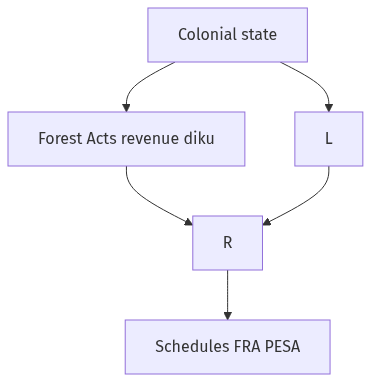
Conclusion
Colonial rule hit tribals through forest law, revenue, settlers, and criminal branding. They answered with hul, ulgulan, hill war, and later constitutional politics, and the same land question still needs PESA and forest rights in practice.
Quick related
Students also ask
-
Identify and discuss the factors responsible for diversity of natural vegetation in India. Assess the significance of wildlife sanctuaries in rain forests regions of India.
Next question on this syllabus topic (2023 · Q15). View answer →
-
Were all tribal responses violent?
No. Revolt was one path. Petition, new religion, labour migration, and later parties were others.
-
Did Independence end the tribal land problem?
Schedules and later FRA changed the law. Displacement by mines and dams shows the conflict continuing.
Same topic · past papers
UPSC has asked this before
These previous-year questions sit on the same topic. Open one to practise the earlier ask.
More from this topic
Q19 · UPSC Mains 2026 · GS I · 15 marks · Solution
Critically examine the challenges of demographic transition in contemporary India.
Indian Society and Diversity
India's demographic transition presents a complex picture of falling fertility rates and a rising working-age population, yet regional divergences undermine uniform gains. While southern and western states face rapid population ageing, northern and central states grapple with youth bulges that risk becoming liabilities without robust human capital investments. Critical bottlenecks include persistent gender imbalances, under-employment, and inadequate skilling infrastructure. Harnessing the demographic dividend requires targeted policy interventions in health, education, and employment generation rather than relying on population numbers alone. Ultimately, sustainable growth depends on transforming quantity into quality through inclusive regional development.
Q9 · UPSC Mains 2026 · GS I · 10 marks · Solution
How do you understand disability? Substantiate the need for inclusive policy framework in India in this regard.
Indian Society and Diversity
• Shifts understanding of disability from an individual medical deficit to a social construct caused by environmental and attitudinal barriers. • Adopts a rights-based paradigm that views persons with disabilities as active citizens entitled to dignity and equality rather than charity. • Fulfils constitutional mandates, notably Article 41, which directs the State to secure rights to work, education, and public assistance. • Addresses the demographic reality of over 2.68 crore disabled individuals in India as per Census 2011 through targeted resource allocation. • Overcomes multisectoral physical, educational, and employment barriers by enforcing the Rights of Persons with Disabilities Act, 2016. • Promotes universal design principles to ensure substantive equality, eliminate social exclusion, and drive inclusive national growth.
Q20 · UPSC Mains 2025 · GS I · 15 marks · Solution
Does tribal development in India centre around two axes, those of displacement and of rehabilitation? Give your opinion.
Indian Society and Diversity
Dams, mines and some conservation projects have made displacement a central tribal experience. Rehabilitation has often been a plot or cash that did not restore forest-based life. Those two axes therefore dominate the political meaning of tribal development. They are not sufficient: education, health, forest rights and PESA voice are development without a bulldozer. Opinion: treat displacement as a last resort with just rehab, and do not reduce all Adivasi policy to oustee management. Secure habitat plus citizenship is the fuller centre.