
Revision summary
Rainfall length, Himalayan height, soil, and relief create India’s vegetation mosaic. Human fire and farming further split climax types. Rainforest in the Ghats, north-east, and islands is the wet, endemic end of that mosaic. Sanctuaries under the Wildlife (Protection) Act, 1972, protect species, catchments, and carbon there. They fail if they stay as fragments without corridors and forest rights.
Model answer
Copper italics in this answer — like this — are the key facts. Each one is unpacked in the Facts & figures rail.
Introduction
India’s natural vegetation runs from wet evergreen forest to desert scrub because climate, relief, and soil change over short distances. Wildlife sanctuaries in the rainforest belts of the Western Ghats, the north-east, and the Andamans protect that wet end of the range.
Body
Factors of vegetational diversity
- Latitude and the Tropic of Cancer split tropical and subtropical belts, so Kerala and Himachal cannot grow the same climax forest.
- The monsoon, its length, and rain-shadow west of the Ghats decide evergreen, deciduous, and thorn forest more than any other single factor.
- Himalayan altitude stacks tropical foothill forest, oak and conifer, and alpine meadow in a few vertical kilometres.
- Soils from alluvium, laterite, black cotton, and desert sand filter which species can root even under the same rainfall.
- Relief, aspect, and drainage create local wet pockets, such as windward Ghats versus leeward Deccan.
- Human use, fire, and grazing have replaced climax forest with savanna, scrub, and plantation, which is also a cause of the pattern we now map.
Types that follow from those factors
- Western Ghats, north-east India, and the Andaman–Nicobar islands hold tropical wet evergreen and semi-evergreen forest.
- The Gangetic and Deccan cores hold moist and dry deciduous sal and teak belts.
- The Thar and the interior Deccan hold thorn and scrub; the Himalaya and the Nilgiri heights hold montane types.
Significance of sanctuaries in rainforest regions
- Rainforest fragments hold endemic frogs, plants, lion-tailed macaque, hornbills, and trees that dry forests do not, so sanctuaries are arks for a biodiversity hotspot.
- The Wildlife (Protection) Act, 1972, lets a sanctuary limit hunting and some land use while still allowing more local rights than a national park in many cases.
- Periyar, Kalakad–Mundanthurai, Bhadra’s wet tracts, Namdapha’s buffer world, and island sanctuaries in the Andamans keep gene pools for medicine, crop wild relatives, and carbon.
- They buffer monsoon catchments that feed rivers such as the Periyar, Sharavathi, and Brahmaputra tributaries, which is water security, not only wildlife watching.
- Tribal and forest-village livelihoods in honey, cane, and fish need these patches, provided the Forest Rights Act, 2006, is not ignored at the boundary.
- Eco-sensitive zones and tiger or elephant corridors only work if rainforest sanctuaries are not islands in a sea of plantation and mine.
Limits of the sanctuary tool
- Small notified patches cannot save a Ghats slope if hydel, highway, and quarry cut the canopy.
- Tourism and exclusion without consent can turn a sanctuary into a conflict zone.
Way forward
- Notify corridors, fund anti-poaching and fire lines, and co-manage with gram sabhas in rainforest catchments.
- Keep Silent Valley-type lessons: some evergreen tracts should stay closed to dam and cash-crop conversion.
Flow diagram
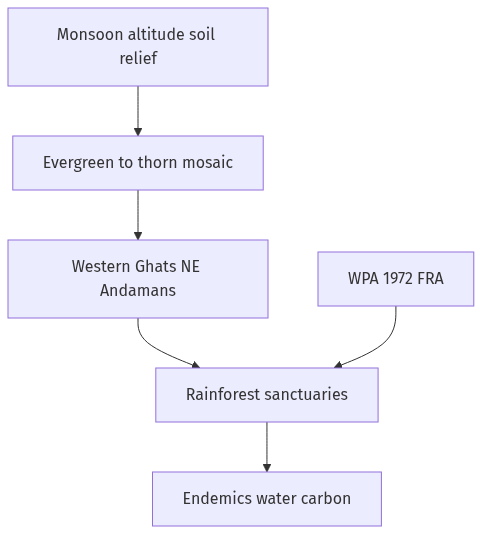
Conclusion
Monsoon, altitude, soil, and human use explain India’s vegetational diversity from evergreen to thorn. Sanctuaries in rainforest regions matter because they hold endemics, water, and carbon that cannot be stored in a dry teak belt, but they work only with corridors and local rights.
Quick related
Students also ask
-
Explore and evaluate the impact of 'Work From Home' on family relationships.
Next question on this syllabus topic (2022 · Q8). View answer →
-
Is a sanctuary the same as a national park?
Both are notified under the 1972 Act. A sanctuary often allows more regulated local use than a national park.
-
Why single out rainforest sanctuaries?
Because evergreen endemics and monsoon catchments are not replaced by protecting only dry deciduous tiger blocks.
Same topic · past papers
UPSC has asked this before
These previous-year questions sit on the same topic. Open one to practise the earlier ask.
-
2015 · Q14 · GS I · 12 marks
Explain the factors responsible for the origin of ocean currents. How do they influence regional climates, fishing and navigation? -
2023 · Q14 · GS I · 15 marks
Comment on the resource potentials of the long coastline of India and highlight the status of natural hazard preparedness in these areas. -
2022 · Q6 · GS I · 10 marks
Discuss the natural resource potentials of 'Deccan trap'
More from this topic
Q19 · UPSC Mains 2026 · GS I · 15 marks · Solution
Critically examine the challenges of demographic transition in contemporary India.
Indian Society and Diversity
India's demographic transition presents a complex picture of falling fertility rates and a rising working-age population, yet regional divergences undermine uniform gains. While southern and western states face rapid population ageing, northern and central states grapple with youth bulges that risk becoming liabilities without robust human capital investments. Critical bottlenecks include persistent gender imbalances, under-employment, and inadequate skilling infrastructure. Harnessing the demographic dividend requires targeted policy interventions in health, education, and employment generation rather than relying on population numbers alone. Ultimately, sustainable growth depends on transforming quantity into quality through inclusive regional development.
Q9 · UPSC Mains 2026 · GS I · 10 marks · Solution
How do you understand disability? Substantiate the need for inclusive policy framework in India in this regard.
Indian Society and Diversity
• Shifts understanding of disability from an individual medical deficit to a social construct caused by environmental and attitudinal barriers. • Adopts a rights-based paradigm that views persons with disabilities as active citizens entitled to dignity and equality rather than charity. • Fulfils constitutional mandates, notably Article 41, which directs the State to secure rights to work, education, and public assistance. • Addresses the demographic reality of over 2.68 crore disabled individuals in India as per Census 2011 through targeted resource allocation. • Overcomes multisectoral physical, educational, and employment barriers by enforcing the Rights of Persons with Disabilities Act, 2016. • Promotes universal design principles to ensure substantive equality, eliminate social exclusion, and drive inclusive national growth.
Q20 · UPSC Mains 2025 · GS I · 15 marks · Solution
Does tribal development in India centre around two axes, those of displacement and of rehabilitation? Give your opinion.
Indian Society and Diversity
Dams, mines and some conservation projects have made displacement a central tribal experience. Rehabilitation has often been a plot or cash that did not restore forest-based life. Those two axes therefore dominate the political meaning of tribal development. They are not sufficient: education, health, forest rights and PESA voice are development without a bulldozer. Opinion: treat displacement as a last resort with just rehab, and do not reduce all Adivasi policy to oustee management. Secure habitat plus citizenship is the fuller centre.