
Revision summary
WFH returns commute time to the family and can help care of children and the old. It erases the wall between office and home in small flats. Women often add paid tasks to unpaid care rather than trade them. Privacy, overtime, and sometimes violence risk rise when exit to a workplace vanishes. Hybrid rules and a fair chore split decide whether the family gains.
Model answer
Copper italics in this answer — like this — are the key facts. Each one is unpacked in the Facts & figures rail.
Introduction
Work from home, massively widened in the pandemic years, moved the office into the house. Family relationships gained shared time and lost the old wall between paid work and care.
Body
Gains for the household
- Commute hours returned to spouses, children, and elderly parents, which could raise daily talk, meals, and supervision of schoolwork.
- Dual-earner couples in Tier 1 and Tier 2 cities saved travel cost and could live nearer to kin instead of only nearer to the central business district.
- Illness, disability, and infant months were easier to manage when a parent did not vanish for ten office hours.
- Some men saw housework that had been invisible, which is a possible, not automatic, step toward fairer sharing.
Strains and unequal loads
- The same roof held meetings, cooking, and online classes, so privacy, sleep, and tempers suffered in small urban flats.
- Women in India already did most unpaid care; WFH often added office output on top of that double shift rather than replacing it.
- Couples without a separate room faced status strain when one partner’s call silenced the other’s, which reproduces workplace hierarchy at home.
- Domestic violence risk can rise when abusers are present all day and exit routes to a workplace shrink.
- Kin who expected constant availability treated the worker as always free, which bred guilt and hidden overtime.
An evaluation
- WFH is good for family time when housing, devices, and a fair split of chores exist; it is harsh when the house is the factory floor for one gender.
- Hybrid rules, paid care, and a right to disconnect decide whether the family is enriched or colonised by the firm.
Flow diagram
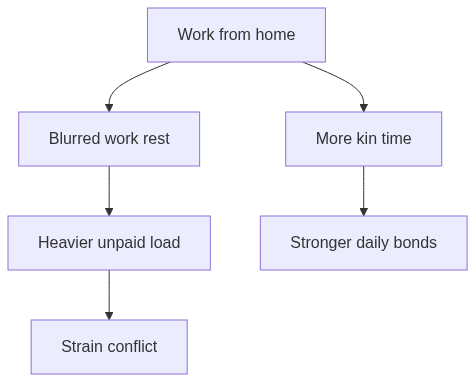
Conclusion
Work from home can thicken family contact and cut the commute tax. It also blurs rest, piles unpaid work on women, and can trap conflict indoors; evaluation therefore turns on housing and gender, not on the laptop alone.
Quick related
Students also ask
-
Given the diversities among the tribal communities in India, in which specific contexts should they be considered as a single category?
Next question on this syllabus topic (2022 · Q10). View answer →
-
Is WFH always good for children?
A present parent can help. A stressed parent on calls in a crowded room can still neglect play and raise conflict.
-
Did WFH equalise gender at home?
Not by itself. Without a split of chores and paid care, it often deepened the double shift.
Same topic · past papers
UPSC has asked this before
These previous-year questions sit on the same topic. Open one to practise the earlier ask.
More from this topic
Q19 · UPSC Mains 2026 · GS I · 15 marks · Solution
Critically examine the challenges of demographic transition in contemporary India.
Indian Society and Diversity
India's demographic transition presents a complex picture of falling fertility rates and a rising working-age population, yet regional divergences undermine uniform gains. While southern and western states face rapid population ageing, northern and central states grapple with youth bulges that risk becoming liabilities without robust human capital investments. Critical bottlenecks include persistent gender imbalances, under-employment, and inadequate skilling infrastructure. Harnessing the demographic dividend requires targeted policy interventions in health, education, and employment generation rather than relying on population numbers alone. Ultimately, sustainable growth depends on transforming quantity into quality through inclusive regional development.
Q9 · UPSC Mains 2026 · GS I · 10 marks · Solution
How do you understand disability? Substantiate the need for inclusive policy framework in India in this regard.
Indian Society and Diversity
• Shifts understanding of disability from an individual medical deficit to a social construct caused by environmental and attitudinal barriers. • Adopts a rights-based paradigm that views persons with disabilities as active citizens entitled to dignity and equality rather than charity. • Fulfils constitutional mandates, notably Article 41, which directs the State to secure rights to work, education, and public assistance. • Addresses the demographic reality of over 2.68 crore disabled individuals in India as per Census 2011 through targeted resource allocation. • Overcomes multisectoral physical, educational, and employment barriers by enforcing the Rights of Persons with Disabilities Act, 2016. • Promotes universal design principles to ensure substantive equality, eliminate social exclusion, and drive inclusive national growth.
Q20 · UPSC Mains 2025 · GS I · 15 marks · Solution
Does tribal development in India centre around two axes, those of displacement and of rehabilitation? Give your opinion.
Indian Society and Diversity
Dams, mines and some conservation projects have made displacement a central tribal experience. Rehabilitation has often been a plot or cash that did not restore forest-based life. Those two axes therefore dominate the political meaning of tribal development. They are not sufficient: education, health, forest rights and PESA voice are development without a bulldozer. Opinion: treat displacement as a last resort with just rehab, and do not reduce all Adivasi policy to oustee management. Secure habitat plus citizenship is the fuller centre.