
Revision summary
India's demographic transition brings falling fertility and a large workforce, but also regional divergence, ageing, youth unemployment, skill gaps, health deficits, low female work participation and migration stress. It will produce a dividend only through decentralised planning, human-capital investment and employment-rich growth.
Model answer
Copper italics in this answer — like this — are the key facts. Each one is unpacked in the Facts & figures rail.
Introduction
Demographic transition refers to the movement from high birth and death rates to low birth and death rates, producing changes in age structure, dependency ratio and workforce size. India has entered an advanced stage because fertility has declined near replacement level and the working-age population is large. But the demographic dividend is not automatic. It can become a dividend only when people are healthy, educated, skilled, employed and socially included.
Body
Core Explanation
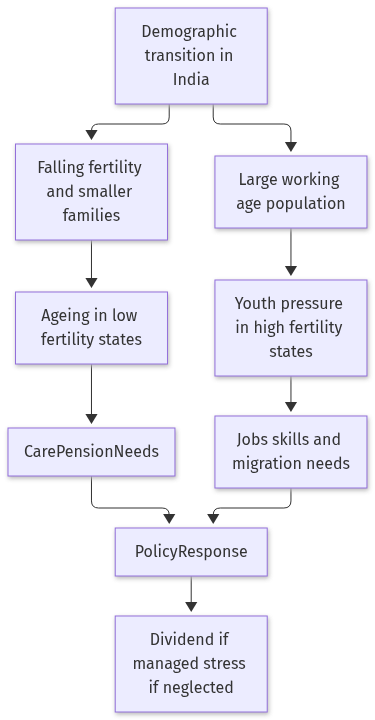
Fertility decline: India is not passing through one uniform transition. Southern and western states have low fertility and are moving towards ageing, while parts of northern and eastern India still have younger populations and higher fertility. A single national population policy cannot serve these different realities. Fertility decline anchors the discussion in concrete evidence rather than a general claim. It shows how population change affects age structure, labour supply, dependency, migration and public services in practice. The setting includes Kerala, Tamil Nadu, Bihar, Uttar Pradesh, ageing states, skill missions and female workforce debates, giving the point clear place, time and Indian weight. But keep the caution: a demographic dividend is possible only when health, education, jobs and gender inclusion improve together.
- Eg: Kerala and Tamil Nadu face faster ageing, while Bihar and Uttar Pradesh need massive investment in schools, skilling and jobs for young entrants.
Regional divergence: As fertility falls and life expectancy rises, the share of elderly people increases. This creates demand for geriatric care, pensions, chronic disease treatment, accessible housing, social care and age-friendly transport. Families are smaller, so traditional care support is also weakening. The chain is straightforward: population change affects age structure, labour supply, dependency, migration and public services. Set it against Kerala, Tamil Nadu, Bihar, Uttar Pradesh, ageing states, skill missions and female workforce debates; then the point has roots. That is the catch: a demographic dividend is possible only when health, education, jobs and gender inclusion improve together.
- Eg: Many elderly persons in low-fertility states live with lifestyle diseases, loneliness and dependence on remittances from migrant children.
Ageing pressure: A large working-age population is useful only if decent work is available. India faces educated unemployment, underemployment, informal work and intense competition for limited government jobs. Growth has not generated enough labour-intensive manufacturing and quality services employment. You can see the scale in actual actors, sites and decisions: Population change affects age structure, labour supply, dependency, migration and public services. Put Kerala, Tamil Nadu, Bihar, Uttar Pradesh, ageing states, skill missions and female workforce debates in the same paragraph so the answer stays grounded. The important limit is: a demographic dividend is possible only when health, education, jobs and gender inclusion improve together.
- Eg: Repeated protests around recruitment delays and paper leaks show the pressure of job-seeking youth.
Youth employment: Schooling and college degrees do not always translate into employable skills. Many youths lack communication ability, digital literacy, practical training, machine skills, care economy skills and green economy skills. This weakens productivity and makes firms complain of unemployability even when unemployment is high. Here the chain has to be spelt out: population change affects age structure, labour supply, dependency, migration and public services. The Indian setting is visible in Kerala, Tamil Nadu, Bihar, Uttar Pradesh, ageing states, skill missions and female workforce debates; that keeps the point close to the question. Still, a demographic dividend is possible only when health, education, jobs and gender inclusion improve together.
- Eg: Engineering and general degree graduates often require additional training before entering formal industry or services.
Skill mismatch: The demographic dividend begins in childhood. Anaemia, stunting, poor maternal health, weak learning outcomes and mental health problems reduce productivity before youth enter the labour market. Population size alone cannot generate growth. Skill mismatch anchors the discussion in concrete evidence rather than a general claim. It shows how population change affects age structure, labour supply, dependency, migration and public services in practice. The setting includes Kerala, Tamil Nadu, Bihar, Uttar Pradesh, ageing states, skill missions and female workforce debates, giving the point clear place, time and Indian weight. That is the catch: a demographic dividend is possible only when health, education, jobs and gender inclusion improve together.
- Eg: High anaemia among women and adolescents affects learning, work capacity and future maternal health.
Female work gap: Fertility decline and female education should ideally increase women's paid work, but safety concerns, unpaid care, patriarchal norms, marriage pressures, lack of nearby jobs and poor transport restrict participation. This wastes half of the demographic potential. The chain is straightforward: population change affects age structure, labour supply, dependency, migration and public services. Set it against Kerala, Tamil Nadu, Bihar, Uttar Pradesh, ageing states, skill missions and female workforce debates; then the point has roots. That is the catch: a demographic dividend is possible only when health, education, jobs and gender inclusion improve together.
- Eg: Many educated young women withdraw from work after marriage or childbirth because childcare and safe commuting are inadequate.
Health deficit: Demographic pressure pushes youth from poorer regions to cities and richer states. Migration supports growth but creates challenges of rental housing, identity documents, social security portability, language barriers, informal jobs and pressure on urban services. This is where the answer gets depth: population change affects age structure, labour supply, dependency, migration and public services through actual actors, sites and decisions. Put Kerala, Tamil Nadu, Bihar, Uttar Pradesh, ageing states, skill missions and female workforce debates in the same paragraph so the answer stays grounded. That is the catch: a demographic dividend is possible only when health, education, jobs and gender inclusion improve together.
- Eg: Migrant workers in construction, delivery, factories and domestic work often lack secure housing and health protection.
Migration stress: India faces a double burden in many families: children require education and nutrition, while elderly parents require medical care. The key caveat is: young adults may remain unemployed or informally employed. This squeezes household savings. A clear answer should show the sequence: population change affects age structure, labour supply, dependency, migration and public services. Use Kerala, Tamil Nadu, Bihar, Uttar Pradesh, ageing states, skill missions and female workforce debates to anchor the argument in relevant places, institutions and evidence. Still, a demographic dividend is possible only when health, education, jobs and gender inclusion improve together.
- Eg: A lower-middle-class family may finance coaching for one child and medicines for grandparents from the same uncertain income.
Flow diagram
Conclusion
India's demographic transition is a window, not a guarantee. The challenges are regional divergence, ageing, youth unemployment, skill gaps, health deficits, low female work participation, migration stress and federal tensions. India needs decentralised demographic planning, employment-rich growth, stronger public health and education, childcare, eldercare and portable welfare to convert population change into development strength.
Quick related
Students also ask
-
How do you account for the growing fast food industries given that there are increased health concerns in modern society? Illustrate your answer with the Indian experience.
Next question on this syllabus topic (2025 · Q18). View answer →
-
Why is demographic dividend not automatic?
Because a large workforce must be healthy, skilled, educated and employed to become productive.
-
Why is state-level planning necessary?
Different states face different stages: some need youth jobs and schools, while others need elderly care and migrant workers.
Same topic · past papers
UPSC has asked this before
These previous-year questions sit on the same topic. Open one to practise the earlier ask.
-
2024 · Q7 · GS I · 10 marks
What is the concept of a 'demographic winter'? Is the world moving towards such a situation? Elaborate.
More from this topic
Q9 · UPSC Mains 2026 · GS I · 10 marks · Solution
How do you understand disability? Substantiate the need for inclusive policy framework in India in this regard.
Indian Society and Diversity
Disability should be understood as an interaction between impairment and barriers, not merely as an individual medical condition. India needs inclusive policy for accessibility, education, employment, assistive technology, social protection and dignity. The answer should move from charity to rights and use examples from transport, schools, recruitment, workplaces and digital services.
Q20 · UPSC Mains 2025 · GS I · 15 marks · Solution
Does tribal development in India centre around two axes, those of displacement and of rehabilitation? Give your opinion.
Indian Society and Diversity
Dams, mines and some conservation projects have made displacement a central tribal experience. Rehabilitation has often been a plot or cash that did not restore forest-based life. Those two axes therefore dominate the political meaning of tribal development. They are not sufficient: education, health, forest rights and PESA voice are development without a bulldozer. Opinion: treat displacement as a last resort with just rehab, and do not reduce all Adivasi policy to oustee management. Secure habitat plus citizenship is the fuller centre.
Q18 · UPSC Mains 2025 · GS I · 15 marks · Solution
How do you account for the growing fast food industries given that there are increased health concerns in modern society? Illustrate your answer with the Indian experience.
Indian Society and Diversity
Fast food grows where work is hurried, advertising is loud, and delivery is cheap, even when health knowledge rises. The same industry sells indulgence and low-calorie versions. India mixed global chains, vegetarian localisation, and older fried snacks on delivery platforms. NFHS-type data show more overweight and diabetes while undernutrition remains, a double burden. The paradox is social and economic, not a simple failure of willpower. Policy labels lag the scooter, so the market still sets the daily meal.