
Revision summary
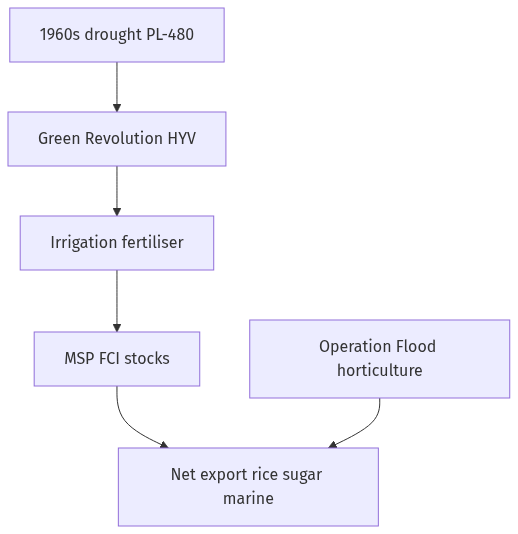
The mid-1960s droughts forced concessional wheat imports. HYV wheat and rice, irrigation, and fertiliser created a grain surplus in north-west India and then beyond. CACP, MSP, and FCI turned surplus into stocks that could be eaten or sold abroad. Milk, horticulture, marine products, and meat widened the export basket after 1991. Net exporter status is real for many years, with nutrition and groundwater as unfinished costs.
Model answer
Copper italics in this answer — like this — are the key facts. Each one is unpacked in the Facts & figures rail.
Introduction
In the mid-1960s India still needed PL-480 wheat after drought. Within a generation it became a regular net exporter of rice, sugar, marine products, and buffalo meat, because production, procurement, and trade policy changed together.
Body
Why India imported in the 1960s
- Two drought years, 1965 and 1966, met a still-low irrigated wheat–rice base, so ships of concessional American grain filled the gap.
- Population growth and little fertiliser or HYV seed left the country one bad monsoon away from a food emergency.
Production turnaround
- The Green Revolution brought semi-dwarf wheat from CIMMYT and rice such as IR8, first in Punjab, Haryana, and western Uttar Pradesh, with canal and tubewell water and fertiliser.
- The Intensive Agriculture District Programme, later national extension, and ICAR–state university research spread varieties beyond the first enclaves.
- Operation Flood from 1970 built a milk grid through cooperatives such as Amul, which cut dairy shortage even if milk is not always counted in the same trade line as grain.
- Horticulture, poultry, and marine catch later added exportable surplus beyond calorie grain.
State markets and stocks
- The Agricultural Prices Commission (now CACP), minimum support prices, and the Food Corporation of India (1965) created a floor for wheat and paddy and a public stock.
- Buffer stocks and the public distribution system first aimed at self-sufficiency; once granaries filled, export became a policy option in good years.
- Irrigation, rural power, and fertilizer subsidy raised yield even while they created groundwater and fiscal costs.
Trade and later diversification
- After 1991, a more open trade regime, port capacity, and private traders helped rice, spices, marine products, and buffalo meat find buyers in West Asia, Africa, and South-East Asia.
- India became a leading rice exporter in volume terms in several recent years, which is the clearest sign of the reversal from the PL-480 era.
- Export bans in drought years still appear, so net exporter status is structural, not a promise every single year.
Caveats the reasons must include
- Calorie export can sit beside household nutrition gaps, so trade success is not full food security.
- Punjab–Haryana groundwater and fertiliser imbalance are the environmental bill of the same surplus.
Way forward
- Shift surplus toward pulses, oilseeds, and climate-resilient millets so export and nutrition are not only a rice–wheat story.
- Use the National Food Security Act, 2013, stocks for the poor first, then export the residual.
Flow diagram
Conclusion
India moved from 1960s grain ships to net food export because HYV seed, water, MSP–FCI stocks, and later trade opened a surplus. The way forward is to keep that surplus without exhausting aquifers or ignoring protein and oilseed gaps.
Quick related
Students also ask
-
Describe the characteristics and types of primary rocks.
Next question on this syllabus topic (2022 · Q4). View answer →
-
Is India a net food exporter every year?
In many recent years yes, especially in rice. Drought or export bans can reverse a single-year balance.
-
Did liberalisation alone create the surplus?
No. HYV, irrigation, and procurement created the grain. Open trade later helped sell it.
Same topic · past papers
UPSC has asked this before
These previous-year questions sit on the same topic. Open one to practise the earlier ask.
-
2024 · Q7 · GS I · 10 marks
What is the concept of a 'demographic winter'? Is the world moving towards such a situation? Elaborate. -
2023 · Q3 · GS I · 10 marks
Bring out the socio-economic effects of the introduction of railways in different countries of the world. -
2023 · Q6 · GS I · 10 marks
How are the fjords formed? Why do they constitute some of the most picturesque areas of the world? -
2021 · Q14 · GS I · 15 marks
Briefly mention the alignment of major mountain ranges of the world and explain their impact on local weather conditions, with examples.
More from this topic
Q17 · UPSC Mains 2026 · GS I · 15 marks · Solution
Analyze the major drivers of human-induced land-use changes in India and their geographical consequences.
World's Physical Geography
Anthropogenic pressures driven by population growth and economic development are the primary catalysts of rapid land-use and land-cover change (LULCC) across India. Agricultural expansion and intensive multi-cropping, particularly
Q16 · UPSC Mains 2026 · GS I · 15 marks · Solution
"The centre of global trade is gradually shifting from the Atlantic region to the Indo-Pacific region." Examine this statement.
World's Physical Geography
• The global center of economic gravity has decisively shifted from the Euro-Atlantic axis to the Indo-Pacific. • The rise of China, Southeast Asia, and India as primary manufacturing and consumption hubs drives this transition. • Vital maritime chokepoints like the Malacca Strait serve as critical arteries for global energy and merchant trade. • Mega free-trade agreements such as RCEP and IPEF have established new regional trade and rule-making architectures. • Post-pandemic supply chain vulnerabilities have accelerated diversification strategies like 'China-plus-one' and 'friend-shoring'. • Control over critical mineral supply chains powers the ongoing digital and green energy transitions in the region. • Sustaining this geo-economic shift requires robust multilateral frameworks, freedom of navigation, and rules-based maritime governance.
Q14 · UPSC Mains 2026 · GS I · 15 marks · Solution
Compare the Loo, Chinook and Foehn winds with respect to their regions of prevalence, their nature and climatic impacts.
World's Physical Geography
• Local winds like the Loo, Chinook, and Foehn are driven by distinct regional pressure gradients and orographic barriers. • The Loo prevails over the Indo-Gangetic Plain, the Chinook along the Rockies' eastern slopes, and the Foehn across the northern Alpine valleys. • The Loo is a scorching, dust-laden convective surface wind generated by intense summer continental heating. • Both the Chinook and Foehn are warm, dry katabatic winds formed via rapid adiabatic compression on the leeward sides of mountains. • The Loo induces severe agricultural stress, crop wilting, and high health risks like heat strokes in South Asia. • Chinooks act as 'snow eaters' in North America, rapidly melting winter snowpacks and opening up pasturelands for grazing. • Foehn winds accelerate Alpine snowmelt, which simultaneously triggers hazardous avalanches and elevates regional wildfire risks.