
Revision summary
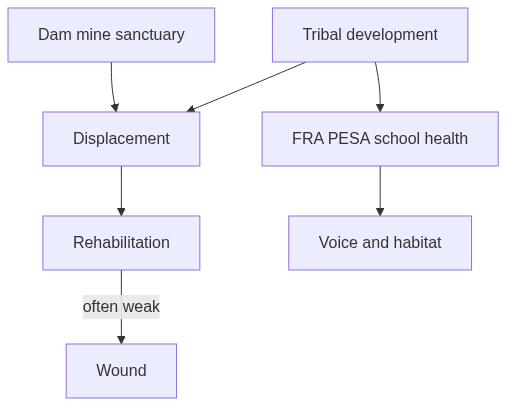
Dams, mines and some conservation projects have made displacement a central tribal experience. Rehabilitation has often been a plot or cash that did not restore forest-based life. Those two axes therefore dominate the political meaning of tribal development. They are not sufficient: education, health, forest rights and PESA voice are development without a bulldozer. Opinion: treat displacement as a last resort with just rehab, and do not reduce all Adivasi policy to oustee management. Secure habitat plus citizenship is the fuller centre.
Model answer
Copper italics in this answer — like this — are the key facts. Each one is unpacked in the Facts & figures rail.
Introduction
- Adivasi politics in independent India has often sounded like a single sentence: the dam or the mine comes, the village goes, a colony is promised, the colony fails. Displacement and rehabilitation are therefore true axes. The opinion asked for here is whether they are the only centre. They are the wound. They are not the whole body of tribal development.
Body
Why the two axes dominate
- Dams: Projects such as Sardar Sarovar made oustee politics the public face of tribal development.
- Mines and steel towns: Coal and bauxite belts in Odisha, Jharkhand and Chhattisgarh moved Scheduled Tribe families off livelihood land.
- Sanctuaries: Some tiger reserves and protected areas also relocated people in the name of conservation.
- Weak rehabilitation: A plot without a forest, cash without a job, or a promise in a file has too often been the package.
- Consent fights: Samatha, Niyamgiri and gram sabha conflicts made development look like removal done to Adivasis.
- Hard test: Until rehabilitation is land for land, forest rights and a veto that bites, this axis stays central and should.
Why development cannot be only that
- Schools that stay: Adivasi districts need teachers and Eklavya-type institutions, not only an oustee file.
- Clinics and language: Health and mother-tongue dignity are development without a bulldozer.
- PESA gram sabhas: Voice over land and resources is citizenship, not a rehabilitation footnote.
- Fair MFP markets: Minor forest produce at a fair price is livelihood policy beyond a resettlement colony.
- FRA titles: Individual and community forest rights treat tribals as rights-holders, not only as project-affected persons.
- Hidden issues: Reducing everything to oustee versus package can hide gender inequality, internal class gaps and youth who want a degree without losing the hill.
Opinion
- Historical centre: Much of what the Indian state called tribal development has orbited displacement and weak rehab; that fact of dams, mines and protected areas is real.
- Normative centre: Tribal development should not centre only on those two axes.
- Ethical centre: Secure habitat, voice and ordinary public goods are the fuller measure.
- Last resort: If rehab were just, displacement would still be a last resort, not a development model.
- Development without oustee: Education and health that arrive without a project eviction are still tribal development.
- Unfinished citizenship: The map of tribal India is not only lost villages; it is living languages and incomplete public goods.
Flow diagram
Conclusion
Displacement and rehabilitation have been the loud centre of tribal development because projects moved people and failed to restore a life. They should remain a hard test of any project. Real development also needs rights, schools, health and a gram sabha that can say no.
Quick related
Students also ask
-
In dealing with socio-economic issues of development, what kind of collaboration between government, NGOs and private sector would be most productive?
Next question on this syllabus topic (2024 · Q10). View answer →
-
Can a mine ever be just for tribals?
Only with free consent, a share of wealth that lasts, and a right to refuse. That standard is rare in practice.
-
Is isolation the same as development?
No. Isolation without a clinic is abandonment. The demand is habitat with citizenship, not a museum.
Same topic · past papers
UPSC has asked this before
These previous-year questions sit on the same topic. Open one to practise the earlier ask.
-
2024 · Q16 · GS I · 15 marks
What is a twister? Why are the majority of twisters observed in areas around the Gulf of Mexico?
More from this topic
Q19 · UPSC Mains 2026 · GS I · 15 marks · Solution
Critically examine the challenges of demographic transition in contemporary India.
Indian Society and Diversity
India's demographic transition presents a complex picture of falling fertility rates and a rising working-age population, yet regional divergences undermine uniform gains. While southern and western states face rapid population ageing, northern and central states grapple with youth bulges that risk becoming liabilities without robust human capital investments. Critical bottlenecks include persistent gender imbalances, under-employment, and inadequate skilling infrastructure. Harnessing the demographic dividend requires targeted policy interventions in health, education, and employment generation rather than relying on population numbers alone. Ultimately, sustainable growth depends on transforming quantity into quality through inclusive regional development.
Q9 · UPSC Mains 2026 · GS I · 10 marks · Solution
How do you understand disability? Substantiate the need for inclusive policy framework in India in this regard.
Indian Society and Diversity
• Shifts understanding of disability from an individual medical deficit to a social construct caused by environmental and attitudinal barriers. • Adopts a rights-based paradigm that views persons with disabilities as active citizens entitled to dignity and equality rather than charity. • Fulfils constitutional mandates, notably Article 41, which directs the State to secure rights to work, education, and public assistance. • Addresses the demographic reality of over 2.68 crore disabled individuals in India as per Census 2011 through targeted resource allocation. • Overcomes multisectoral physical, educational, and employment barriers by enforcing the Rights of Persons with Disabilities Act, 2016. • Promotes universal design principles to ensure substantive equality, eliminate social exclusion, and drive inclusive national growth.
Q18 · UPSC Mains 2025 · GS I · 15 marks · Solution
How do you account for the growing fast food industries given that there are increased health concerns in modern society? Illustrate your answer with the Indian experience.
Indian Society and Diversity
Fast food grows where work is hurried, advertising is loud, and delivery is cheap, even when health knowledge rises. The same industry sells indulgence and low-calorie versions. India mixed global chains, vegetarian localisation, and older fried snacks on delivery platforms. NFHS-type data show more overweight and diabetes while undernutrition remains, a double burden. The paradox is social and economic, not a simple failure of willpower. Policy labels lag the scooter, so the market still sets the daily meal.