
Revision summary
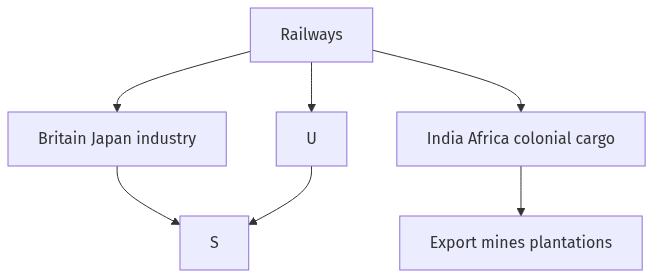
Britain used railways to move coal and factory goods and to urbanise the industrial north. The United States used a transcontinental line to make a continental market and to settle the west. Japan and Russia used state-backed trunk lines for catch-up and empire. Colonial India and Africa often saw lines that moved export cargo and troops, with mixed social gains. Everywhere, railways changed time, travel, and the idea of a national space.
Model answer
Copper italics in this answer — like this — are the key facts. Each one is unpacked in the Facts & figures rail.
Introduction
Railways, from the 1830s onward, cut the cost of moving bulk goods and people over land. The social and economic effects were large, but they were not the same in Britain, the United States, India, Japan, and colonial Africa.
Body
Industrial cores
- In Britain the Stockton and Darlington line (1825) and later the national grid moved coal and factory goods, which sped urban growth in places such as Manchester and Birmingham.
- Factory time, commuting, and a national market in food and labour followed the timetable, so class life in towns was remade around the station.
- In the United States the transcontinental railroad of 1869 tied the east to California, cheapened grain and cattle, and helped a continental home market.
- The same American lines displaced Native nations, spread settlers, and made land a commodity, so social cost sat beside economic gain.
Late industrialisers and colonies
- Meiji Japan used state-backed railways from the 1870s to move silk, coal, and soldiers, which supported industrial catch-up without a long private railway age.
- Tsarist Russia’s Trans-Siberian Railway opened Siberia to grain, timber, and exile, and it tied a huge land empire to European markets.
- In India the first passenger line ran from Bombay to Thane in 1853; later the network moved cotton, wheat, jute, and troops for a colonial export economy.
- Indian railways also created a national market, a working class of workshop towns, and faster nationalist travel, even while freight rates favoured raw exports.
- In parts of Africa colonial lines ran from mine or plantation to port, which extracted minerals and cash crops without building a dense internal market.
Shared social effects
- Railways standardised time, spread print and pilgrims, and mixed strangers in third-class carriages, which changed how people imagined a country.
- They also carried epidemics, soldiers, and famine grain, so the social effect could be relief in one year and deeper commercial risk in the next.
Way forward for comparison
- Always name who owned the line and what cargo paid for it, because a coal railway and a cotton-to-port railway do not produce the same society.
Flow diagram
Conclusion
Railways built national markets and industrial towns in some countries and extractive corridors in others. The fair comparison is to weigh cheaper freight against whose land, labour, and cargo the line was built to serve.
Quick related
Students also ask
-
How are the fjords formed? Why do they constitute some of the most picturesque areas of the world?
Next question on this syllabus topic (2023 · Q6). View answer →
-
Were Indian railways only a colonial drain?
Freight and finance often served British trade. The same network also made a national market, mill towns, and political travel.
-
Why compare several countries?
The question asks for different countries. Ownership and cargo explain why effects were industrial in Britain and extractive on many colonial lines.
Same topic · past papers
UPSC has asked this before
These previous-year questions sit on the same topic. Open one to practise the earlier ask.
More from this topic
Q17 · UPSC Mains 2026 · GS I · 15 marks · Solution
Analyze the major drivers of human-induced land-use changes in India and their geographical consequences.
World's Physical Geography
Anthropogenic pressures driven by population growth and economic development are the primary catalysts of rapid land-use and land-cover change (LULCC) across India. Agricultural expansion and intensive multi-cropping, particularly
Q16 · UPSC Mains 2026 · GS I · 15 marks · Solution
"The centre of global trade is gradually shifting from the Atlantic region to the Indo-Pacific region." Examine this statement.
World's Physical Geography
• The global center of economic gravity has decisively shifted from the Euro-Atlantic axis to the Indo-Pacific. • The rise of China, Southeast Asia, and India as primary manufacturing and consumption hubs drives this transition. • Vital maritime chokepoints like the Malacca Strait serve as critical arteries for global energy and merchant trade. • Mega free-trade agreements such as RCEP and IPEF have established new regional trade and rule-making architectures. • Post-pandemic supply chain vulnerabilities have accelerated diversification strategies like 'China-plus-one' and 'friend-shoring'. • Control over critical mineral supply chains powers the ongoing digital and green energy transitions in the region. • Sustaining this geo-economic shift requires robust multilateral frameworks, freedom of navigation, and rules-based maritime governance.
Q14 · UPSC Mains 2026 · GS I · 15 marks · Solution
Compare the Loo, Chinook and Foehn winds with respect to their regions of prevalence, their nature and climatic impacts.
World's Physical Geography
• Local winds like the Loo, Chinook, and Foehn are driven by distinct regional pressure gradients and orographic barriers. • The Loo prevails over the Indo-Gangetic Plain, the Chinook along the Rockies' eastern slopes, and the Foehn across the northern Alpine valleys. • The Loo is a scorching, dust-laden convective surface wind generated by intense summer continental heating. • Both the Chinook and Foehn are warm, dry katabatic winds formed via rapid adiabatic compression on the leeward sides of mountains. • The Loo induces severe agricultural stress, crop wilting, and high health risks like heat strokes in South Asia. • Chinooks act as 'snow eaters' in North America, rapidly melting winter snowpacks and opening up pasturelands for grazing. • Foehn winds accelerate Alpine snowmelt, which simultaneously triggers hazardous avalanches and elevates regional wildfire risks.