
Revision summary
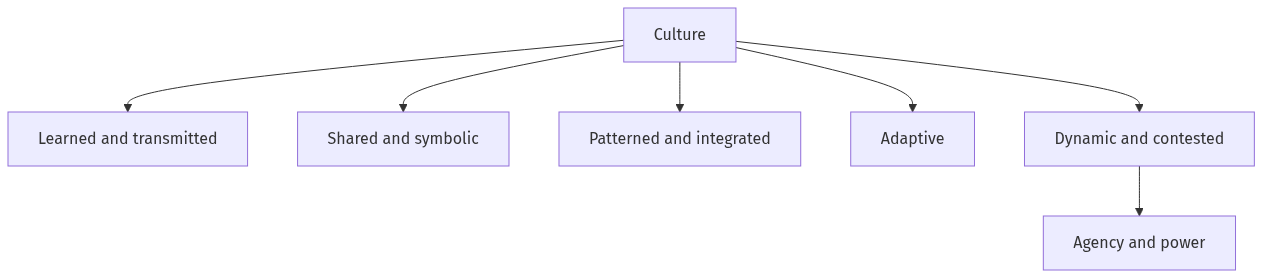
Culture is a learned and symbolically mediated design for living. Its core attributes are sharing, symbolism, patterning, adaptation, transmission and change. Tylor supplies the complex whole; Geertz supplies public meaning; Bourdieu links culture to embodied practice. Kula shows integration of exchange, rank, ritual and inter-island relations. Shared culture is never identical experience: gender, class, age and power matter. Treat integration as a question, not as automatic harmony.
Model answer
Copper italics in this answer — like this — are the key facts. Each one is unpacked in the Facts & figures rail.
Introduction
Culture is the learned and symbolically mediated way in which members of a society make life intelligible and practicable. E. B. Tylor called it a “complex whole”; Clifford Geertz later stressed webs of significance. Its attributes explain both the continuity of a way of life and its capacity to vary and change.
Body
Principal attributes
- Learned and transmitted: Culture is acquired through enculturation, not inherited biologically. Margaret Mead’s work in Samoa made social learning central, even though her conclusions were later debated.
- Shared but unequally: Language, kin terms and ritual codes are intersubjective. Yet age, gender, class and status create different cultural competencies; sharing does not mean unanimity.
- Symbolic: Words, flags, totems and food taboos stand for meanings beyond themselves. Geertz’s Balinese cockfight condensed status and masculinity into a public performance.
- Integrated and patterned: Economy, kinship and ritual affect one another. Malinowski’s Trobriand Kula joined exchange, rank, magic and inter-island relations. Integration is an empirical question, not proof of harmony.
- Adaptive—and sometimes maladaptive: Clothing, shelter and subsistence mediate environments. The sacred-cattle debate shows that adaptation is interpreted through values and political economy, while modern diet can turn an earlier preference for energy-rich food into metabolic risk.
- Dynamic and cumulative: Diffusion, invention, migration and contest continually alter culture. Indian caste associations, for example, entered electoral and digital arenas rather than simply disappearing.
- Universal capacity, particular forms: All humans possess culture, but no single cultural form is biologically inevitable. This supports Boasian cultural relativism and comparison without ranking societies.
Culture is also explicit and implicit, material and non-material, ideal and actually practised. Pierre Bourdieu’s habitus helps connect these layers: learned history becomes bodily disposition without becoming an unchangeable programme.
Critical caution
Functionalism sometimes pictured a seamless whole. Eric Wolf, feminist anthropology and practice theory reveal porous boundaries, internal conflict and unequal power. Individuals reproduce culture, but they also improvise and resist it.
Flow diagram
Conclusion
Culture is learned, shared, symbolic, patterned, adaptive and dynamic. These properties make collective life possible without making people cultural copies. Anthropology therefore studies patterned meaning together with history, inequality and agency.
Quick related
Students also ask
-
Critical perspective on avoidance and joking relationship
Next question on this syllabus topic (2024 · Q1(c)). View answer →
-
Is culture unique to humans?
Cumulative symbolic culture is unusually elaborated in humans. Social learning also occurs in other primates, so the difference is one of scale and symbolic complexity, not absence versus presence.
-
Does cultural integration mean consensus?
No. Institutions are connected, but the connection may embody conflict, domination or contradiction as well as cooperation.
Same topic · past papers
UPSC has asked this before
These previous-year questions sit on the same topic. Open one to practise the earlier ask.
-
2025 · Q1(e) · Anthropology GS 1 · 10 marks
Culture and embodiment. -
2025 · Q4(b) · Anthropology GS 1 · 15 marks
Write a note on Mousterian tool tradition, Mousterian culture and its makers -
2026 · Q6(b) · Anthropology GS 1 · 15 marks
Critically discuss how culture determines human behaviour in the light of Leslie White's theory -
2025 · Q1(c) · Anthropology GS 1 · 10 marks
Osteodontokeratik culture and its makers. -
2025 · Q2(b) · Anthropology GS 1 · 15 marks
Compare and contrast the symbolic approaches of Clifford Geertz and Victor Turner to understand culture
More from this topic
Q4(b) · UPSC Mains 2025 · Anthropology GS 1 · 15 marks · Solution
Write a note on Mousterian tool tradition, Mousterian culture and its makers
The Nature of Culture
The tradition is Middle Palaeolithic flakes, Levallois technique, scrapers, points and denticulates. Bordes saw facies as cultural variants. Binford saw functional tool-kits. Culture includes fire, hunting and shelters. Be cautious on burial and ornament. Makers in Europe are mainly Neanderthals. In the Levant early modern humans also used Mousterian tools. The date ballpark is the Middle Palaeolithic, to about 40,000 years ago in Europe. Mousterian is not identical with all Neanderthal behaviour everywhere.
Q1(e) · UPSC Mains 2025 · Anthropology GS 1 · 10 marks · Solution
Culture and embodiment.
The Nature of Culture
Embodiment means culture is lived as a body, not only as symbols in the head. Csordas, following Merleau-Ponty, treated the body as the ground of culture. Bourdieu’s habitus is class and gender as posture, taste and practical sense. Mauss described techniques of the body such as walking, swimming and childbirth. Medical anthropology uses the mindful body and structural violence made flesh. The body is cultural practice, not a costume.
Q5(b) · UPSC Mains 2024 · Anthropology GS 1 · 10 marks · Solution
Cultural relevance of the Kula
The Nature of Culture
Malinowski described Kula exchange among the Massim in Argonauts of the Western Pacific. Soulava necklaces move clockwise and mwali armbands counter-clockwise. Temporary possession yields prestige; valuables must circulate. Kula creates delayed reciprocity, trust, leadership and inter-island integration. Gimwali barter accompanies but is distinguished from ceremonial exchange. Weiner corrected Malinowski's male bias by documenting women's wealth and exchange.