
Revision summary
Fission-track dating counts damage trails from uranium-238 fission in minerals or glass. Price, Walker and Fleischer developed the method. Zircon, apatite and volcanic glass are the usual materials. Applications include dating tephra at hominin sites, heated stone, and Himalayan or Siwalik thermal history. Heat can anneal tracks and reset the clock, so dates need stratigraphic and other radiometric checks. Different minerals do not share one single year-range.
Model answer
Copper italics in this answer — like this — are the key facts. Each one is unpacked in the Facts & figures rail.
Introduction
Fission-track dating is a radiometric clock that counts damage trails left when uranium-238 atoms split inside a mineral or glass. P. B. Price, R. M. Walker and R. L. Fleischer developed the method. For anthropology it is a way to date volcanic layers and heated materials that sit with fossils or tools.
Body
How the clock works
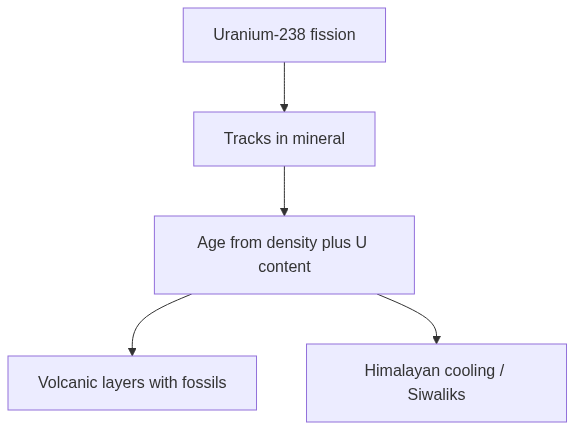
Uranium-238 occasionally undergoes spontaneous fission. Each fission leaves a tiny track in the crystal. The sample is polished and etched so the tracks can be counted under a microscope. The uranium content is measured, often by inducing extra tracks in a reactor. Age is then a function of track density and uranium concentration.
Useful materials include zircon, apatite and volcanic glass (obsidian or tephra). The method works over a wide geological span, from relatively young volcanic glasses to much older crustal minerals. The range depends on the mineral and on whether tracks have been reset by heat.
Heat can reset as well as date. Heating can anneal old tracks and restart the clock, which is why the method also records thermal history, not only “the age of the rock”.
Applications
- Hominin and Palaeolithic sites: Volcanic ash and tuff above or below fossils can be dated, alongside potassium–argon and argon–argon where those apply. East African rift volcanics are a standard setting.
- Obsidian and burnt flint: Provenance and last-heating events can be approached where tracks and chemistry allow.
- Siwaliks and mountain belts: Fission-track work on apatite and zircon is widely used in Himalayan cooling and uplift histories. That geological clock matters when we place Siwalik apes such as Sivapithecus in a landscape that was itself rising.
- Thermochronology: Even when the “age” is not an occupation date, the thermal path of a basin or a tool-stone source is anthropological context.
Limitation
Tracks fade if the mineral is heated above a closure temperature. Mixed ages and partial annealing need specialist interpretation. Fission-track dates should be cross-checked with stratigraphy and, where possible, with another radiometric method.
Flow diagram
Conclusion
Fission tracks count uranium fission damage in zircon, apatite or volcanic glass. Anthropology uses them for volcanic layers, heated stone and landscape history. Heat can reset the clock, so the date is never a slogan.
Quick related
Students also ask
-
Chronometric dating
Next question on this syllabus topic (2024 · Q5(a)). View answer →
-
Is this the same as carbon-14?
No. Radiocarbon dates organic carbon on a shorter recent timescale. Fission tracks date uranium-bearing minerals and glasses, often much older volcanic or geological events.
-
How does this relate to Siwalik apes?
Landscape clocks and volcanic clocks place fossils in time. Himalayan fission-track cooling is geological context for Sivapithecus.
Same topic · past papers
UPSC has asked this before
These previous-year questions sit on the same topic. Open one to practise the earlier ask.
-
2026 · Q5(e) · Anthropology GS 1 · 10 marks
Thermoluminescence dating method. -
2025 · Q6(a) · Anthropology GS 1 · 20 marks
What are genetic markers? Discuss their applications in understanding population variation, disease association and forensics -
2024 · Q6(b) · Anthropology GS 1 · 15 marks
Discuss the applications of forensic anthropology with suitable examples. -
2023 · Q6(c) · Anthropology GS 1 · 15 marks
Describe the practical applications of DNA technology in the current scenario.
More from this topic
Q5(e) · UPSC Mains 2026 · Anthropology GS 1 · 10 marks · Solution
Thermoluminescence dating method.
Principles of Prehistoric Archaeology. Chronology
• Absolute dating method measuring time passed since a mineral object was last intensely heated. • Relies on ionizing radiation from soil trapping electrons in quartz and feldspar crystal lattices. • Heating the sample to ~500°C releases these trapped electrons as a light signal (thermoluminescence). • Total accumulated radiation divided by the annual background dose rate gives the elapsed time. • Applied mainly to ceramics, pottery, terracotta, and burnt flints from ancient hearths. • Effectively dates events from 300 to 500,000 years ago, covering the Middle to Upper Pleistocene. • Directly dates the moment of human firing, extending chronologies far beyond radiocarbon limits.
Q5(a) · UPSC Mains 2024 · Anthropology GS 1 · 10 marks · Solution
Chronometric dating
Principles of Prehistoric Archaeology. Chronology
Chronometric dating gives an age in years; relative dating only orders remains. Radiocarbon dates organic material to about 50,000 years and requires calibration. K–Ar/Ar–Ar dates volcanic layers associated with early hominins. TL dates last heating; OSL dates last light exposure. U-series and ESR extend the cave and tooth record. Every date belongs to a sample and event and must fit association and stratigraphy.
Q5(b) · UPSC Mains 2023 · Anthropology GS 1 · 10 marks · Solution
Prehistoric significance of Rakhigarhi
Principles of Prehistoric Archaeology. Chronology
Rakhigarhi is a very large Harappan site in Haryana on the Ghaggar–Drishadvati belt. ASI and Deccan College excavations exposed town and cemetery. Craft and agriculture match the Indus urban economy. 2019 aDNA lacked a Steppe signal in the reported Mature Harappan genome. The site joins settlement archaeology to biological prehistory.