
Revision summary
Chronometric dating gives an age in years; relative dating only orders remains. Radiocarbon dates organic material to about 50,000 years and requires calibration. K–Ar/Ar–Ar dates volcanic layers associated with early hominins. TL dates last heating; OSL dates last light exposure. U-series and ESR extend the cave and tooth record. Every date belongs to a sample and event and must fit association and stratigraphy.
Model answer
Copper italics in this answer — like this — are the key facts. Each one is unpacked in the Facts & figures rail.
Introduction
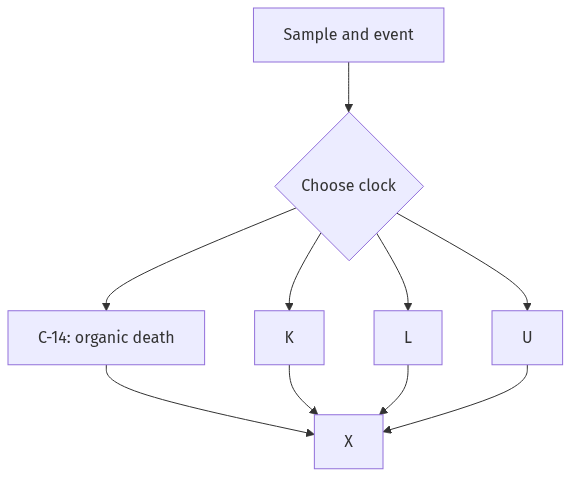
Chronometric dating assigns an age in calendar years, with an error range, to an archaeological event or deposit. Unlike relative dating, which only orders layers or artefacts, it uses a measurable physical clock. No method dates “the site” in the abstract: it dates a particular sample and event.
Body
Principal clocks
- Radiocarbon (Willard Libby): decay of carbon-14 dates once-living charcoal, bone collagen or seed, normally to about 50,000 years. Calibration against tree rings is essential; contamination and reservoir effects can mislead.
- Potassium–argon and argon–argon: decay of potassium-40 dates volcanic minerals from roughly 100,000 years into geological time. Tuffs bracketing Olduvai and East African hominins are classic applications; the dated eruption is not automatically the fossil's death.
- Uranium-series: radioactive disequilibrium dates carbonates, corals, cave speleothems and sometimes teeth, broadly from thousands to several hundred thousand years. Open-system uranium movement is the chief danger.
- Luminescence: thermoluminescence dates the last heating of pottery or burnt flint; optically stimulated luminescence dates the last sunlight exposure of quartz or feldspar sediment. Incomplete zeroing produces old ages.
- Electron-spin resonance: trapped electrons in tooth enamel or carbonate can reach into the Middle Pleistocene, but dose-rate reconstruction is demanding.
- Dendrochronology, pioneered by A. E. Douglass, gives annual precision where preserved wood and a regional master sequence exist.
Indian prehistory often combines radiocarbon for Neolithic charcoal, as at Mehrgarh-related contexts, with luminescence for older alluvial Palaeolithic deposits. A secure date also requires association, stratigraphy and preferably a second clock.
Flow diagram
Conclusion
Chronometric dating transformed prehistory from a sequence into a timescale. Its anthropological value lies in matching the clock to the sample and behavioural event, then testing the result against stratigraphy rather than treating a laboratory number as self-validating.
Quick related
Students also ask
-
Prehistoric significance of Rakhigarhi
Next question on this syllabus topic (2023 · Q5(b)). View answer →
-
Are absolute and chronometric dating identical?
Chronometric is the safer term because every laboratory age has an uncertainty range and methodological assumptions.
-
Can radiocarbon date a handaxe?
Not directly. It can date associated organic matter if the association is secure and within range.
Same topic · past papers
UPSC has asked this before
These previous-year questions sit on the same topic. Open one to practise the earlier ask.
-
2026 · Q5(e) · Anthropology GS 1 · 10 marks
Thermoluminescence dating method. -
2025 · Q5(c) · Anthropology GS 1 · 10 marks
Fission track dating method and its applications. -
2021 · Q1(e) · Anthropology GS 1 · 10 marks
Thermoluminescence (TL) dating.
More from this topic
Q5(e) · UPSC Mains 2026 · Anthropology GS 1 · 10 marks · Solution
Thermoluminescence dating method.
Principles of Prehistoric Archaeology. Chronology
• Absolute dating method measuring time passed since a mineral object was last intensely heated. • Relies on ionizing radiation from soil trapping electrons in quartz and feldspar crystal lattices. • Heating the sample to ~500°C releases these trapped electrons as a light signal (thermoluminescence). • Total accumulated radiation divided by the annual background dose rate gives the elapsed time. • Applied mainly to ceramics, pottery, terracotta, and burnt flints from ancient hearths. • Effectively dates events from 300 to 500,000 years ago, covering the Middle to Upper Pleistocene. • Directly dates the moment of human firing, extending chronologies far beyond radiocarbon limits.
Q5(c) · UPSC Mains 2025 · Anthropology GS 1 · 10 marks · Solution
Fission track dating method and its applications.
Principles of Prehistoric Archaeology. Chronology
Fission-track dating counts damage trails from uranium-238 fission in minerals or glass. Price, Walker and Fleischer developed the method. Zircon, apatite and volcanic glass are the usual materials. Applications include dating tephra at hominin sites, heated stone, and Himalayan or Siwalik thermal history. Heat can anneal tracks and reset the clock, so dates need stratigraphic and other radiometric checks. Different minerals do not share one single year-range.
Q5(b) · UPSC Mains 2023 · Anthropology GS 1 · 10 marks · Solution
Prehistoric significance of Rakhigarhi
Principles of Prehistoric Archaeology. Chronology
Rakhigarhi is a very large Harappan site in Haryana on the Ghaggar–Drishadvati belt. ASI and Deccan College excavations exposed town and cemetery. Craft and agriculture match the Indus urban economy. 2019 aDNA lacked a Steppe signal in the reported Mature Harappan genome. The site joins settlement archaeology to biological prehistory.