
Revision summary
Rakhigarhi is a very large Harappan site in Haryana on the Ghaggar–Drishadvati belt. ASI and Deccan College excavations exposed town and cemetery. Craft and agriculture match the Indus urban economy. 2019 aDNA lacked a Steppe signal in the reported Mature Harappan genome. The site joins settlement archaeology to biological prehistory.
Model answer
Copper italics in this answer — like this — are the key facts. Each one is unpacked in the Facts & figures rail.
Introduction
Rakhigarhi in Hisar, Haryana, is among the largest Harappan settlements. Its significance is size, a cemetery, craft, and the aDNA that tied the Indus people to a wider prehistoric map.
Body
Site and culture
- The mound complex on the now-dry Drishadvati–Ghaggar belt shows planned streets, brick, drains, and craft debris of the Mature Harappan, excavated in major seasons by Amarendra Nath for the ASI and later by Vasant Shinde of Deccan College.
- Cemetery work, including RGR-7, gives burial practice and osteology, which most Harappan cities still lack at this scale.
- Beads, copper, and agricultural remains place Rakhigarhi inside the Indus craft and food economy, not as a frontier camp.
Prehistoric significance
- Extent argues that the Harappan world had more than Mohenjo-daro and Harappa as capitals of density.
- Niraj Rai, Shinde, and collaborators published aDNA in 2019 showing ancestry related to Iranian farmers and South Asian hunter-gatherers, without a Steppe pastoralist signal in that Mature Harappan individual, which matters for later Indo-Aryan debates.
- The site therefore links archaeology, biological anthropology, and language prehistory without turning one skeleton into a whole invasion story.
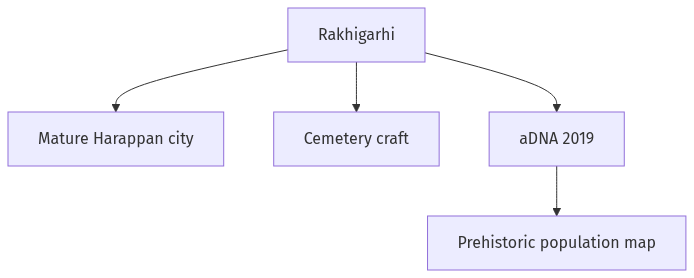
Flow diagram
Conclusion
Rakhigarhi is prehistoric evidence of a first-rank Harappan city with burials and genome data. Its significance is the Indus as a large, biologically sampled civilisation in the Ghaggar belt, not only as two famous Pakistani mounds.
Quick related
Students also ask
-
Thermoluminescence (TL) dating.
Next question on this syllabus topic (2021 · Q1(e)). View answer →
-
Does one genome settle the Aryan debate?
No. It constrains models for that time and place. Later Steppe-related ancestry in South Asia is a different chronological file.
-
Is Rakhigarhi the Harappan capital?
It is a first-rank city by size. Harappan politics had several large centres, not one proven capital.
More from this topic
Q5(e) · UPSC Mains 2026 · Anthropology GS 1 · 10 marks · Solution
Thermoluminescence dating method.
Principles of Prehistoric Archaeology. Chronology
• Absolute dating method measuring time passed since a mineral object was last intensely heated. • Relies on ionizing radiation from soil trapping electrons in quartz and feldspar crystal lattices. • Heating the sample to ~500°C releases these trapped electrons as a light signal (thermoluminescence). • Total accumulated radiation divided by the annual background dose rate gives the elapsed time. • Applied mainly to ceramics, pottery, terracotta, and burnt flints from ancient hearths. • Effectively dates events from 300 to 500,000 years ago, covering the Middle to Upper Pleistocene. • Directly dates the moment of human firing, extending chronologies far beyond radiocarbon limits.
Q5(c) · UPSC Mains 2025 · Anthropology GS 1 · 10 marks · Solution
Fission track dating method and its applications.
Principles of Prehistoric Archaeology. Chronology
Fission-track dating counts damage trails from uranium-238 fission in minerals or glass. Price, Walker and Fleischer developed the method. Zircon, apatite and volcanic glass are the usual materials. Applications include dating tephra at hominin sites, heated stone, and Himalayan or Siwalik thermal history. Heat can anneal tracks and reset the clock, so dates need stratigraphic and other radiometric checks. Different minerals do not share one single year-range.
Q5(a) · UPSC Mains 2024 · Anthropology GS 1 · 10 marks · Solution
Chronometric dating
Principles of Prehistoric Archaeology. Chronology
Chronometric dating gives an age in years; relative dating only orders remains. Radiocarbon dates organic material to about 50,000 years and requires calibration. K–Ar/Ar–Ar dates volcanic layers associated with early hominins. TL dates last heating; OSL dates last light exposure. U-series and ESR extend the cave and tooth record. Every date belongs to a sample and event and must fit association and stratigraphy.