
Revision summary
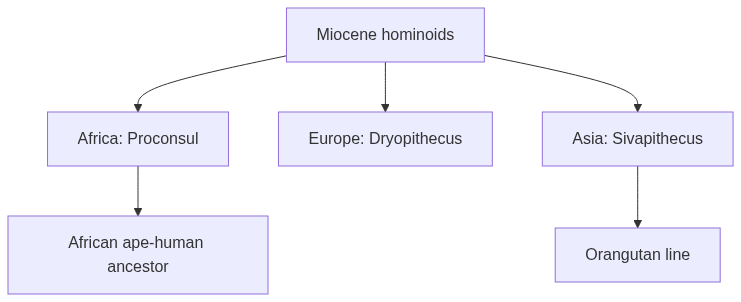
The Miocene, about 23 to 5.3 million years ago, was the main radiation of fossil apes, followed by late-Miocene decline. Africa gives Proconsul as a stem hominoid that was not yet a specialised hanging ape. Europe gives Dryopithecus and related forms, which matter for biogeography. Asia gives Sivapithecus on the orangutan line. Ramapithecus is not a hominin. Gigantopithecus is a giant pongine side branch. Significance lies in mosaic traits, an African last-common-ancestor setting, and climate winnowing of apes. There is no single missing link.
Model answer
Copper italics in this answer — like this — are the key facts. Each one is unpacked in the Facts & figures rail.
Introduction
The Miocene epoch, about 23 to 5.3 million years ago, was the age of ape radiation. Fossil apes were more diverse in Africa, Europe and Asia than living apes are today. These fossils do not give one missing link. They give a bush of experiments from which later African hominins and living great apes were winnowed.
Body
Miocene hominoid remains and their significance in evolution
- Miocene epoch: The Miocene lasted approximately 23 to 5.33 million years ago (mya) and witnessed a major radiation of hominoids across Africa, Europe, and Asia. It is therefore crucial for understanding the diversification of apes and the evolutionary background of the human lineage.
- Adaptive radiation: Miocene hominoids occupied diverse ecological niches, ranging from dense forests to more open woodland environments. Their fossils demonstrate that human evolution was bushy and branching, rather than a simple linear progression from ape to human.
Major Miocene hominoid remains
- Proconsul: Proconsul from the Miocene of East Africa is one of the earliest well-known hominoids. It lacked an external tail and possessed a combination of monkey-like and ape-like features, making it important for understanding the early divergence of hominoids from other catarrhines.
- Significance of Proconsul: Its relatively flexible spine, ape-like dentition, and absence of a tail provide evidence for the early development of hominoid characteristics, although it was not a direct human ancestor.
- Dryopithecus: Dryopithecus was widely distributed in Miocene Europe. Its anatomical features, including adaptations of the limbs and shoulder region, suggest an arboreal lifestyle involving climbing and suspensory locomotion.
- Significance of Dryopithecus: Dryopithecus demonstrates the diversification of European apes and provides evidence for the evolution of different forms of arboreal locomotion during the Miocene.
- Sivapithecus: Sivapithecus, found in the Siwalik Hills of India and Pakistan, lived approximately 12–8 mya. It possessed a distinctive facial morphology, including a relatively concave facial profile, closely placed eyes, and thick enamel.
- Evolutionary significance of Sivapithecus: Its facial similarities to modern orangutans suggest that Sivapithecus is closely related to the orangutan lineage and is important for understanding the diversification of Asian apes.
- Ramapithecus: Ramapithecus was initially identified from fragmentary jaw and dental remains from the Siwaliks and was once considered a possible early human ancestor because of its thick enamel and apparently more human-like jaw.
- Reinterpretation of Ramapithecus: Later discoveries of more complete remains showed that the features attributed to Ramapithecus fall within the variation of Sivapithecus. It is therefore no longer regarded as a direct human ancestor and is closely associated with the orangutan side of hominoid evolution.
Late Miocene hominins
- Hominin emergence: The Late Miocene, particularly around 7–6 mya, provides some of the earliest possible evidence for the emergence of the hominin lineage, especially through anatomical features associated with upright posture and bipedal locomotion.
- Sahelanthropus tchadensis: Sahelanthropus tchadensis, discovered at Toros-Menalla in Chad and dated to approximately 7–6 mya, shows a mosaic of primitive ape-like and potentially derived hominin features.
- Foramen magnum: Its relatively anteriorly positioned foramen magnum has been interpreted as evidence that the head was positioned on a more vertically oriented body, consistent with some form of habitual upright posture. However, the extent of its bipedalism remains debated.
- Orrorin tugenensis: Orrorin tugenensis, discovered in Kenya and dated to approximately 6.2–5.8 mya, is known particularly from femoral remains.
- Evidence of bipedalism: Features of the Orrorin femur, including aspects of the femoral head and neck and cortical bone distribution, have been interpreted as evidence for bipedal locomotion. However, the precise locomotor behaviour of Orrorin remains subject to scientific debate.
Significance in human evolution
- Understanding hominoid diversification: Miocene fossils demonstrate extensive adaptive radiation of hominoids, with numerous ape species evolving in different ecological settings. This challenges the idea of a single progressive line leading directly to modern humans.
- Human–ape divergence: Molecular and fossil evidence indicates that the last common ancestor of humans and chimpanzees lived much later than the early Miocene hominoids. Thus, most Miocene apes such as Proconsul, Dryopithecus, and Sivapithecus should not be placed directly on the human evolutionary line.
- Sarich and Wilson: Molecular-clock studies by Vincent Sarich and Allan Wilson proposed a relatively recent human–African ape divergence, helping challenge earlier views that placed the separation much deeper in geological time.
- Ramapithecus debate: The history of Ramapithecus illustrates how fragmentary fossil evidence can lead to incorrect phylogenetic conclusions. It was once considered an early human ancestor but was later reinterpreted in light of more complete fossils and molecular evidence.
- Origin of bipedalism: Fossils such as Sahelanthropus and Orrorin provide some of the earliest evidence relevant to the emergence of bipedalism. Bipedalism became the defining locomotor adaptation of later hominins.
- Environmental significance: Late Miocene climatic and ecological changes, including the expansion of more open woodland and mosaic environments, may have favoured new locomotor and dietary adaptations. However, human evolution cannot be explained by a single environmental cause.
- Non-honing chewing complex: The evolutionary reduction of large projecting canines and changes in the premolar–canine relationship are associated with the development of the non-honing chewing complex, an important distinction between hominins and many earlier apes.
- Dietary adaptation: Changes in teeth and jaws indicate shifts in dietary strategies and food processing. However, dental morphology alone cannot establish a simple transition from fruit-eating to omnivory or directly explain later brain expansion.
- Forest to woodland adaptations: While some Miocene hominoids remained strongly adapted to forest environments, others occupied more open woodland and ecological transition zones. This demonstrates the ecological diversity of Miocene apes.
- Evolutionary bushiness: Several hominoid species existed simultaneously and many became extinct without leaving direct descendants. Human evolution is therefore better understood as a branching evolutionary tree rather than a linear ladder.
- Fossil bridge: Miocene hominoids provide an important evolutionary background between earlier catarrhine primates and later hominoids. They help identify the anatomical, ecological, and behavioural changes that preceded the emergence of early hominins.
- Overall significance: Miocene hominoid fossils are significant because they reveal the origin and diversification of apes, the separation of major hominoid lineages, the emergence of possible early hominin adaptations, and the complex branching nature of human evolution.
Flow diagram
Conclusion
- Miocene hominoids are the comparative baseline for later hominins: a pan-Old World ape radiation, locomotor experiments, and a late-Miocene squeeze. Significance is phylogenetic and ecological. Ramapithecus is not the first man. Proconsul, Sivapithecus and the African setting of the last common ancestor are the working set.
Quick related
Students also ask
-
Discuss different forms of primate social organisation
Next question on this syllabus topic (2022 · Q2(b)). View answer →
-
Where does Ramapithecus belong today?
Thick enamel once misled phylogeny. The fossils belong with Sivapithecus and the orangutan, not with Australopithecus.
-
Did bipedalism start in the Miocene?
Some late Miocene taxa are argued to show a more upright trunk. Consensus still places habitual hominin bipedalism in the Pliocene African record.
Same topic · past papers
UPSC has asked this before
These previous-year questions sit on the same topic. Open one to practise the earlier ask.
-
2025 · Q8(c) · Anthropology GS 1 · 15 marks
Examine the utility of human remains in forensic analysis. Discuss the facial reconstruction technique -
2023 · Q4(b) · Anthropology GS 1 · 15 marks
Discuss various methods of personal identification based on skeletal remains.
More from this topic
Q6(c) · UPSC Mains 2026 · Anthropology GS 1 · 15 marks · Solution
What are Strepsirhini Primates? Describe their geographical distribution and mention the characteristics that distinguish them from Haplorhini Primates
Characteristics of Primates
Strepsirhini represents a suborder of primates characterized by primitive mammalian traits such as a rhinarium, tooth comb, and grooming claw. Geographically, they are primarily restricted to Madagascar, with other populations found in sub-Saharan Africa and tropical Asia. They are distinguished from Haplorhini primates by features like unfused mandibular symphysis, postorbital bar instead of a closed plate, and a reflective tapetum lucidum. Understanding their taxonomy provides crucial insights into early primate evolution and divergence patterns. This answer outlines their definition, distribution, and critical anatomical distinctions from haplorhines.
Q1(d) · UPSC Mains 2025 · Anthropology GS 1 · 10 marks · Solution
Smell as a signal among non-human primates.
Characteristics of Primates
Smell is chemical communication through glands, urine and body odour. Strepsirrhines keep a rhinarium and vomeronasal organ and mark heavily, as in ring-tailed lemur stink fights. Callitrichids such as marmosets and tamarins mark range with glands. Haplorhine monkeys and apes rely more on vision, though some inspection behaviour remains. Functions include territory, reproductive status, kin recognition and alarm. Human pheromone claims are a separate and contested literature.
Q2(b) · UPSC Mains 2022 · Anthropology GS 1 · 15 marks · Solution
Discuss different forms of primate social organisation
Characteristics of Primates
Primates are not all troop animals. Orangutans disperse, gibbons pair, gorillas often keep one-male groups. Macaques and baboons live in ranked multi-male troops. Chimpanzees use fission–fusion parties, as at Gombe. Ecology, predation, and kinship explain the spread.