
Revision summary
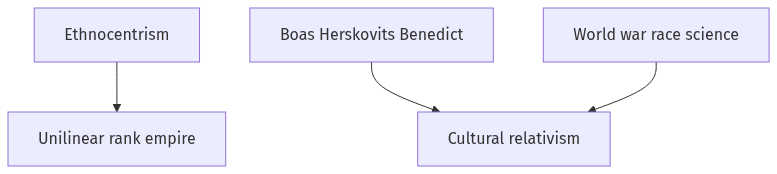
Ethnocentrism judged others by a home ladder of civilisation. Tylor–Morgan evolution and colonial display backed that habit. Boas, Herskovits, Benedict, and Mead made local history the frame. Post-war anti-racist science sealed the teaching shift. Relativism is method; it is not silence about violence.
Model answer
Copper italics in this answer — like this — are the key facts. Each one is unpacked in the Facts & figures rail.
Introduction
Ethnocentrism judges other lives by one’s home standard. Cultural relativism, as a method, asks that those lives be understood in their own terms first. The shift is a history of empire, science, and war.
Body
Ethnocentrism in context
- Unilinear evolutionists such as Tylor and Morgan ranked savagery, barbarism, and civilisation, which fitted colonial offices and mission schools.
- World fairs and racial anthropometry presented other peoples as exhibits. Gobineau and later racial science made hierarchy look natural.
The relativist turn
- Franz Boas, against Spencer and museum evolution, argued that each culture is a historical product. Language, myth, and body must be taken on their own terms.
- Herskovits named cultural relativism as a principle. Ruth Benedict’s Patterns of Culture and Mead’s Samoa, whatever the later debate, taught American readers that custom is not one ladder.
- The world wars and the Holocaust made ranking peoples as a scientific programme politically intolerable. UNESCO statements after 1950 used Boasian language against race doctrine.
Limit
- Relativism is a method of understanding, not a ban on judging cruelty. Boas still opposed racism. Geertz later warned against treating cultures as sealed islands.
- Indian anthropology after Srinivas used relativism in the village without denying law or reform.
Flow diagram
Conclusion
Ethnocentrism rode with empire and unilinear rank. Boasian fieldwork, anti-racist science, and the shock of racial war put cultural relativism in its place as a working ethic.
Quick related
Students also ask
-
Is race a valid and biologically meaningful concept?
Next question on this syllabus topic (2021 · Q5(c)). View answer →
-
Does relativism forbid comparison?
No. It forbids ranking as a moral ladder before the local logic is known.
-
Is ethnocentrism only Western?
Every group can be ethnocentric. Anthropology’s shift was to stop making that habit into a science of rank.
Same topic · past papers
UPSC has asked this before
These previous-year questions sit on the same topic. Open one to practise the earlier ask.
-
2016 · Q1(b) · Anthropology GS 1 · 10 marks
Cultural Relativism
More from this topic
Q4(b) · UPSC Mains 2025 · Anthropology GS 1 · 15 marks · Solution
Write a note on Mousterian tool tradition, Mousterian culture and its makers
The Nature of Culture
The tradition is Middle Palaeolithic flakes, Levallois technique, scrapers, points and denticulates. Bordes saw facies as cultural variants. Binford saw functional tool-kits. Culture includes fire, hunting and shelters. Be cautious on burial and ornament. Makers in Europe are mainly Neanderthals. In the Levant early modern humans also used Mousterian tools. The date ballpark is the Middle Palaeolithic, to about 40,000 years ago in Europe. Mousterian is not identical with all Neanderthal behaviour everywhere.
Q1(e) · UPSC Mains 2025 · Anthropology GS 1 · 10 marks · Solution
Culture and embodiment.
The Nature of Culture
Embodiment means culture is lived as a body, not only as symbols in the head. Csordas, following Merleau-Ponty, treated the body as the ground of culture. Bourdieu’s habitus is class and gender as posture, taste and practical sense. Mauss described techniques of the body such as walking, swimming and childbirth. Medical anthropology uses the mindful body and structural violence made flesh. The body is cultural practice, not a costume.
Q5(b) · UPSC Mains 2024 · Anthropology GS 1 · 10 marks · Solution
Cultural relevance of the Kula
The Nature of Culture
Malinowski described Kula exchange among the Massim in Argonauts of the Western Pacific. Soulava necklaces move clockwise and mwali armbands counter-clockwise. Temporary possession yields prestige; valuables must circulate. Kula creates delayed reciprocity, trust, leadership and inter-island integration. Gimwali barter accompanies but is distinguished from ceremonial exchange. Weiner corrected Malinowski's male bias by documenting women's wealth and exchange.