
Revision summary
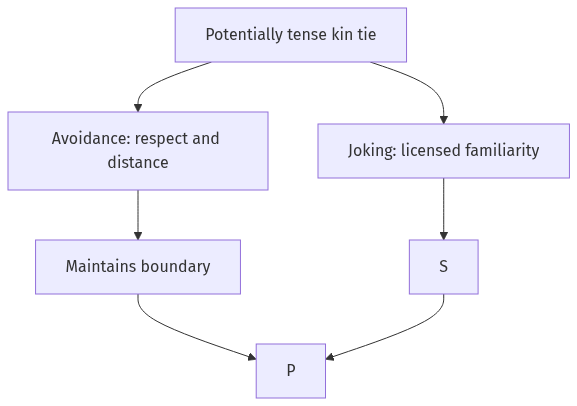
Avoidance prescribes reserve; joking licenses teasing between named kin categories. Radcliffe-Brown read both as complementary ways of regulating conjunction and separation. Mother-in-law/son-in-law avoidance and cross-cousin or junior-affine joking are common patterns. Symmetrical joking permits reciprocity; asymmetrical joking protects one-sided licence. Gluckman highlights ritualised expression of contradiction. Critical analysis asks whether joking reproduces gendered power and whether rules match actual conduct.
Model answer
Copper italics in this answer — like this — are the key facts. Each one is unpacked in the Facts & figures rail.
Introduction
Avoidance and joking are patterned ways of regulating potentially tense kin relations. Avoidance prescribes distance, reserve or non-address; joking licenses familiarity, teasing or symbolic insult. A. R. Radcliffe-Brown treated them as complementary devices through which kinship manages conjunction and separation.
Body
Forms and functions
Avoidance commonly marks relations where intimacy could threaten hierarchy or sexual propriety: son-in-law and mother-in-law, daughter-in-law and father-in-law, or siblings after puberty. It may regulate eye contact, speech, names, food sharing or physical proximity.
Joking relationships permit mockery and familiarity between specified categories—often cross-cousins, grandparents and grandchildren, or affinal kin such as a man and his wife’s younger siblings. In parts of India, devar–bhabhi and jija–sali joking contrasts with respect or avoidance toward senior affines.
Radcliffe-Brown distinguished symmetrical joking, where both parties tease, from asymmetrical joking, where one may mock and the other must not take offence. His African material showed joking alliances extending beyond families to clans or peoples. The institutions:
- dissipate hostility where marriage creates competing loyalties;
- mark generation and rank;
- permit criticism in a protected idiom;
- keep affinal groups connected without collapsing boundaries.
Critical perspective
The functionalist account can make every joke socially useful and every silence harmonious. Max Gluckman’s idea of ritualised rebellion better captures licensed disrespect that expresses contradiction without necessarily changing structure. Feminist analysis asks who is compelled to endure the joke: sexual teasing may reproduce male privilege rather than release equal tension.
Actual conduct varies by personality, migration, household form and media. A prescribed avoidance term does not prove everyday distance, and jocularity can become harassment. Alliance, descent and residence explain the relation more fully than “tension reduction” alone. Comparison must therefore join the rule to observed interaction and local meanings.
Flow diagram
Conclusion
Avoidance creates disciplined distance; joking creates licensed proximity. Their classic value is the management of affinal and generational ambiguity. A critical reading adds power, gender and practice, asking whose tension is relieved and whose speech is constrained.
Quick related
Students also ask
-
Cultural relevance of the Kula
Next question on this syllabus topic (2024 · Q5(b)). View answer →
-
Are avoidance and joking opposites?
Behaviourally yes, structurally they can be complementary: one protects a boundary while the other permits a controlled relationship across it.
-
Does every society have the same categories?
No. The relevant relatives and permitted behaviours vary with descent, alliance, residence, gender and local etiquette.
Same topic · past papers
UPSC has asked this before
These previous-year questions sit on the same topic. Open one to practise the earlier ask.
-
2025 · Q6(c) · Anthropology GS 1 · 15 marks
Describe briefly the theoretical perspectives in linguistic anthropology to explain the relationship of culture, language and thought
More from this topic
Q4(b) · UPSC Mains 2025 · Anthropology GS 1 · 15 marks · Solution
Write a note on Mousterian tool tradition, Mousterian culture and its makers
The Nature of Culture
The tradition is Middle Palaeolithic flakes, Levallois technique, scrapers, points and denticulates. Bordes saw facies as cultural variants. Binford saw functional tool-kits. Culture includes fire, hunting and shelters. Be cautious on burial and ornament. Makers in Europe are mainly Neanderthals. In the Levant early modern humans also used Mousterian tools. The date ballpark is the Middle Palaeolithic, to about 40,000 years ago in Europe. Mousterian is not identical with all Neanderthal behaviour everywhere.
Q1(e) · UPSC Mains 2025 · Anthropology GS 1 · 10 marks · Solution
Culture and embodiment.
The Nature of Culture
Embodiment means culture is lived as a body, not only as symbols in the head. Csordas, following Merleau-Ponty, treated the body as the ground of culture. Bourdieu’s habitus is class and gender as posture, taste and practical sense. Mauss described techniques of the body such as walking, swimming and childbirth. Medical anthropology uses the mindful body and structural violence made flesh. The body is cultural practice, not a costume.
Q5(b) · UPSC Mains 2024 · Anthropology GS 1 · 10 marks · Solution
Cultural relevance of the Kula
The Nature of Culture
Malinowski described Kula exchange among the Massim in Argonauts of the Western Pacific. Soulava necklaces move clockwise and mwali armbands counter-clockwise. Temporary possession yields prestige; valuables must circulate. Kula creates delayed reciprocity, trust, leadership and inter-island integration. Gimwali barter accompanies but is distinguished from ceremonial exchange. Weiner corrected Malinowski's male bias by documenting women's wealth and exchange.