
Revision summary
Appadurai models globalisation as five disjunctive scapes, not as homogenisation. Ethno-, media-, techno-, finance-, and ideoscapes move at different speeds. Imagined worlds extend Anderson’s imagined communities. Deterritorialisation is the social condition of that map. The model fits migrants, media, and remittances. Critique: thin production, weak borders, and the immobile poor must be added.
Model answer
Copper italics in this answer — like this — are the key facts. Each one is unpacked in the Facts & figures rail.
Introduction
Arjun Appadurai pictured the global cultural economy as irregular flows, not as a single Western culture covering the earth. The five scapes and their disjunctures are the model, and the critique is what the model underplays.
Body
The model
- In Disjuncture and Difference in the Global Cultural Economy and then Modernity at Large, Arjun Appadurai argued that globalisation is not cultural homogenisation.
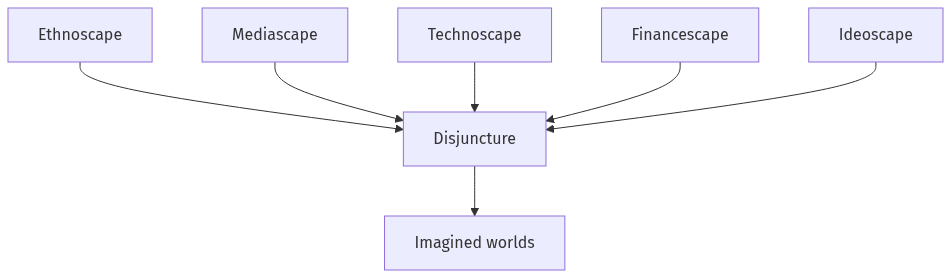
- He named five dimensions of global flow: ethnoscapes of tourists, migrants, and exiles; mediascapes of images and news; technoscapes of machines and software; financescapes of capital; and ideoscapes of state and opposition ideologies such as freedom and rights.
- These scapes move at different speeds, so they are disjunctive: capital can arrive without people, images without investment, and migrants without rights.
- Imagined worlds, extending Benedict Anderson’s imagined communities, are the social facts people inhabit when they live in more than one scape at once.
- Deterritorialisation is the condition of that life: group, money, and sacred geography no longer sit inside one village fence, a point that also meets George Marcus’s multi-sited ethnography.
What the model does well
- It fits Gulf Malayali labour, satellite television, remittances, and Hindutva or human-rights talk as one field, not as separate chapters.
- It refuses the old isolate of Malinowski’s island as the only unit of culture.
- It keeps imagination as a social practice, which is why film, cricket, and WhatsApp rumours belong in political economy.
Criticisms
- Class, factory, and agrarian production are thinner than in Wolf or Sidney Mintz; scapes can sound like circulation without a shop floor.
- The state is present in ideoscapes but can look weaker than visas, camps, and border police actually are.
- Five lists invite mechanical answers that tick scapes without showing a disjuncture in one case.
- Some critics say Appadurai over-credits mobility and under-credits people who cannot move, including many indigenous communities locked by mines rather than by airports.
- Gender and caste in India need more than a flow diagram; the household still rations who migrates.
Critical use in an answer
- Keep the five scapes as a map of disjuncture.
- Ground them in one chain, such as a Kerala–Gulf ethnoscape plus a financescape of remittances plus a mediascape of telephone serials.
- Add production, border, and inequality so the conceptualisation does not float.
Flow diagram
Conclusion
Appadurai’s global cultural economy is a theory of disjunctive scapes and imagined worlds, not of one McWorld. It remains the best teaching map of cultural globalisation if class, border, and immobility are written back in.
Quick related
Students also ask
-
Discuss the historical and cultural contexts that led to superseding ethnocentrism with cultural relativism in anthropology
Next question on this syllabus topic (2022 · Q4(b)). View answer →
-
Is Appadurai saying culture no longer has a place?
No. He is saying place is networked. A village can still be a node in several scapes.
-
How does this differ from cultural imperialism?
Imperialism models a one-way copy of the West. Appadurai models irregular, multi-directional flows and local imagination.
Same topic · past papers
UPSC has asked this before
These previous-year questions sit on the same topic. Open one to practise the earlier ask.
-
2025 · Q2(c) · Anthropology GS 1 · 15 marks
How political economy is integrated with ecological and adaptability perspectives in bio-cultural anthropology? -
2025 · Q7(b) · Anthropology GS 1 · 15 marks
What are the major theories proposed in support of the origin of food production? How the change in subsistence economy brought revolution during this period?
More from this topic
Q4(b) · UPSC Mains 2025 · Anthropology GS 1 · 15 marks · Solution
Write a note on Mousterian tool tradition, Mousterian culture and its makers
The Nature of Culture
The tradition is Middle Palaeolithic flakes, Levallois technique, scrapers, points and denticulates. Bordes saw facies as cultural variants. Binford saw functional tool-kits. Culture includes fire, hunting and shelters. Be cautious on burial and ornament. Makers in Europe are mainly Neanderthals. In the Levant early modern humans also used Mousterian tools. The date ballpark is the Middle Palaeolithic, to about 40,000 years ago in Europe. Mousterian is not identical with all Neanderthal behaviour everywhere.
Q1(e) · UPSC Mains 2025 · Anthropology GS 1 · 10 marks · Solution
Culture and embodiment.
The Nature of Culture
Embodiment means culture is lived as a body, not only as symbols in the head. Csordas, following Merleau-Ponty, treated the body as the ground of culture. Bourdieu’s habitus is class and gender as posture, taste and practical sense. Mauss described techniques of the body such as walking, swimming and childbirth. Medical anthropology uses the mindful body and structural violence made flesh. The body is cultural practice, not a costume.
Q5(b) · UPSC Mains 2024 · Anthropology GS 1 · 10 marks · Solution
Cultural relevance of the Kula
The Nature of Culture
Malinowski described Kula exchange among the Massim in Argonauts of the Western Pacific. Soulava necklaces move clockwise and mwali armbands counter-clockwise. Temporary possession yields prestige; valuables must circulate. Kula creates delayed reciprocity, trust, leadership and inter-island integration. Gimwali barter accompanies but is distinguished from ceremonial exchange. Weiner corrected Malinowski's male bias by documenting women's wealth and exchange.