
Revision summary
CST-UP in Lucknow is the State nodal science council. National labs already sit in Lucknow; the Council should connect them to UP universities. The 2025 Policy’s plausible aims are climate-ready research, biotech, startups, and STEM access. Resilience means research that serves flood, heat, and crop shock. The limit is money, posts, and maintenance, not the launch event. Do not cite invented crore outlays.
Model answer
Introduction
A resilient R&D ecosystem needs labs, universities, firms, and disaster-ready science, not only a policy booklet. The 2025 Science and Technology Policy and CST-UP should be judged on that test, without inventing budget crore figures that are not on the public record here.
Body
What CST-UP already is
- The Council of Science and Technology, Uttar Pradesh, at Lucknow, is the State’s nodal body for science popularisation, project grants, and coordination with national laboratories.
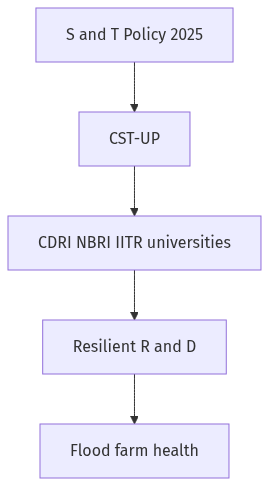
- Lucknow already hosts CSIR-CDRI, CSIR-NBRI, CSIR-IITR, and a biotech park, so CST-UP’s real job is to plug State universities and districts into that cluster, not to replace it.
Plausible aims of the 2025 Policy
- Official 2025 language, as such policies usually run, aims at university–industry projects, climate-resilient agriculture research, biotechnology, disaster science, startups, and wider STEM access including women.
- Resilience here means research that still works after flood, heat, and crop shock, and an R&D base that is not limited to one or two Lucknow institutes.
- District science centres, patent facilitation, and links with IIT-BHU, new IITs, and medical research campuses are the natural instruments of that aim.
Evaluation
- Strength: a fresh policy can set missions for flood, drought, public health, and agro-processing that match UP’s risk, and CST-UP can carry small grants to state universities.
- Strength: naming startups and industry as R&D partners can move the Council beyond school science fairs.
- Weakness: Councils fail when grants are thin, delayed, or captured by a few campuses; a 2025 document does not by itself hire scientists.
- Weakness: resilience needs long-term careers and equipment maintenance; announcement cycles are shorter than a lab cycle.
- Verdict: the Policy and CST-UP are useful scaffolding; a resilient ecosystem will show in joint patents, disaster models used by SDM offices, and farm trials, not in the launch date.
Flow diagram
Conclusion
The 2025 Science and Technology Policy and CST-UP can build resilient R&D if they tie Lucknow’s national labs to State universities and district risks. Evaluation stays cautious: aims are sound; delivery will be grants, people, and used research, not the brochure.
Quick related
Students also ask
-
Critically examine the socio-economic potential of the new UP AYUSH Policy, 2025 in promoting wellness tourism and agricultural diversification.
Next question in the 2025 paper (Q20). View answer →
-
Can we quote a 2025 budget outlay in crore?
Not from this answer. Treat 2025 aims as programme direction unless an official gazette figure is in hand.
-
Is CST-UP a substitute for CSIR labs?
No. It should coordinate State funds and universities with those labs, not duplicate them.
Same topic · past papers
UPPSC has asked this before
These previous-year questions sit on the same topic. Open one to practise the earlier ask.
More from this paper
Q1 · UPSC Mains 2025 · UPGS5 · 8 marks · Solution
Describe the cultural significance of 'Ayodhya' on the basis of ancient literature.
UP history, civilisation and culture
The Ramayana makes Ayodhya the Kosalan capital of Rama. The Skanda Purana’s Ayodhya Mahatmya places it among the moksha-puris. Buddhist texts remember Saketa, and Jain books remember Tirthankara births at Vinita or Saketa. Together these books give Ayodhya its lasting cultural weight in Uttar Pradesh.
Q2 · UPSC Mains 2025 · UPGS5 · 8 marks · Solution
Agra's Indo-Islamic architecture has a blend of Indian, Persian and Islamic styles. Comment.
UP history, civilisation and culture
Agra’s Mughal buildings mix Indian craft, Persian gardens, and Islamic tombs. Agra Fort shows Akbar’s sandstone and Shah Jahan’s marble in one complex. The Taj Mahal is a Persian garden-tomb built by Indian workshops. Itimad-ud-Daulah is an early white-marble inlay tomb in Agra.
Q3 · UPSC Mains 2025 · UPGS5 · 8 marks · Solution
Discuss in short the contribution of Arya Samaj in education of Uttar Pradesh.
Health and education in UP
Arya Samaj treated Vedic and modern schooling as one programme in the United Provinces. DAV schools and colleges became the main urban chain. Gurukul Kangri and kanya gurukuls modelled residential and girls’ education. Hindi as a medium was a lasting Samaj mark in Uttar Pradesh. The spread was stronger in the west than in Purvanchal.