
Revision summary
The 2025 AYUSH Policy aims to use traditional medicine for health, jobs, and tourism. Wellness tourism can add stays on Varanasi–Prayagraj–Ayodhya–Buddhist routes. Agricultural diversification can expand mint, tulsi, ashwagandha, and amla with buy-back. Risks are fake medicine, unregulated clinics, price crash, and land pressure at tirthas. AYUSH does not replace rural PHC work on anaemia. Cite aims, not invented crore budgets.
Model answer
Introduction
The 2025 UP AYUSH Policy is meant to grow Ayurveda, Yoga, Unani, Siddha, and Homoeopathy as health, livelihood, and tourism. A critical look must weigh wellness tourism and medicinal-plant farming against quality, land, and evidence risks, without fake crore claims.
Body
Potential for wellness tourism
- Uttar Pradesh already has Varanasi, Prayagraj, Ayodhya, the Buddhist circuit, and Agra on the visitor map; AYUSH stays, yoga, and panchakarma can add nights to the same routes.
- A plausible 2025 policy aim is accredited wellness centres, trained therapists, and tie-ups with hotels so that “AYUSH tourism” is a billed service, not only a slogan at Kumbh.
- Social gain can include jobs for yoga instructors, masseurs, and small guest houses in pilgrimage towns.
- The critical limit is quality: unregulated clinics, fake herbs, and crowding at Sangam or Kashi can injure both patients and the State’s name.
Potential for agricultural diversification
- Mentha, tulsi, ashwagandha, amla, and other aromatics already grow in belts of western and central UP; a policy that assures seed, buy-back, and processing can shift some cereal land into medicinal crops.
- Farmer producer groups and ODOP-type branding can link the field to pharmacies and wellness packs.
- Diversification fails if prices crash, if water-hungry herbs enter Bundelkhand without a plan, or if collectors strip wild stock instead of cultivating.
Socio-economic balance
- Women in home herbal work and rural youth in therapy training are the inclusive promise; capture by a few large brands is the exclusive risk.
- Wellness tourism can raise local food and handicraft demand; it can also inflate land near tirthas and push tenants out.
- AYUSH is not a substitute for PHC anaemia work; a fair critique keeps medical claims inside evidence and keeps tourism from eating the health budget.
Verdict
- Socio-economic potential is real along pilgrimage circuits and mint-herb belts if accreditation, pharmacopoeia quality, and farmer contracts exist.
- Without those, 2025 remains a brochure that neither heals nor pays the small grower.
Flow diagram
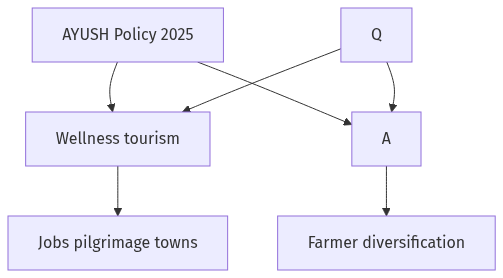
Conclusion
The 2025 AYUSH Policy can add wellness nights on UP’s tirtha map and medicinal crops beside wheat and mint, which is genuine socio-economic potential. The critical condition is quality control and farmer price, not an invented outlay figure.
Quick related
Students also ask
-
Should the answer quote a 2025 AYUSH budget in crore?
No, unless an official figure is cited. Describe aims: wellness standards, herb cultivation, and jobs.
-
Can AYUSH tourism replace rural health centres?
No. Wellness visitors and herb income are extra. Anaemia and IMR still need the public PHC system.
Same topic · past papers
UPPSC has asked this before
These previous-year questions sit on the same topic. Open one to practise the earlier ask.
More from this paper
Q1 · UPSC Mains 2025 · UPGS5 · 8 marks · Solution
Describe the cultural significance of 'Ayodhya' on the basis of ancient literature.
UP history, civilisation and culture
The Ramayana makes Ayodhya the Kosalan capital of Rama. The Skanda Purana’s Ayodhya Mahatmya places it among the moksha-puris. Buddhist texts remember Saketa, and Jain books remember Tirthankara births at Vinita or Saketa. Together these books give Ayodhya its lasting cultural weight in Uttar Pradesh.
Q2 · UPSC Mains 2025 · UPGS5 · 8 marks · Solution
Agra's Indo-Islamic architecture has a blend of Indian, Persian and Islamic styles. Comment.
UP history, civilisation and culture
Agra’s Mughal buildings mix Indian craft, Persian gardens, and Islamic tombs. Agra Fort shows Akbar’s sandstone and Shah Jahan’s marble in one complex. The Taj Mahal is a Persian garden-tomb built by Indian workshops. Itimad-ud-Daulah is an early white-marble inlay tomb in Agra.
Q3 · UPSC Mains 2025 · UPGS5 · 8 marks · Solution
Discuss in short the contribution of Arya Samaj in education of Uttar Pradesh.
Health and education in UP
Arya Samaj treated Vedic and modern schooling as one programme in the United Provinces. DAV schools and colleges became the main urban chain. Gurukul Kangri and kanya gurukuls modelled residential and girls’ education. Hindi as a medium was a lasting Samaj mark in Uttar Pradesh. The spread was stronger in the west than in Purvanchal.