
Revision summary
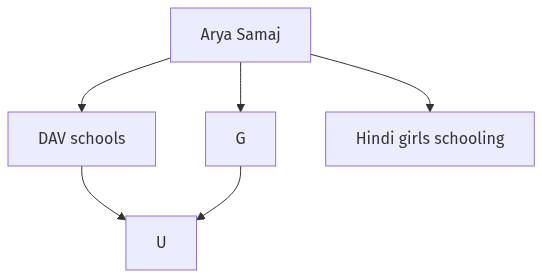
Arya Samaj treated Vedic and modern schooling as one programme in the United Provinces. DAV schools and colleges became the main urban chain. Gurukul Kangri and kanya gurukuls modelled residential and girls’ education. Hindi as a medium was a lasting Samaj mark in Uttar Pradesh. The spread was stronger in the west than in Purvanchal.
Model answer
Introduction
Arya Samaj, founded by Dayanand Saraswati in 1875, treated Vedic learning and modern schooling as one programme. A short discussion for Uttar Pradesh must name DAV schools, gurukuls, Hindi, and girls’ education.
Body
Schools and gurukuls
- Arya Samaj branches in western Uttar Pradesh, especially Meerut, Saharanpur, and Kanpur, opened vernacular schools when mission and government schools were few.
- The DAV line, begun at Lahore in 1886, spread a large chain of Dayanand Anglo-Vedic schools and colleges across the United Provinces and later Uttar Pradesh.
- Gurukul Kangri, started in 1902 by Swami Shraddhanand near Haridwar, then in the United Provinces, modelled residential Vedic-plus-modern education that other UP gurukuls copied.
- Kanya gurukuls and Arya Kanya Pathshalas put girls’ literacy on the Samaj’s list, which mattered in a province where female schooling was very low.
Content and language
- The Samaj pushed Hindi as a medium and Sanskrit as a classical subject, which fed the Hindi public sphere of the United Provinces.
- It opposed caste bars at the school gate in principle, though practice varied, and it linked education to shuddhi and social reform.
Limit
- The network was strongest in western and urban UP; eastern districts remained thinner, so the contribution is real but uneven.
Flow diagram
Conclusion
Arya Samaj contributed to UP education through DAV schools, gurukuls, Hindi-medium teaching, and girls’ pathshalas, above all in western towns. The short verdict is a wide voluntary school system, not a substitute for the state system.
Quick related
Students also ask
-
Elucidate the cultural significance of literature and music in day-to-day life of people of Uttar Pradesh.
Next question in the 2025 paper (Q4). View answer →
-
Is Gurukul Kangri in today’s Uttar Pradesh?
It stands near Haridwar, now in Uttarakhand. It was founded in the United Provinces and shaped UP gurukul practice.
-
Did Arya Samaj replace government schools?
No. It added a voluntary chain beside the state and missions, mainly in western and urban districts.
More from this paper
Q1 · UPSC Mains 2025 · UPGS5 · 8 marks · Solution
Describe the cultural significance of 'Ayodhya' on the basis of ancient literature.
UP history, civilisation and culture
The Ramayana makes Ayodhya the Kosalan capital of Rama. The Skanda Purana’s Ayodhya Mahatmya places it among the moksha-puris. Buddhist texts remember Saketa, and Jain books remember Tirthankara births at Vinita or Saketa. Together these books give Ayodhya its lasting cultural weight in Uttar Pradesh.
Q2 · UPSC Mains 2025 · UPGS5 · 8 marks · Solution
Agra's Indo-Islamic architecture has a blend of Indian, Persian and Islamic styles. Comment.
UP history, civilisation and culture
Agra’s Mughal buildings mix Indian craft, Persian gardens, and Islamic tombs. Agra Fort shows Akbar’s sandstone and Shah Jahan’s marble in one complex. The Taj Mahal is a Persian garden-tomb built by Indian workshops. Itimad-ud-Daulah is an early white-marble inlay tomb in Agra.
Q4 · UPSC Mains 2025 · UPGS5 · 8 marks · Solution
Elucidate the cultural significance of literature and music in day-to-day life of people of Uttar Pradesh.
UP society, festivals and languages
Ramcharitmanas, Braj bhakti, Kabir, and Premchand enter homes and schools. Thumri, dadra, birha, and kajari mark marriage, monsoon, and harvest. Lucknow, Banaras, and Braj are both literary and musical regions. Daily UP culture is recited and sung, not only read.