
Revision summary
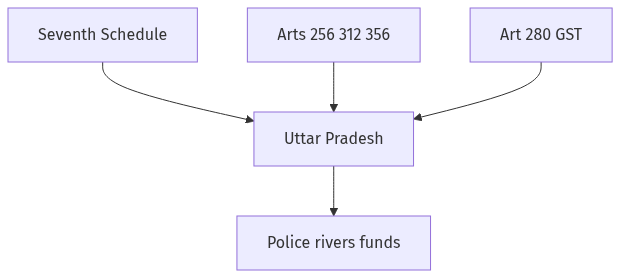
Legislative relations rest on Articles 245–255 and the three lists. Administrative relations use Articles 256–257, All-India Services, and Article 356. Financial relations run through the Finance Commission and the GST Council. UP relevance is police on the State List, huge CSS dependence, and river sharing. The Governor and President’s Rule remain the sharp Union tools.
Model answer
Introduction
Centre–State relations in the Constitution are legislative, administrative, and financial. For Uttar Pradesh the same articles decide how the Union and the largest Hindi-heartland State share law, money, and All-India Services.
Body
Legislative relations
- Articles 245–255 and the Seventh Schedule divide Union, State, and Concurrent Lists; UP legislates on police, public order, land, and local government unless a Union law occupies a concurrent field.
- Article 254 gives Union law supremacy on the Concurrent List if there is a clash, subject to presidential assent for some State laws.
- Article 249 and 250 let Parliament enter State subjects in special and emergency conditions.
Administrative relations
- Articles 256–257 require State compliance with Union laws and allow Union directions; All-India Services under Article 312 staff UP’s IAS and IPS.
- Article 263 provides an Inter-State Council; river boards and the Yamuna–Ganga basin make this real for UP with neighbouring States.
- Article 356 President’s Rule has been used in UP in past political crises, which is the hardest administrative override.
Financial relations
- Articles 268–281, the Finance Commission under Article 280, and the GST Council under Article 279A decide tax shares, grants, and cess.
- Centrally sponsored schemes on health, education, and rural jobs need UP matching funds and district machinery.
Relevance for Uttar Pradesh
- As the most populous State, UP’s Assembly majority often shapes Union politics, yet its budget still depends on tax devolution and CSS.
- Law and order remain a State List charge, so communal peace, police reform, and the Gangsters Act are Lucknow’s files under Union criminal statutes.
- Governor’s assent, GST compensation debates, and river sharing with Delhi, Haryana, and downstream States are the living Centre–State file for UP.
- Cooperative federalism is the textbook; bargaining over funds, cadres, and 356 is the practice.
Flow diagram
Conclusion
The Constitution divides Centre and State through the Seventh Schedule, administrative directions, All-India Services, and Finance Commission–GST transfers. For Uttar Pradesh those provisions decide police, rivers, and the money that runs the largest State, so federal text is daily administration.
Quick related
Students also ask
-
Discuss the composition, powers and functions of the Legislative Assembly of Uttar Pradesh.
Next question in the 2025 paper (Q16). View answer →
-
Is police a Union subject?
Public order and police are State List entries, though Union criminal laws and All-India IPS cadre bind the State.
-
Why does GST matter to UP?
A large consuming State lives on tax devolution and GST shares; Council votes affect Lucknow’s budget.
Same topic · past papers
UPPSC has asked this before
These previous-year questions sit on the same topic. Open one to practise the earlier ask.
-
2025 · Q7 · UPGS5 · 8 marks
Comment on the relevance of the Right to Information Act in Uttar Pradesh. -
2023 · Q2 · UPGS5 · 8 marks
Discuss the nature of regional parties in Uttar Pradesh. Throw light on their importance in the politics of the state. -
2023 · Q13 · UPGS5 · 12 marks
Throw light on the e-District Project of Uttar Pradesh government. Is it a good initiative in the direction of E-governance in Uttar Pradesh? Examine. -
2023 · Q17 · UPGS5 · 12 marks
Throw light on the contributions of the warriors of Uttar Pradesh in the Freedom Struggle of 1857.
More from this paper
Q1 · UPSC Mains 2025 · UPGS5 · 8 marks · Solution
Describe the cultural significance of 'Ayodhya' on the basis of ancient literature.
UP history, civilisation and culture
The Ramayana makes Ayodhya the Kosalan capital of Rama. The Skanda Purana’s Ayodhya Mahatmya places it among the moksha-puris. Buddhist texts remember Saketa, and Jain books remember Tirthankara births at Vinita or Saketa. Together these books give Ayodhya its lasting cultural weight in Uttar Pradesh.
Q2 · UPSC Mains 2025 · UPGS5 · 8 marks · Solution
Agra's Indo-Islamic architecture has a blend of Indian, Persian and Islamic styles. Comment.
UP history, civilisation and culture
Agra’s Mughal buildings mix Indian craft, Persian gardens, and Islamic tombs. Agra Fort shows Akbar’s sandstone and Shah Jahan’s marble in one complex. The Taj Mahal is a Persian garden-tomb built by Indian workshops. Itimad-ud-Daulah is an early white-marble inlay tomb in Agra.
Q3 · UPSC Mains 2025 · UPGS5 · 8 marks · Solution
Discuss in short the contribution of Arya Samaj in education of Uttar Pradesh.
Health and education in UP
Arya Samaj treated Vedic and modern schooling as one programme in the United Provinces. DAV schools and colleges became the main urban chain. Gurukul Kangri and kanya gurukuls modelled residential and girls’ education. Hindi as a medium was a lasting Samaj mark in Uttar Pradesh. The spread was stronger in the west than in Purvanchal.